

2026 Portable Transformer Ratio Tester Buying Guide
Complete 2026 buying guide for portable transformer ratio testers: check accuracy, voltage range, IEC/IEEE compliance and features for field & factory use.
Introduction
Choosing the right portable transformer ratio tester is critical for reliable, compliant testing in both field maintenance and factory acceptance. A poor choice leads to inaccurate readings, wasted time, and non-compliance with IEC 60076-1 and IEEE C57.12.90 standards. This 2026 buying guide breaks down the essential features, compares use cases, and helps you select the best tester for distribution, power, and specialty transformers.
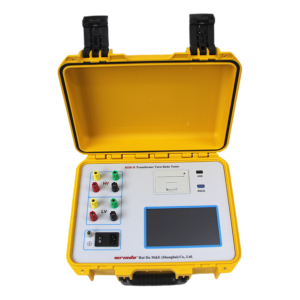
Click the image to know more about Transformer Turns Ratio Tester.
Core Buying Criteria (2026 Standards)
1. Measurement Accuracy (Non-Negotiable)
Accuracy directly determines test validity. For most applications:
- Target: ≤ ±0.2% (industry best practice)
- Critical Applications: ≤ ±0.1% or ±0.05% (utility, high-voltage, and factory FAT)
- Range Dependency: Ensure accuracy holds across your ratio range (e.g., 0.8–10,000:1)
2. Voltage & Ratio Range
Match the tester to your transformer fleet:
- Ratio Coverage: 0.8–10,000:1 (covers small distribution to large power transformers)
- Test Voltage: 5–250V AC (field-safe low voltage; factory may use up to 250V)
- Specialty Support: Check for CT/PT, Z-type, phase-shifting, and furnace transformer modes
3. Battery Life & Portability
Field work demands long runtime and easy transport:
- Battery: ≥ 8 hours or 800+ tests per charge (lithium-ion preferred)
- Weight: ≤ 5 kg (handheld/backpack-friendly; <2 kg for ultra-portable)
- Build: Rugged, IP65-rated, shock-resistant casing for outdoor use
4. Three-Phase Testing Capability
Modern testers must support true three-phase simultaneous testing:
- Faster testing (≤10 seconds per full three-phase test)
- Auto-detects vector groups (Dyn11, YNd1, etc.)
- Eliminates phase-by-phase errors
5. Data Management & Reporting
For compliance and traceability:
- Export: PDF, CSV, Excel via USB/ Bluetooth/Wi-Fi (2026 standard)
- Storage: ≥ 100 test records; cloud sync capability
- Auto-Logging: OLTC tap sequencing and deviation calculation
6. Safety & Compliance
- IEC 60076-1, IEEE C57.12.90 certified
- Overcurrent/overvoltage protection; reverse-polarity detection
- Color-coded leads for safe, error-free wiring
Use Case Matching: Field vs. Factory
| Aspect | Field Testing (Substations, Remote Sites) | Factory Testing (FAT, Production) |
|---|---|---|
| Priority | Portability, battery life, ruggedness | High accuracy, automation, reporting |
| Accuracy | ±0.1–0.2% | ±0.05–0.1% |
| Battery | ≥8 hours / 800+ tests | AC-powered preferred |
| Features | Handheld, IP65, fast testing | Automated OLTC, detailed phase analysis |
| Top Pick | Ultra-light, battery-powered testers | Bench-top/portable hybrid with lab-grade precision |
How Wrindu Testers Stand Out (2026)
Wrindu’s portable ratio testers are engineered for field and factory excellence, combining precision, speed, and durability:
- Ultra-High Accuracy: ±0.03% (far exceeds IEC/IEEE requirements)
- True 3-Phase Testing: Single connection, <10-second full tests; auto vector group detection
- Built-In Demagnetization: No extra tools—critical for accurate readings
- Long Battery Life: 8+ hours / 1,000+ tests per charge
- Rugged IP65 Design: Shockproof, dust/water-resistant for harsh field conditions
- Smart Data Export: PDF/CSV/Excel; cloud-ready for 2026 compliance
- Wide Compatibility: Supports distribution, power, CT/PT, Z-type, and phase-shifting transformers
- IEC/IEEE Certified: Fully compliant with global standards
FAQs
Q: What accuracy level do I need for routine field ratio testing?
A: For most distribution transformer maintenance, ±0.2% is sufficient. For critical high-voltage or utility assets, aim for ±0.1% or better to catch early winding issues.
Q: Can a portable tester handle both distribution and large power transformers?
A: Yes—choose a model with a ratio range of 0.8–10,000:1 and test voltage up to 250V. Wrindu’s RDB-IIH and JYT series cover this full spectrum.
Q: How important is battery life for field ratio testing?
A: Extremely important. A tester with <8 hours of battery life risks incomplete testing on remote sites. Look for 800+ test cycles per charge (lithium-ion) for all-day use.
Q: Do I need three-phase testing capability for single-phase transformers?
A: No, but a three-phase tester still works for single-phase units and future-proofs your investment for three-phase fleet expansion.
Q: What’s the difference between ±0.05% and ±0.2% accuracy in real testing?
A: A ±0.05% tester detects tiny deviations (e.g., 0.05% error on a 1000:1 ratio = 0.5 turn difference), critical for factory FAT. ±0.2% is cost-effective for routine field checks where small deviations are less urgent.
Q: Can I use the same portable tester for OLTC and non-OLTC transformers?
A: Yes—select a tester with automated OLTC tap sequencing (auto-cycles all taps) to save time. Wrindu models include this as standard.
Q: Are Wrindu testers compliant with IEC 60076-1 and IEEE C57.12.90?
A: Absolutely. All Wrindu portable ratio testers are certified to meet these global standards, ensuring your test data is accepted worldwide.
Q: How do I verify a tester’s accuracy before buying?
A: Request a calibration certificate, test against a known reference transformer, or ask for a field trial. Wrindu provides certified calibration and trial units for validation.
