

4-Wire Kelvin Method | Precision Resistance Measurement Guide | Wrindu
Master the 4-wire Kelvin method for ultra-precise low resistance measurement. Learn how it works, step-by-step usage, key benefits, applications & why it beats 2-wire testing.
What Is the 4-Wire Kelvin Method?
The 4-wire Kelvin method (also known as the Kelvin connection or four-terminal sensing) is a precision electrical measurement technique designed to eliminate the impact of test lead resistance and contact resistance, enabling highly accurate readings of low resistance values (typically below 1Ω). Widely used in industrial, OEM, and high-voltage testing, this method is the gold standard for measuring resistances in components like cables, connectors, switches, motor windings, and shunt resistors—where even milliohm-level errors can compromise performance and safety.
Unlike basic 2-wire resistance testing, the 4-wire Kelvin method separates current-carrying and voltage-sensing circuits, removing external resistance interference from the final measurement. For professionals in power utilities, manufacturing, and electronics, mastering this technique is critical for reliable quality control, fault diagnosis, and compliance with industrial testing standards.
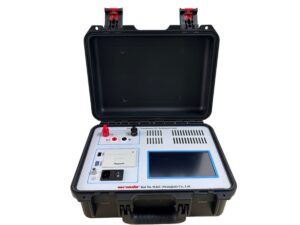
Click the picture to know more about Wrindu Low DC Resistance Tester.
Why the 4-Wire Kelvin Method Matters: Limitations of 2-Wire Testing
Before diving into the mechanics of the 4-wire Kelvin method, it’s vital to understand the flaws of standard 2-wire resistance measurement that make it unsuitable for low-resistance applications:
-
Lead Resistance Interference: Test leads themselves have small resistance values (often 0.1–0.5Ω), which skew readings when measuring low-resistance targets.
-
Contact Resistance Errors: Resistance between test probes and the component under test adds unwanted variance to results.
-
Inaccurate Low-Value Readings: For resistances under 1Ω, lead and contact resistance can account for a large percentage of the total measured value, rendering data useless.
-
Unreliable Industrial Results: In high-stakes settings like substations or OEM production, 2-wire errors can lead to faulty component installations, equipment failures, and costly downtime.
The 4-wire Kelvin method solves all these issues, delivering precision readings that 2-wire testing simply cannot match—making it an indispensable technique for professional electrical testing.
How Does the 4-Wire Kelvin Method Work?
The 4-wire Kelvin method operates on a simple yet effective principle: isolating current injection from voltage measurement using four separate test leads, split into two distinct pairs:
1. Current-Carrying Leads (Force Leads)
One pair of leads carries a constant, known test current through the component being measured. These leads handle the current flow but do not contribute to the voltage reading, meaning their resistance has no impact on the final measurement result.
2. Voltage-Sensing Leads (Sense Leads)
The second pair of leads connects directly across the component to measure the voltage drop caused by the injected current. Since high-impedance multimeters or testers draw negligible current through these sense leads, lead resistance and contact resistance are eliminated from the voltage calculation.
Kelvin’s Core Calculation (Ohm’s Law)
Once the voltage drop is measured accurately, the true resistance of the component is calculated using Ohm’s Law: $$R = V/I$$
Where $$R$$ = Resistance (Ω/mΩ), $$V$$ = Measured Voltage Drop (V), $$I$$ = Injected Test Current (A). This calculation excludes all external resistance, delivering unrivaled accuracy.
Step-by-Step Guide: How to Use the 4-Wire Kelvin Method
Follow this structured process to perform accurate 4-wire Kelvin resistance measurements, whether using a dedicated Kelvin multimeter, micro-ohmmeter, or Wrindu’s industrial testing equipment:
Step 1: Prepare Your Tools & Workspace
Gather a 4-wire compatible tester (Kelvin multimeter/micro-ohmmeter), four insulated test leads (or dedicated Kelvin clips), and the component to test. Ensure the circuit is fully powered off, discharge any capacitors, and clean component terminals to remove dirt, oxidation, or debris—this minimizes contact resistance and ensures a stable connection.
Step 2: Connect the 4 Test Leads Correctly
-
Connect the current-carrying (force) leads to the outer terminals of the component, completing the current injection circuit.
-
Connect the voltage-sensing (sense) leads to the inner terminals, directly across the resistive element you want to measure.
-
Double-check connections: never cross force and sense leads, as this will negate the Kelvin method’s accuracy benefits.
Step 3: Configure Your Testing Instrument
Set your multimeter or tester to the low-resistance range (mΩ/Ω scale) and activate the 4-wire/Kelvin measurement mode. For industrial tools like Wrindu’s precision testers, select the appropriate test current for your target component to optimize accuracy.
Step 4: Run the Measurement & Record Results
Initiate the test, wait for the reading to stabilize, and record the resistance value. For optimal reliability, take 2–3 repeat measurements and calculate the average. The displayed value is the true resistance of the component, free from lead and contact interference.
Step 5: Post-Measurement Best Practices
Disconnect leads safely, power down the tester, and clean the test area. Compare your measured resistance to the component’s rated specifications to identify defects, wear, or compliance issues.
Key Advantages of the 4-Wire Kelvin Method
-
Eliminates Lead & Contact Resistance: The biggest advantage—completely removes external resistance interference for pinpoint accuracy.
-
Ultra-Precise Low Resistance Readings: Delivers accurate measurements down to micro/milliohm levels, impossible with 2-wire testing.
-
Reduced Measurement Error: Cuts error rates to below 0.5% (vs. 5–10% for 2-wire testing in low-resistance scenarios).
-
Industrial-Grade Reliability: Performs consistently in harsh environments, ideal for field testing and factory quality control.
-
Wide Component Compatibility: Works for nearly all low-resistance electrical components across industries.
-
Compliance with Testing Standards: Meets ISO, IEC, and CE requirements for precision industrial and OEM testing.
4-Wire Kelvin Method: Key Industrial & OEM Applications
The 4-wire Kelvin method is a staple technique across high-precision industries, where accurate resistance measurement is critical for safety, performance, and quality. Top use cases include:
1. Power & Electrical Utilities
Test cable connections, busbar joints, transformer windings, and switchgear contacts. Detects loose connections, corrosion, and insulation defects that cause overheating and power failures—vital for substation maintenance and grid reliability.
2. Electronics & OEM Manufacturing
Quality control for shunt resistors, PCB traces, connectors, and battery terminals. Ensures components meet OEM specifications, reducing defective products and production delays.
3. Automotive & Transportation
Measure resistance in motor windings, battery cables, and vehicle electrical connections. Critical for electric vehicle (EV) battery testing and automotive safety compliance.
4. Aerospace & Heavy Machinery
Inspect high-current components, wiring harnesses, and industrial motor parts. Ensures reliability in extreme operating conditions and meets strict aerospace standards.
5. Industrial Maintenance & Fault Diagnosis
Troubleshoot equipment failures, identify worn components, and validate repair work. Reduces unplanned downtime and extends the lifespan of industrial machinery.
4-Wire vs. 2-Wire Resistance Measurement: Full Comparison
|
Parameter
|
4-Wire Kelvin Method
|
2-Wire Resistance Method
|
|---|---|---|
|
Measurement Accuracy
|
Ultra-high (micro/milliohm precision)
|
Low (inaccurate for <1Ω resistance)
|
|
Lead/Contact Resistance
|
Fully eliminated
|
Included in readings (major error source)
|
|
Ideal Use Case
|
Low-resistance components, industrial testing, OEM QC
|
High-resistance components, basic DIY testing
|
|
Complexity
|
Moderate (requires 4 leads & compatible tester)
|
Simple (2 leads, basic multimeter)
|
|
Industrial Compliance
|
Meets ISO/IEC standards
|
Not suitable for industrial standards
|
Common Mistakes to Avoid with the 4-Wire Kelvin Method
Even with the right resistance measurment, simple errors can compromise accuracy. Avoid these pitfalls for reliable results:
-
Crossing Force & Sense Leads: Mixing up current and voltage leads destroys the Kelvin connection and produces false readings.
-
Dirty/Corroded Terminals: Oxidation and debris increase contact resistance, even with the 4-wire setup—always clean test points first.
-
Using Non-Kelvin Compatible Tools: Standard multimeters without 4-wire mode cannot deliver the benefits of Kelvin measurement.
-
Testing Live Circuits: Always power down circuits and discharge capacitors to avoid injury and damaged equipment.
-
Skipping Repeat Readings: Single measurements may have fluctuations; take multiple tests for consistent data.
Choosing the Right Tools for 4-Wire Kelvin Measurement
To leverage the full potential of the 4-wire Kelvin method, you need precision-engineered tools designed for industrial and OEM use:
-
Kelvin-Enabled Multimeters: Digital multimeters with dedicated 4-wire resistance mode for versatile testing.
-
Micro-Ohmmeters: Specialized tools for ultra-low resistance measurements (down to µΩ levels).
-
Dedicated Kelvin Clips/Leads: Insulated, high-quality leads designed to maintain stable connections.
-
Industrial OEM Testing Kits: All-in-one solutions like Wrindu’s precision testing kits, calibrated for Kelvin measurement and compliant with global standards.
Wrindu Expert Insight on 4-Wire Kelvin Testing
“For industrial and OEM clients, the 4-wire Kelvin method isn’t just a testing technique—it’s the foundation of reliable resistance measurement. Low-resistance errors can lead to catastrophic equipment failures in power grids and manufacturing lines, which is why we integrate Kelvin-compatible functionality into all our high-precision testing tools. Our Shanghai-based engineering team calibrates every device to eliminate measurement bias, helping B2B partners reduce downtime, ensure compliance, and maintain peak operational efficiency. Mastering the 4-wire Kelvin method is non-negotiable for any team prioritizing accuracy and safety.”— Dr. Li Wei, Chief Engineer, Wrindu
Conclusion: Master the 4-Wire Kelvin Method for Precision Testing
The4-wire Kelvin method is the undisputed gold standard for accurate low-resistance measurement, solving the inherent flaws of 2-wire testing and delivering reliable data for industrial, OEM, and high-voltage applications. By separating current and voltage circuits, it eliminates external resistance interference, making it indispensable for quality control, fault diagnosis, and regulatory compliance.
Whether you’re testing cable connections in a substation, validating OEM components on a production line, or troubleshooting industrial machinery, adopting the 4-wire Kelvin method ensures you make data-driven decisions with confidence. Pair this technique with calibrated, Kelvin-compatible tools from trusted manufacturers like Wrindu to maximize accuracy and streamline your testing workflow.
Frequently Asked Questions (FAQs)
Q: When should I use the 4-wire Kelvin method instead of 2-wire testing?
A: Use the 4-wire Kelvin method for any low-resistance measurement (below 1Ω), including cables, motor windings, connectors, and shunt resistors. Use 2-wire testing only for high-resistance components (above 100Ω) in basic, non-critical applications.
Q: Can any multimeter perform 4-wire Kelvin measurements?
A: No—only multimeters with a dedicated 4-wire/Kelvin resistance mode can execute this technique. Standard 2-wire multimeters lack the isolated sensing circuits needed for accurate results.
Q: What is the minimum resistance the 4-wire Kelvin method can measure?
A: High-quality industrial tools using the 4-wire Kelvin method can accurately measure resistance down to microohm (µΩ) levels, making it suitable for ultra-low-resistance industrial components.
Q: Is the 4-wire Kelvin method suitable for field testing?
A: Yes—portable Kelvin-enabled testers are designed for field use in substations, factories, and job sites, delivering consistent accuracy even in harsh industrial environments.
Q: Why choose Wrindu tools for 4-wire Kelvin testing?
A: Wrindu’s industrial testing equipment is pre-calibrated for 4-wire Kelvin measurement, meets ISO/IEC/CE standards, and is engineered for heavy-duty use, ensuring long-term reliability and precision for B2B and OEM applications.
