

Wrindu RD6000A Transformer Tan Delta Tester
WRINDU RD6000A Transformer Tan Delta Tester provides precise, fast measurements for transformer testing, ensuring high accuracy, safety, and efficient performance in challenging environments.
The RD6000A Transformer Tan Delta Tester from WRINDU is a cutting-edge solution for transformer testing, designed to offer precise and fast measurements in challenging field environments. This state-of-the-art tester breaks away from traditional methods by using frequency conversion power supply technology along with advanced microelectronics, ensuring optimal performance for tan delta testing.
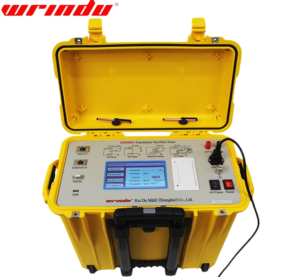
Click the picture to know more about Tan delta Tester of Transformer.
Key Features of Tan Delta Tester
| Feature | Description |
|---|---|
| High Accuracy & Precision | Utilizes Fourier transform digital filtering technology for measuring parameters like capacitance and dielectric loss with high precision. Offers automatic measurement for efficiency. |
| Advanced Frequency Conversion Technology | Eliminates interference from typical 50Hz power supply frequency by using automatic frequency conversion. Operates in high electromagnetic interference environments. |
| Built-in Safety Features | Includes Grounding Protection, Overcurrent Protection, and Electric Shock Protection to ensure safety of both the operator and the instrument during testing. |
| CVT Testing Function | Features a Capacitive Voltage Transformer (CVT) testing function for testing 110kV reverse wiring without disconnection. Ideal for complex transformer setups. |
| Easy Operation | Fully digital automation system, large LCD display for clear test results, and RS232/USB interfaces for easy data transfer, making it user-friendly. |
| High-Voltage Performance | Capable of delivering up to 10kV output and 5A maximum current, suitable for testing transformers with capacitance from 3pF to 1μF. Includes internal and external high-voltage testing. |
| Noise Suppression | Built-in 50Hz noise suppression ensures stable operation even in high-interference environments. |
Technical Specifications
| Specification | Details |
|---|---|
| Dielectric Loss (tgδ) | Accuracy: ±(reading × 1% + 0.00040), resolution: 0.001%, no limitations on range. |
| Capacitance Measurement Range | 3pF~60000pF/10kV, 60pF~1μF/0.5kV for internal and external high voltage. |
| Voltage Setting Range | Adjustable from 100V to 10kV, with a resolution of 1V. |
| Test Current Range | From 10μA to 5A, covering a wide range of transformer test requirements. |
| Frequency | Single frequency range 40Hz to 70Hz. Can automatically set dual frequencies: 50Hz ±0.1Hz to 50Hz ±10Hz and 60Hz ±0.1Hz to 60Hz ±10Hz. |
| Max Output Voltage | 200mA at 10kV/5A. |
| Test Modes | Includes UST (Under-Test) mode and GST (Grounded-Short Test) mode for reliable testing capabilities. |
| CVT Self-Exciting Low Voltage Output | Output voltage: 3V to 50V, with a current capacity of 3A to 30A. |
Additional Features
| Feature | Description |
|---|---|
| Mini-Type Thermal Printer | Integrated printer for quick and easy result documentation. |
| Power Supply | Operates on 220V AC, 50Hz ±1% power supply, compatible with most standard setups. |
| Environmentally Friendly | Operates optimally in ambient temperatures from -10℃ to 50℃ and humidity levels up to 90%. |
Why Choose Wrindu RD6000A Transformer Tan Delta Tester?
| Benefit | Description |
|---|---|
| Fast & Efficient | Provides quick and accurate testing, saving time without compromising precision. |
| Robust Performance | High tolerance to interference and ability to perform in demanding field environments, making it a reliable tool for challenging conditions. |
| Safety First | Built-in safety measures, such as grounding, overcurrent, and electric shock protection, ensure secure operations during testing for both the operator and the instrument. |
FAQs
What is the acceptable tan delta value?
A: An acceptable tan delta value should be less than 0.005 for a new transformer, and for an older transformer, the difference should be equal to or less than 0.001. If the tan delta value exceeds these limits, it indicates that there is insulation damage present.
What does a high tanδ value mean?
A: A high tanδ value indicates that the insulation material is degrading or contaminated. This leads to greater energy losses and higher chances of failure. It suggests that the insulation cannot effectively resist electrical stress, which may shorten the equipment’s service life.
What does a negative tanδ value mean?
A: A negative tanδ value usually signals a measurement error or a problem with the test setup. Under ideal conditions, tanδ should always be positive because the resistive current component (IR) is always positive in insulation tests.
What are IEC standards?
A: IEC standards are international guidelines that ensure the safety, performance, and interoperability of electrical devices. They help facilitate global trade and ensure that devices and systems work together reliably.
What is the IEC standard for tan delta testing?
A: IEC 60851-5 outlines the method for measuring the dielectric tangent (tanδ) in enamel wire, which is crucial for motor windings. This test helps assess insulation quality by measuring energy loss as heat, with higher values indicating poorer insulation.
What is a tan delta test?
A: A tan delta test measures the condition of insulation by evaluating the energy lost as heat when the material is exposed to alternating voltage. This helps assess the performance of transformers, motors, circuit breakers, and generators, as well as predict maintenance needs.
Why is tan delta testing preferred over DC testing?
A: AC testing provides more repeatable results than DC testing. DC testing can be destructive, potentially leaving free electrons inside the insulation and increasing the risk of partial discharge, especially if there are imperfections or voids.
What is insulation?
A: Insulation is a non-conductive material that separates two parts with different voltages to prevent electricity from flowing between them. It is used to protect electrical components from unwanted current flow.
Why do we measure tan delta?
A: We measure tan delta to assess the condition of insulation. It helps determine how close the insulation is to failure, allowing us to plan maintenance and prevent unexpected breakdowns by monitoring for degradation.
You might be interested in
