

How Does Tan Delta Testing Compare to Insulation Resistance Testing?
Compare Tan Delta Testing and Insulation Resistance Testing. Learn how each test works, their use cases, and why Tan Delta is more sensitive to insulation aging.
When testing the condition of insulation in electrical equipment, such as transformers, two of the most common tests used are Tan Delta Testing and Insulation Resistance Testing (IR Test). Both are crucial for evaluating insulation performance, but they work in different ways and offer distinct insights. Let’s explore how these tests compare in terms of their functionality, sensitivity, and best use cases.
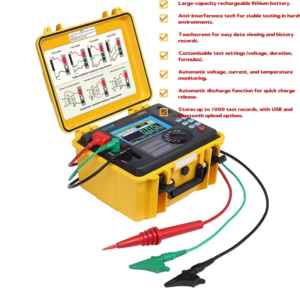
Click the image to know more about IR Tester.
How Does the Insulation Resistance (IR) Test Work?
The Insulation Resistance (IR) Test involves applying a DC voltage to the insulation and measuring its resistance. This test is relatively simple and straightforward. It gives you a general idea of whether the insulation is intact or whether there are any severe issues, such as short circuits or high resistance paths.
However, the IR test is not very sensitive to the aging of insulation. It can provide a pass/fail result but doesn’t give much information on how the insulation will perform over time. This makes it suitable for a quick check of the insulation’s condition, especially when you’re dealing with relatively new equipment or when a simple test is required.
How Is Tan Delta Testing Different?
Tan Delta Testing, on the other hand, involves applying an AC voltage to the insulation. This method is more sensitive than the IR test and can detect subtle changes in the insulation’s properties that indicate aging or degradation. The test measures the Tan Delta value, which gives you an indication of the dielectric losses occurring within the insulation material.
Unlike the IR test, Tan Delta is more sensitive to aging, making it an ideal choice for assessing the health of insulation over time. It can detect problems like partial discharge or small leaks that may not be detectable with a simple resistance test. This is why Tan Delta Testing is particularly useful for older equipment or when monitoring the long-term condition of insulation in assets like transformers.
What Are the Best Use Cases for Each Test?
Both tests have their strengths, and knowing when to use each one is important for effective maintenance and asset management.
-
Insulation Resistance Testing (IR Test) is ideal for:
-
Quick checks of new equipment or during routine maintenance.
-
Identifying large-scale faults like breakdowns or shorts in insulation.
-
Checking insulation resistance over short periods of time, usually for safety assessments.
-
-
Tan Delta Testing is better for:
-
Monitoring the aging of insulation and detecting early signs of degradation.
-
Performing more detailed condition assessments of transformers or high-voltage equipment.
-
Diagnosing subtle problems that may not be detected by simpler tests like the IR test.
-
When Should You Choose Tan Delta Testing Over Insulation Resistance Testing?
You should choose Tan Delta Testing when you need a more sensitive evaluation of your equipment’s insulation, especially if you’re dealing with transformers or equipment that has been in service for a longer period. The Wrindu Tan Delta Tester is specifically designed to provide accurate readings for such assessments, ensuring that you can detect even the smallest changes in insulation quality.
Insulation Resistance Testing, however, is sufficient for quick assessments and is typically used in simpler maintenance or safety checks. It’s the go-to test when you need to check if the insulation is still intact but doesn’t require a detailed understanding of its aging process.
