

How to Detect Wire and Cable Breakpoints Easily?
Struggling with cable breakpoints in engineering maintenance? Learn 7 practical detection methods (multimeter, induction pen & more) and master safe operations. Try Wrindu Cable Fault Testing System for efficient, accurate results.
Cable breakpoints are a common and troublesome problem in engineering maintenance. They can cause equipment downtime, affect work efficiency, and even lead to potential safety hazards. Accurate and quick detection of cable breakpoints is key to reducing maintenance time and costs. Wrindu, a professional provider of cable testing solutions, has rich experience in solving cable fault problems. Its Wrindu Cable Fault Testing System can help engineering maintenance personnel detect breakpoints more efficiently, making maintenance work easier and more reliable.
Why Do Cable Breakpoints Happen and Why Is Accurate Detection Important?
Cable breakpoints usually occur due to aging, mechanical damage, poor connection, or harsh working environments. For engineering maintenance personnel, finding breakpoints without professional methods is like looking for a needle in a haystack. It wastes a lot of time and energy. Accurate detection not only shortens maintenance time but also ensures the safe operation of the entire cable system. Wrindu understands this pain point deeply, so it develops the Wrindu Cable Fault Testing System to help solve this problem efficiently.
What Are the Common Principles of Cable Breakpoint Detection?
Before learning specific detection methods, it is necessary to understand the basic principles of cable breakpoint detection. The common principles are simple and easy to understand: first, using the conductivity of the cable—if there is a breakpoint, the current or signal will be interrupted; second, using the induction effect of the cable—when the cable is energized, it will generate an electromagnetic field, and the breakpoint will cause changes in the electromagnetic field. Most detection methods and instruments, including the Wrindu Cable Fault Testing System, are designed based on these two basic principles.
What Are the 7 Practical Methods to Detect Cable Breakpoints?
Below are 7 practical methods for detecting cable breakpoints. Each method includes simple operation steps, suitable for different cable types and maintenance scenarios. You can choose the most appropriate one according to your actual situation. Wrindu also recommends matching these methods with the Wrindu Cable Fault Testing System for better detection results.
Multimeter Method
This is the most common and easy-to-operate method. You only need a multimeter to complete the detection.
Operation steps: ① Turn off the power of the cable to ensure safety; ② Adjust the multimeter to the resistance gear (Ω); ③ Connect the two test leads of the multimeter to the two ends of the cable respectively; ④ If the multimeter shows a large resistance value (close to infinity), there is a breakpoint in the cable; if the resistance value is small, the cable is normal; ⑤ If there is a breakpoint, move one test lead gradually along the cable until the resistance value changes suddenly—that is the breakpoint position.
Induction Pen Method
This method is suitable for energized cables (pay attention to safety). The induction pen can detect the electromagnetic field generated by the energized cable.
Operation steps: ① Turn on the induction pen and adjust it to the appropriate gear; ② Hold the induction pen and move it along the surface of the energized cable; ③ When the induction pen stops beeping or the indicator light goes out, the position is the breakpoint of the cable; ④ After finding the breakpoint, turn off the power immediately for maintenance.
Audio Detector Method
The audio detector is composed of a signal generator and a receiver, which is suitable for long-distance cable breakpoint detection.
Operation steps: ① Connect the signal generator of the audio detector to one end of the cable; ② Turn on the signal generator, and it will send out a specific audio signal; ③ Hold the receiver and move it along the cable; ④ When the audio sound of the receiver becomes weak or disappears, the breakpoint is near this position; ⑤ Confirm the exact breakpoint position by fine-tuning the receiver.
Visual Inspection Method
This method is the simplest and does not require any instruments. It is suitable for cables with obvious damage.
Operation steps: ① Turn off the cable power; ② Check the entire cable carefully, focusing on the positions where the cable is bent, pressed, or aged; ③ If you find obvious cracks, breaks, or loose connections on the cable surface, that is the breakpoint or potential breakpoint; ④ Mark the position and perform maintenance in time.
Capacitance Method
This method is suitable for long cables. It uses the capacitance characteristics of the cable to calculate the breakpoint position.
Operation steps: ① Turn off the cable power and disconnect both ends of the cable; ② Use a multimeter with capacitance measurement function to measure the capacitance of the cable; ③ Calculate the approximate length of the cable according to the capacitance value (the longer the cable, the larger the capacitance); ④ Compare it with the actual length of the cable to determine the breakpoint position.
Oscilloscope Method
This method is suitable for high-precision breakpoint detection, such as signal cables and communication cables.
Operation steps: ① Connect the oscilloscope to one end of the cable; ② Send a test signal to the cable; ③ Observe the waveform displayed on the oscilloscope; ④ If the waveform is interrupted or distorted, there is a breakpoint in the cable; ⑤ Adjust the test position to find the exact breakpoint.
Wrindu Cable Fault Testing System Method
This is the most efficient and accurate method, especially suitable for complex engineering scenarios. The Wrindu Cable Fault Testing System integrates multiple detection principles, which can quickly detect breakpoints, short circuits, and other faults of various cables.
Operation steps: ① Connect the Wrindu Cable Fault Tester to the cable according to the operation manual; ② Turn on the system and select the “breakpoint detection” function; ③ The system will automatically send test signals and collect data; ④ The breakpoint position will be displayed on the system screen clearly, with an error of less than 10cm; ⑤ You can directly go to the marked position for maintenance, which greatly saves time.
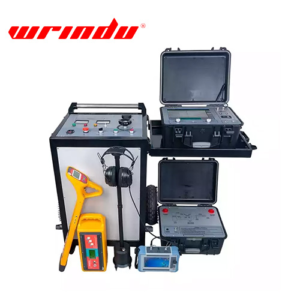
Click the picture to know more about Wrindu Cable Fault Testing System.
What Safety Precautions Should Be Taken When Detecting Cable Breakpoints?
Safety is the first priority in cable maintenance. Here are some key safety precautions to help you avoid accidents:
- Always turn off the power of the cable before detection. Do not detect energized cables unless you use a professional energized detection instrument (such as an induction pen) and wear insulating gloves.
- Wear appropriate protective equipment, such as insulating gloves, insulating shoes, and goggles, to prevent electric shock or injury.
- Check whether the detection instruments (multimeter, induction pen, Wrindu Cable Fault Testing System, etc.) are in normal condition before use. Do not use damaged instruments.
- When detecting outdoor cables, avoid working in rainy, windy, or thunderstorm weather to prevent electric leakage.
- After finding the breakpoint, mark it clearly and cut off the power again before maintenance. Do not touch the broken part directly with your hands.
Common Questions About Cable Breakpoint Detection (For Maintenance Personnel)
Q1: Which detection method is the fastest for short cables?
A1: The induction pen method or multimeter method is the fastest. They are easy to operate and do not require complex steps, which is very suitable for short cables in daily maintenance.
Q2: Can the Wrindu Cable Fault Testing System detect all types of cable breakpoints?
A2: Yes, it can. The Wrindu Cable Fault Testing System is suitable for all types of cables, including power cables, signal cables, communication cables, and control cables. It can detect breakpoints, short circuits, and other common faults efficiently.
Q3: Why does the multimeter show normal but there is still a breakpoint?
A3: It may be a hidden breakpoint (such as internal breakage of the cable core without surface damage). You can use the audio detector method or Wrindu Cable Fault Testing System to detect it, which is more accurate.
Q4: Is it safe to use the audio detector for energized cables?
A4: No, it is not safe. The audio detector needs to connect the signal generator to the cable. You must turn off the power first to avoid electric shock and instrument damage.
Q5: How to choose the right detection method for long-distance cables?
A5: Use the audio detector method or Wrindu Cable Fault Testing System. The Wrindu Cable Fault Testing System is more recommended because it can display the breakpoint position directly, saving you the trouble of moving the receiver back and forth.
How to Choose the Right Cable Breakpoint Detection Method?
Choosing the right detection method can improve maintenance efficiency and reduce costs. You can choose according to the following criteria:
- Short cables (within 10 meters): Choose the multimeter method, induction pen method, or visual inspection method. They are simple and cost-effective.
- Long cables (more than 10 meters): Choose the audio detector method, capacitance method, or Wrindu Cable Fault Testing System. The Wrindu system is the most efficient.
- High-precision requirements (such as signal cables): Choose the oscilloscope method or Wrindu Cable Fault Testing System. They can provide accurate breakpoint positions.
- Complex engineering scenarios: Priority choose the Wrindu Cable Fault Testing System. It integrates multiple functions, can adapt to various harsh environments, and is easy to operate even for non-professional personnel.
