

Best Instruments for IEC Transformer No Load Loss Testing
Learn how to ensure IEC 60076-compliant transformer no load loss testing. Discover critical instruments & why Wrindu No Load and Load Loss Tester stands out with ultra-accuracy, all-in-one design and field usability.
Accurate no load loss testing is one of the most technically demanding procedures in transformer FAT and site verification. Under IEC 60076, the measurement must be performed at rated voltage, with a sinusoidal waveform, and within defined accuracy limits.
Because no load loss involves low current, very low power factor, and high phase sensitivity, instrument selection directly determines whether the result is reliable or misleading.
This article explains the best instruments for IEC transformer no load loss testing, with practical engineering guidance.
Why Instrument Selection Is Critical?
During no load loss testing:
-
The secondary winding is open-circuited
-
Only magnetizing current flows
-
Power factor is typically 0.1 or lower
At such low power factor, even small phase-angle errors cause large power deviations.
For example:
-
A 0.2° phase error can introduce several percent measurement error
-
Harmonic distortion increases core loss artificially
-
Voltage instability directly affects loss (P ∝ V²)
IEC compliance is not just about performing the test — it is about measuring correctly.
High-Accuracy Power Analyzer (Core Instrument)
Why It Is Essential
A high-precision three-phase power analyzer is the most important instrument in IEC no load loss testing.
Key Requirements
-
Phase angle accuracy ≤ 0.05°
-
High resolution at low power factor
-
True RMS measurement
-
Harmonic analysis capability
-
Stable sampling under low current
Engineering Recommendation
Ordinary wattmeters are not suitable for IEC-level testing. A professional power analyzer ensures:
-
Accurate active power calculation
-
Reliable PF measurement
-
Stable and repeatable readings
This is the foundation of FAT credibility.
Stable AC High-Voltage Source
Why Voltage Quality Matters?
IEC requires rated voltage under near-sinusoidal conditions.
Because:
P∝V2P \propto V^2
A 2% voltage increase results in approximately 4% higher loss.
Key Requirements
-
Voltage stability within ±0.5%
-
Low harmonic distortion (THD < 3%)
-
Smooth voltage ramping capability
Practical Tip
Avoid using unstable site power supply directly. A regulated AC source improves accuracy significantly.
Precision Voltage and Current Transformers (VT & CT)
Why Instrument Transformers Matter?
If external CTs or VTs are used, their accuracy class must be suitable for low power factor measurement.
Recommended Specifications
-
Accuracy class 0.2 or better
-
Low phase displacement
-
Calibrated for measurement range
Poor-quality CTs introduce phase shift error, directly affecting active power calculation.
Harmonic Analyzer or Integrated Harmonic Monitoring
Why Harmonics Cannot Be Ignored?
Transformer core loss increases with harmonic content. Even if voltage magnitude is correct, distorted waveform inflates loss measurement.
IEC emphasizes near-sinusoidal voltage conditions.
What to Monitor
-
Total Harmonic Distortion (THD)
-
Individual harmonic components
-
Waveform symmetry
Most modern power analyzers integrate harmonic analysis, which simplifies testing.
How Wrindu No load and load loss Tester Stands out?
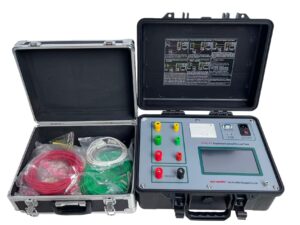
Ultra-High Accuracy Matching IEC 60076 Strict Requirements
- High-precision measurement: Voltage and current accuracy up to ±(0.2% rdg ±0.05% f.s.), ensuring stable readings even at low signals.
- Exceptional low power-factor performance: Accurate measurement down to Cos φ < 0.02, eliminating large deviations caused by minor phase errors.
- 5-digit high resolution and advanced A/D synchronous AC sampling technology, providing refined data for core loss evaluation.
- Built-in harmonic monitoring capability, supporting waveform analysis to avoid inflated loss results from distorted voltage.
Integrated All-in-One Design for Both Lab & On-Site Testing
- Measures no-load loss, load loss, short-circuit impedance, and zero-sequence impedance in one device.
- Optimized for 35kV and above main transformers, supporting both laboratory FAT and heavy-duty on-site verification.
- Supports both internal power supply and external voltage regulator, adapting to diverse field power conditions.
- Compact, lightweight, and highly portable, greatly reducing workload and improving efficiency for on-site technicians.
Intelligent Calculation & Automatic Compensation for Consistent, Comparable Results
- Automatic temperature, frequency, and current correction, standardizing test data for direct comparability.
- Intelligent calculation of impedance voltage percentage at rated conditions and deviation from manufacturer values.
- Supports single-phase, three-phase, and zero-sequence impedance measurement, covering full-spectrum transformer testing.
User-Friendly Operation & Efficient Data Management
- Large 7.0-inch color touch screen with menu-guided operation, intuitive for field technicians.
- Built-in high-speed thermal printer for instant on-site report generation.
- Non-volatile memory storing up to 160 test records, ensuring data persistence.
- USB data transfer for seamless export to computers for archiving, analysis, and certification.
Robust & Reliable for Harsh On-Site Environments
- Wide operating temperature range: -10°C to 50°C.
- Ambient humidity tolerance up to 85% RH (non-condensing).
- Stable under wide power supply variation: AC220V ±10%.
