

Common Myths & Misconceptions About Transformer Ratio Testing
Debunk top transformer ratio testing myths, clarify IEC/IEEE standards, avoid false failures and learn accurate testing best practices for field & factory.
Even seasoned electrical technicians and utility teams fall for common transformer ratio testing myths that lead to inaccurate readings, wasted time, non-compliance with IEC 60076-1 & IEEE C57.12.90 standards, and missed equipment faults. These misconceptions often stem from outdated practices or misinterpretation of testing rules.
In this guide, we debunk the most widespread myths, back each claim with industry facts, and help you run reliable, compliant transformer ratio testing every single time.
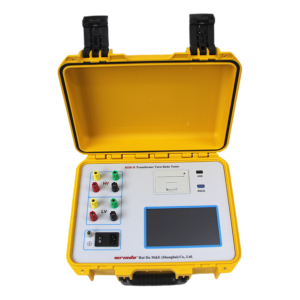
Click the image to know more about Transformer Turns Ratio Tester.
Myth 1: Voltage Ratio = Turns Ratio (No Differences At All)
The Misconception: Technicians often use voltage ratio and turns ratio interchangeably, assuming they are identical in all testing scenarios.
The Fact: While the two values align under ideal no-load conditions, voltage ratio is a measured, variable value that can be skewed by magnetizing current, residual magnetism, and wiring losses. Turns ratio is a fixed physical design value printed on the transformer nameplate. Per IEC and IEEE standards, tests validate that measured voltage ratio stays within ±0.5% of the fixed turns ratio—they are not the same metric.
Myth 2: A Single Tap Test Is Enough for OLTC Transformers
The Misconception: Testing only the main/neutral tap position means the transformer passes ratio testing, even for units with on-load tap changers (OLTC).
The Fact: IEEE C57.12.90 explicitly requires testing every tap position sequentially. Worn contacts, misaligned taps, or partial winding faults often only appear at specific taps, and skipping tap positions guarantees you’ll miss critical defects.
Myth 3: Demagnetization Is an Optional Step Before Testing
The Misconception: Demagnetizing the transformer core is a waste of time and doesn’t impact test accuracy.
The Fact: Residual magnetism is one of the top causes of false ratio test failures, creating deviations of 1% or more. IEC 60076-1 recommends mandatory demagnetization before testing to eliminate magnetic interference and ensure precise readings.
Myth 4: Low-Cost Testers Meet IEC/IEEE Accuracy Standards
The Misconception: Any portable ratio tester works for compliance, as long as it gives a reading.
The Fact: The ±0.5% tolerance mandate requires high-precision equipment. Cheap, uncalibrated testers often have accuracy as low as ±1–2%, leading to false passes or unnecessary repairs. Only IEC/IEEE-certified testers with ≤0.2% accuracy (and preferably ≤0.1%) meet global compliance rules.
Myth 5: Ratio Testing Is Only for New or Broken Transformers
The Misconception: Routine ratio testing is unnecessary for working transformers with no obvious issues.
The Fact: Regular annual ratio testing is a core preventive maintenance task. It catches early warning signs like insulation degradation, tap wear, and minor winding faults before they cause catastrophic failures, grid downtime, or safety hazards.
Myth 6: Field Testing Must Use Full Rated Voltage
The Misconception: Accurate ratio testing requires applying the transformer’s full rated high voltage.
The Fact: Both IEC and IEEE standards recommend using 5–10% of rated HV for field testing for safety. Low-voltage excitation delivers equally accurate results and eliminates the risk of electric shock or equipment damage in remote substations.
Myth 7: A Passing Ratio Test Means the Transformer Is Perfect
The Misconception: If the ratio test passes within ±0.5%, the transformer has no faults at all.
The Fact: Ratio testing only verifies winding turn accuracy and tap functionality. It does not detect insulation weaknesses, oil contamination, loose connections, or core issues. Always pair ratio testing with insulation resistance tests, oil analysis, and visual inspections for a full health check.
How Wrindu Testers Debunk Myths & Ensure Accurate Testing
Wrindu’s portable transformer ratio test kits are designed to counter common testing myths and eliminate errors, keeping you compliant and efficient:
-
0.03% Ultra-High Accuracy: Crushes the myth that “any tester works”—far exceeds IEC/IEEE precision requirements
-
One-Touch Auto Demagnetization: Makes mandatory demagnetization fast and effortless, no more skipped steps
-
Automated OLTC Tap Sequencing: Tests every tap in minutes, ending the myth of single-tap sufficiency
-
Safe Low-Voltage Testing: Preconfigured 5–10% rated voltage settings for field compliance
-
Dual Ratio Display: Shows both measured voltage ratio and nameplate turns ratio to clarify the difference
-
Calibration Alerts: Ensures equipment stays accurate, eliminating false results from uncalibrated tools
-
Rugged, Field-Ready Design: Proves high-precision testing works in remote sites without full rated voltage
FAQs: Transformer Ratio Testing Myths (Long-Tail Q&A)
Q: Can I skip demagnetization if the transformer hasn’t been used in months?
A: No—residual magnetism can linger in the core for years. Always demagnetize before testing to avoid false failures, regardless of idle time.
Q: Is a 0.5% deviation acceptable even if my tester shows 0.6%?
A: No—IEC and IEEE standards strictly enforce the ±0.5% tolerance. Even 0.1% over the limit counts as a failure and requires troubleshooting.
Q: Do I need ratio testing if I only moved the transformer a short distance?
A: Yes—even short-distance transport can cause minor winding shifts or tap misalignment. A quick ratio test rules out hidden damage.
Q: Are three-phase transformers exempt from full tap testing?
A: No—three-phase OLTC transformers require full tap testing across all phases, per IEEE C57.12.90 requirements.
Q: Can a passing ratio test fix a transformer’s internal faults?
A: No—ratio testing only detects faults, it does not repair them. A passing result means no ratio-related faults exist, but other issues may still be present.
Q: How often should I recalibrate my tester to avoid myth-driven errors?
A: Calibrate annually per IEC standards, or after heavy use, drops, or exposure to harsh conditions to maintain accuracy.
