

Why Is Variable Frequency Technology Important in AC Withstand Voltage Testing
Learn how variable frequency technology improves AC withstand voltage testing by reducing power consumption, increasing efficiency, and enhancing testing flexibility for cables, transformers, and GIS equipment.
AC withstand voltage testing is one of the most important methods for evaluating the insulation condition of power equipment. However, traditional power-frequency testing often faces challenges such as large equipment size, high power consumption, and limited flexibility.
This is why variable frequency technology has become increasingly popular in modern high-voltage testing applications.
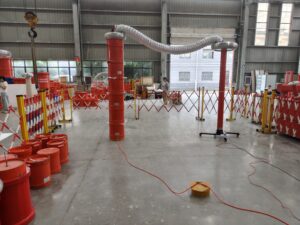
Click to know more about AC Series Resonance Variable Frequency Withstand Voltage Test Device.
What Is Variable Frequency AC Withstand Voltage Testing?
Variable frequency AC withstand voltage testing uses an adjustable frequency power source to create resonance between the reactor and the capacitance of the test object.
Instead of relying solely on a large test transformer to generate high voltage, the system utilizes resonance to efficiently boost voltage while minimizing power demand.
This technology is particularly effective for testing:
- Power cables
- GIS equipment
- Transformers
- Switchgear
- Substation systems
How Does Variable Frequency Improve Testing Efficiency?
One of the biggest advantages is flexibility.
Different electrical equipment has different capacitance values. A fixed-frequency test system may struggle to achieve resonance under varying conditions.
A variable frequency system can automatically adjust the output frequency until the resonant point is reached.
Benefits include:
- Lower power consumption
- Faster testing
- Stable output voltage
- Improved testing accuracy
Why Is Resonance More Energy Efficient?
In a resonant circuit, most of the energy circulates between the reactor and the capacitive load.
The power supply only needs to compensate for system losses.
As a result:
- Smaller power sources can generate higher test voltages
- Equipment weight is reduced
- Field testing becomes easier
For utilities and maintenance teams, this means lower operating costs and improved mobility.
How Does Automatic Frequency Tracking Help Operators?
Modern systems can automatically search for the optimal resonant frequency.
This reduces operator workload and minimizes human error.
Automatic tuning can also:
- Improve repeatability
- Reduce setup time
- Enhance test safety
These advantages are especially important when testing multiple cable sections or different types of equipment in a single project.
Where Can This Technology Be Applied?
Variable frequency resonance technology is widely used in:
- Power transmission networks
- Renewable energy projects
- Industrial power systems
- Utility substations
- Electrical equipment manufacturing
For projects involving high-voltage cables, GIS, and transformers, solutions such as the RDXZ-270kVA/270kV AC Series Resonance Variable Frequency Withstand Voltage Test Device provide a practical way to perform efficient insulation testing while maintaining high safety standards.
FAQs
Why is variable frequency testing better than traditional power-frequency testing?
Variable frequency testing requires less power, offers better portability, and can adapt to different test objects more easily.
What frequency range is commonly used?
Most systems operate between 20Hz and 300Hz depending on the application and standards.
Is variable frequency testing suitable for long cables?
Yes. It is widely recognized as one of the most effective methods for testing long high-voltage cables.
Can transformers be tested using variable frequency resonance systems?
Yes. Many systems support transformer testing within a controlled frequency range close to power frequency.
Conclusion
Variable frequency technology has transformed AC withstand voltage testing by improving efficiency, reducing equipment size, and enhancing safety. As power systems continue to expand, this technology will remain a key solution for reliable insulation assessment.
