

Why Does Reactor Design Matter in High-Voltage Resonance Testing
Explore the role of reactor design in AC resonance testing. Learn how modular reactors improve efficiency, portability, stability, and testing performance in high-voltage applications.
When discussing AC resonance test systems, attention is often focused on voltage levels and frequency ranges. However, the reactor is one of the most important components affecting overall performance.
A well-designed reactor directly influences testing stability, efficiency, and reliability.
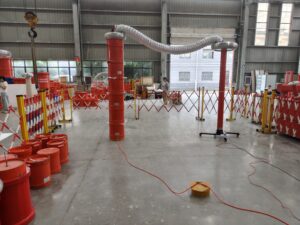
Click to know more about AC Series Resonance Variable Frequency Withstand Voltage Test Device.
What Role Does the Reactor Play?
The reactor provides the inductance required to create resonance with the capacitance of the test object.
Without the correct inductance:
- Resonance cannot be achieved
- Test voltage cannot be generated efficiently
- Testing accuracy may be reduced
The reactor is therefore the foundation of the entire resonance system.
Why Is Modular Reactor Design Important?
Different test objects require different inductance values.
Modular reactors allow operators to:
- Connect reactors in series
- Connect reactors in parallel
- Adapt to different cable lengths
- Test multiple voltage classes
This flexibility increases equipment utilization and reduces investment costs.
How Does Reactor Construction Affect Reliability?
Modern dry-type reactors typically use vacuum epoxy casting technology.
Advantages include:
- Excellent insulation performance
- Moisture resistance
- Reduced maintenance requirements
- Improved mechanical strength
These features are especially important for outdoor and field testing applications.
Why Is Portability Becoming More Important?
Utility companies increasingly perform testing at substations and construction sites.
Portable reactors help engineers:
- Reduce transportation costs
- Simplify installation
- Increase testing efficiency
Lightweight modular designs have become a major trend in modern test equipment.
How Does Reactor Quality Affect Test Results?
High-quality reactors contribute to:
- Stable resonance conditions
- Accurate voltage output
- Lower losses
- Consistent test performance
This is particularly important for critical assets such as transformers, GIS equipment, and high-voltage cables.
Systems such as the RDXZ-270kVA/270kV AC Series Resonance Variable Frequency Withstand Voltage Test Device utilize modular high-voltage reactors to support a wide range of testing applications while maintaining portability and performance.
FAQs
What is the main function of a reactor in a resonance test system?
It provides inductance needed to establish resonance with the test object.
Why are reactors connected in series and parallel?
Different combinations allow the system to match various test requirements.
Are dry-type reactors suitable for field applications?
Yes. They offer good insulation performance and require minimal maintenance.
How does reactor quality influence testing?
Higher-quality reactors improve stability, efficiency, and measurement accuracy.
Conclusion
The reactor is much more than a supporting component. It is a critical element that determines the effectiveness of a resonance test system. Proper reactor design helps ensure accurate, safe, and efficient high-voltage testing.
