

How Does an Insulation Resistance Tester Work?
Learn how an insulation tester (Megger) works, including capacitive charging current, polarization current, surface leakage, and conduction current. Understand insulation resistance measurement, Ohm’s Law, and why timing and discharge are critical for accurate electrical testing.
An insulation tester (often called a Megger) is a portable device that measures how well electrical insulation is working. It gives you a direct reading of insulation resistance in ohms, megohms, gigaohms, or teraohms.
For high-quality insulation, you will typically see a very high resistance value—usually in the megohm range or above. Essentially, this tool is a high-resistance ohmmeter that features a built-in direct current (DC) generator. This generator can be powered by a hand crank, batteries, or a mains outlet. It sends a high DC voltage through the insulation, creating tiny currents across its surfaces. The tester then measures the total current to calculate the resistance.
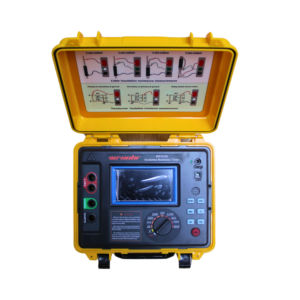
Click the image to know more about Wrindu IR Tester.
What Are the Components of the Test Current?
When you apply test voltage to an insulator, you can calculate its resistance using Ohm’s Law ($R = \frac{E}{I}$). However, the measurement is a bit tricky because the total current is actually made up of several different smaller currents.
1. Capacitive Charging Current
This is the current needed to charge the insulation material, which acts like a capacitor. It starts very high but drops exponentially to almost zero as the material finishes charging.
2. Absorption or Polarization Current
This current is made up of three sub-components that drop toward zero over several minutes:
-
Free Electron Drive: The electric field pushes free electrons through the insulation.
-
Molecular Distortion: The electric field shifts the negative electron shells surrounding atomic nuclei toward the positive voltage.
-
Molecular Alignment: Polarized molecules line up with the applied electric field.
Materials like polyethylene show almost no polarization absorption, while materials with moisture or contamination show a much higher absorption current.
3. Surface Leakage Current
This current flows across the surface of the insulation due to moisture, dirt, or salt contamination. It stays constant over time and depends heavily on temperature and ionization levels.
4. Conduction Current
This is a steady current that flows directly through the insulation material. It is represented as a high-value resistor in parallel with the insulation’s capacitance. It forms the core part of the leakage current once the material is fully charged and full absorption has occurred.
Why Is Timing Important in Insulation Testing?
Because the total current changes over time as the capacitive and absorption currents drop, Ohm’s Law ($R = \frac{E}{I}$) only gives a perfectly stable reading after an infinite amount of time.
Additionally, stored energy from the capacitive and absorption currents must be safely discharged after the test is complete. Larger equipment holds more energy and takes longer to fully discharge. Therefore, the very first step of any new test is to make sure the insulation is completely discharged.
FAQs
What is a normal reading for good electrical insulation?
For high-quality and healthy insulation, the resistance reading should typically be very high, falling into the megohm ($\text{M}\Omega$) range or even higher (like gigaohms or teraohms).
Why must you discharge insulation before and after a test?
Insulation acts like a capacitor and stores energy during a test. You must ensure it is fully discharged beforehand so residual energy doesn’t corrupt your new reading, and you must discharge it afterward for vital safety reasons.
How does moisture affect insulation resistance measurements?
Moisture and surface contaminants increase the orientation polarization and surface leakage. This causes a higher overall current to flow, which results in a much lower and poorer insulation resistance reading.
