

5 Things You Need to Know About Low Resistance Testing
Learn what low resistance testing is and how Kelvin four-wire measurement works. Discover how high test current, probe setup, temperature correction, and noise reduction improve micro-ohm accuracy in electrical systems, including cables, switchgear, and circuit breakers.
What is Low Resistance Testing?
Typically, in the electrical testing industry, low resistance refers to any value below 1 ohm.
While 1 ohm might already sound small, there is a whole world of critical measurements far below that. To measure these tiny values accurately, standard meters won’t work. You need an instrument with exceptional precision and a high test current—usually anywhere from 100 mA to 600 A.
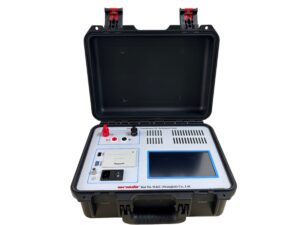
How Does Low Resistance Testing Work?
Low resistance testing relies on Kelvin Bridge technology using a four-terminal tester (two current terminals and two potential terminals):
-
Current Probes: These are placed at the outer ends of the test item to inject a specific test current.
-
Potential Probes: These are connected across the specific area you want to measure (such as a cable joint) to detect the voltage drop.
Using the known current and the measured voltage drop, the instrument uses Ohm’s Law to accurately calculate the resistance.
How Should You Set Up the Test Probes?
For maximum precision—especially if you are submitting results to a third party or saving them to a database—you should follow the 1.5x rule:
The Rule: Space the potential and current probes at a distance equal to 1.5 times the circumference of the item you are testing.
Note: If you are just doing quick troubleshooting or a basic “go/no-go” test, you don’t strictly need to follow this rule, but it is always recommended for the best accuracy.
What Factors Can Affect Your Measurements?
Measuring micro-ohms can be tricky because several environmental and physical factors interfere with the results. Here is how you can manage them:
-
Temperature: Resistance changes with temperature (as temperature goes up, resistance usually goes up). Always adjust your findings to a common temperature base. Good testers have built-in formulas to do this automatically so changing weather doesn’t ruin your data trends.
-
Electrical Noise: Field testing often introduces background noise. You can easily override this noise by increasing your test current.
-
Thermal EMF: When two different metals touch (like copper and nickel in a circuit breaker), they can create an unintended voltage, causing up to a 400% error. Increasing the current significantly reduces this error.
-
Contamination: Rust, dirt, and oxides build up on surfaces like circuit breaker contacts. A higher test current can literally break through the contamination to get a clean reading.
-
Hotspots: These are hidden spots where metal has worn away. While a standard continuity test might miss them, a low resistance test highlights them immediately before they cause total equipment failure.
What Are the Benefits of Low Resistance Testing?
Implementing low resistance testing offers major advantages for your electrical systems:
-
Saves Time: Quick “go/no-go” tests let you troubleshoot and pass/fail equipment instantly.
-
Predictive Maintenance: By tracking resistance over time in a database, you can catch wear and tear before a breakdown occurs.
-
Safety & Lightning Protection: Fault currents always follow the path of least resistance. Testing ensures your grounding and lightning protection systems are actually safe.
FAQs
Why is standard multimeter testing not enough for low resistance?
Standard multimeters do not use a four-terminal (Kelvin) setup. They cannot subtract the resistance of their own test leads, which easily distorts measurements below 1 ohm.
How does high test current help improve low resistance readings?
A higher test current increases the signal-to-noise ratio. It helps overcome electrical background noise, minimizes errors caused by thermal EMF, and punches through surface contamination like oxides.
What happens if I do not correct my test results for temperature?
If you do not correct for temperature, your data will fluctuate wildly simply based on the weather. This makes it impossible to accurately track the true condition of your equipment over time.
