

How Does a Cable Fault Locator Work? A Complete Guide to Underground Cable Fault Detection
Learn how a cable fault locator works, including fault pre-location, pinpointing methods, and underground cable fault detection technologies.
Why Is Understanding Cable Fault Location Technology Important?
Underground cables are widely used in modern power systems, including urban distribution networks, industrial facilities, renewable energy projects, and transportation systems.
However, when a cable fault occurs, engineers cannot directly see the damaged area because the cable is buried underground. Finding the fault location only through excavation can take a long time and increase repair costs.
A professional cable fault locator helps maintenance teams quickly identify cable problems by analyzing electrical signals, measuring fault distance, and locating the exact fault point.
Understanding how a cable fault testing system works can help utilities and contractors select suitable equipment and improve cable maintenance efficiency.
Wrindu RDCD-II and RDCD-III Cable Fault Testing Systems combine multiple fault location technologies to provide complete solutions for underground cable diagnosis.
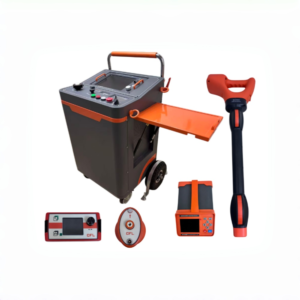
Click the image to know more about Wrindu Cable Fault Testing Systems.
What Types of Underground Cable Faults Can Be Detected?
Different cable failures require different testing methods. A professional cable fault locator should be able to identify various fault conditions.
How Can a Cable Fault Locator Detect Low Resistance Faults?
Low resistance faults happen when cable insulation damage creates a conductive path between conductors or between the conductor and ground.
Common causes include:
- Cable aging
- Insulation damage
- Joint problems
- External mechanical impact
Low voltage pulse testing is usually used to detect these faults by analyzing reflected signals.
How Are High Resistance Cable Faults Located?
High resistance faults are more difficult to detect because normal testing signals may not create obvious reflections.
High voltage impulse testing is often applied to generate a temporary discharge at the fault point.
The system then analyzes:
- Current waveform
- Voltage response
- Signal reflection time
to calculate the approximate fault distance.
Can Cable Fault Testers Detect Open Circuit and Cable Break Faults?
Yes.
Open circuit faults occur when the conductor is completely broken or disconnected.
A cable fault locator can detect these problems by sending electrical pulses through the cable and analyzing the returned signal.
This method is commonly used for:
- Cable break detection
- Open circuit location
- Cable length measurement
How Does a Cable Fault Pre-Location Method Work?
Cable fault pre-location is the first step in finding underground cable faults.
The purpose is to estimate the distance between the testing point and the damaged area.
How Does the Low Voltage Pulse Method Work?
The tester sends a low voltage pulse into the cable.
When the signal reaches:
- A fault point
- A cable joint
- The cable end
part of the signal reflects back.
The equipment calculates the distance based on the signal travel time.
This method is fast and suitable for many basic cable faults.
How Does the Impulse Current Method Locate Difficult Faults?
For high resistance faults, engineers usually need a stronger testing method.
The impulse current method applies a high voltage pulse to create a discharge at the fault location.
The system records the electrical response and calculates the fault distance.
This method is commonly used for:
- Medium voltage cable systems
- Underground power networks
- Utility cable maintenance
How Does Cable Fault Pinpointing Find the Exact Fault Location?
After pre-location, engineers still need to identify the exact underground position.
Fault pinpointing helps reduce unnecessary excavation work.
How Does Acoustic Detection Work?
When a high voltage impulse reaches a fault point, it creates a discharge sound underground.
A sensitive acoustic sensor can detect the strongest sound signal.
The closer the sensor is to the fault point, the stronger the signal becomes.
How Does Magnetic Field Detection Improve Fault Location Accuracy?
Electrical discharge creates electromagnetic signals around the cable.
A magnetic receiver can detect these signals and help engineers identify the underground fault position.
Combining acoustic and magnetic methods improves accuracy in complex environments.
Why Is Cable Route Detection Important Before Repair Work?
Knowing the cable route is essential before excavation.
Incorrect cable route information may cause:
- Wrong excavation location
- Longer repair time
- Safety risks
Modern cable fault testing systems can provide cable path detection functions.
Engineers can identify:
- Cable direction
- Cable position
- Underground cable route
before locating the exact fault point.
How Do Wrindu Cable Fault Testing Systems Improve Fault Diagnosis?
Wrindu RDCD-II and RDCD-III Cable Fault Testing Systems integrate multiple testing functions into one solution.
The systems include:
What Functions Are Included in Wrindu Cable Fault Testing Systems?
They provide:
- Fault distance measurement
- High voltage impulse testing
- Multiple pulse testing
- Cable route detection
- Acoustic magnetic pinpointing
This integrated design helps users reduce testing steps and improve field efficiency.
What Makes RDCD-III Suitable for Advanced Cable Diagnosis?
RDCD-III provides additional intelligent features for professional users.
Key functions include:
- Testing distance up to 100km
- Localization accuracy of ±0.2m
- WIFI and SIM communication
- Digital waveform storage
- Remote data analysis
These features make it suitable for large underground cable networks.
FAQs About Cable Fault Locator Technology
What is the working principle of a cable fault locator?
A cable fault locator sends electrical signals into the cable and analyzes reflected signals or discharge responses to calculate the fault distance and location.
Can a cable fault locator detect underground cable faults without excavation?
Yes. The equipment can locate the approximate fault distance and exact position before excavation, reducing unnecessary digging.
What is the difference between cable fault pre-location and pinpointing?
Pre-location identifies the approximate distance from the testing point to the fault, while pinpointing finds the exact physical location on the ground.
How accurate can underground cable fault location be?
The accuracy depends on cable conditions and testing methods. Advanced systems can achieve sub-meter positioning accuracy. Wrindu RDCD-III provides ±0.2m localization accuracy.
Which cable fault testing method is best for high resistance faults?
High voltage impulse testing combined with impulse current analysis is commonly used for locating high resistance cable faults.
