

How to Calculate High-Voltage Capacitor Energy? Formula and Examples
Learn how to calculate capacitor energy using the E = ½CV² formula. Explore voltage and capacitance effects, calculation examples, and the RDCD-C cable fault tester.
Capacitor energy is an important parameter in high-voltage cable fault testing. It indicates how much electrical energy a capacitor stores before discharge.
Engineers can calculate stored energy using capacitance and charging voltage. This calculation helps them understand cable fault tester specifications and compare different capacitor configurations.

Click the image to know more about Wrindu RDCD-C Vehicle-Mounted Cable Fault Testing System.
What Is the Formula for Calculating Capacitor Energy?
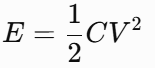
The energy stored in a capacitor is calculated using:
[
E=\frac{1}{2}CV^2
]
Where:
- E = Stored energy in joules (J)
- C = Capacitance in farads (F)
- V = Charging voltage in volts (V)
The formula shows that capacitor energy depends on both capacitance and voltage. Voltage has a squared effect on stored energy.
How Do You Convert Microfarads and Kilovolts Before Calculation?
Capacitor specifications often use microfarads (μF) and kilovolts (kV). However, the standard energy formula requires farads (F) and volts (V).
Use these conversions:
- 1 μF = 0.000001 F
- 1 kV = 1,000 V
- 1 J = 1,000 mJ
For example, a 4 μF capacitor charged to 32 kV must be converted as follows:

[
C=4\times10^{-6}\ F
]
[
V=32,000\ V
]
The converted values can then be used in the energy formula.
How Do You Calculate the Energy of a 4 μF Capacitor at 32 kV?
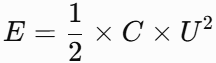
Use the capacitor energy formula:
[
E=\frac{1}{2}\times C\times V^2
]
Substitute the values:
[
E=\frac{1}{2}\times4\times10^{-6}\times32000^2
]
[
E=2048\ J
]
Therefore, a 4 μF capacitor charged to 32 kV stores 2,048 J of theoretical electrical energy.
How Does Charging Voltage Affect Capacitor Energy?
Charging voltage has a squared relationship with stored energy when capacitance remains unchanged.
For example, consider a 4 μF capacitor at different charging voltages.
| Charging Voltage | Capacitance | Stored Energy |
|---|---|---|
| 8 kV | 4 μF | 128 J |
| 16 kV | 4 μF | 512 J |
| 24 kV | 4 μF | 1,152 J |
| 32 kV | 4 μF | 2,048 J |
Doubling the charging voltage increases stored energy by four times. This is why voltage selection has a significant effect on high-voltage impulse energy.
How Does Capacitance Affect Stored Energy?
Capacitance has a linear relationship with stored energy when charging voltage remains unchanged.
For example, at a charging voltage of 16 kV:
| Capacitance | Charging Voltage | Stored Energy |
|---|---|---|
| 4 μF | 16 kV | 512 J |
| 8 μF | 16 kV | 1,024 J |
| 16 μF | 16 kV | 2,048 J |
| 32 μF | 16 kV | 4,096 J |
Doubling capacitance doubles the theoretical stored energy if voltage remains constant.
What Are Common Mistakes When Calculating Capacitor Energy?
Engineers should pay attention to several common calculation errors.
| Common Mistake | Correct Method |
|---|---|
| Using kV directly as V | Multiply kV by 1,000 |
| Using μF directly as F | Multiply μF by 0.000001 |
| Forgetting the squared voltage | Calculate V × V |
| Omitting the 1/2 factor | Include 0.5 in the formula |
| Confusing stored energy with delivered energy | Distinguish theoretical stored energy from actual energy delivered to the test circuit |
Correct unit conversion is essential for obtaining the right energy value.
How Is Capacitor Energy Used in Cable Fault Testing?
In high-voltage impulse testing, the capacitor stores electrical energy before discharge. The equipment releases this energy into the cable test circuit as a high-voltage impulse.
When the applied voltage reaches the breakdown level of a damaged insulation point, a discharge may occur at the fault location. Engineers can then use fault pre-location and pinpointing methods to investigate the damaged section.
The actual energy delivered to the test circuit may differ from the theoretical energy stored in the capacitor.
What Is the Maximum Capacitor Energy of the RDCD-C?
The WRINDU RDCD-C Vehicle-Mounted Cable Fault Testing System has a maximum impulse energy specification of 2,048 J.
Its high-voltage control system provides three built-in capacitor configurations:
| Capacitance | Rated Voltage | Theoretical Stored Energy |
|---|---|---|
| 4 μF | 32 kV | 2,048 J |
| 16 μF | 16 kV | 2,048 J |
| 64 μF | 8 kV | 2,048 J |
The system has an output voltage range of 0–32 kV. The selected capacitor configuration determines the available voltage and capacitance combination.
Frequently Asked Questions
What is the unit of capacitor energy?
Capacitor energy is measured in joules (J).
Does doubling capacitance double stored energy?
Yes. Stored energy doubles when capacitance doubles and charging voltage remains unchanged.
Does doubling voltage increase capacitor energy by four times?
Yes. Stored energy increases by four times when voltage doubles and capacitance remains unchanged.
Can two different capacitor configurations have the same stored energy?
Yes. Different voltage and capacitance combinations can produce the same theoretical stored energy.
Is 2,048 J the energy delivered during every cable fault test?
No. It is the maximum specified stored energy for the RDCD-C. Actual stored and delivered energy depends on the selected configuration and operating conditions.
About Wrindu Cable Fault Testing Equipment
Wrindu is a Chinese OEM manufacturer of electrical testing equipment and power testing solutions, established in 2014.
The RDCD-C Vehicle-Mounted Cable Fault Testing System provides high-voltage impulse testing with a maximum specified impulse energy of 2,048 J. It is designed for underground cable fault testing applications.
