

How to Calculate Power Factor in Single-Phase and Three-Phase Systems?
Learn how to calculate power factor in single-phase, balanced and unbalanced three-phase systems using simple formulas and practical examples.
Power factor (PF) is an important value in AC electrical systems. Engineers calculate it to understand the relationship between active power and apparent power.
The calculation method depends on the electrical system. Single-phase systems use voltage and current directly, while balanced three-phase systems require an additional factor of √3 when using line voltage and line current.
This article explains how to calculate power factor with formulas, practical examples, and common measurement conditions.
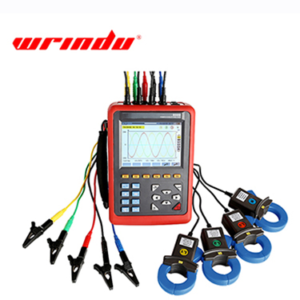
Click the image to know more about Wrindu Power Quality Analyzer.
How Do You Calculate Power Factor in an AC Circuit?
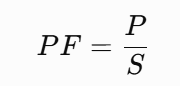
Power factor is the ratio of active power (P) to apparent power (S).
The basic formula is:
[
PF=\frac{P}{S}
]
Where:
- PF = Power factor
- P = Active power (W or kW)
- S = Apparent power (VA or kVA)
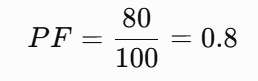
For example, an electrical load uses 80 kW of active power and has 100 kVA of apparent power.
[
PF=\frac{80}{100}=0.8
]
The power factor is 0.8.
Engineers can use this formula for both single-phase and three-phase systems. However, they need to calculate apparent power according to the system configuration.
How Do You Calculate Power Factor in a Single-Phase System?
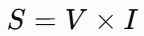
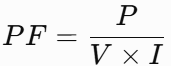
For a single-phase AC system, apparent power is the product of RMS voltage and RMS current.
[
S=V\times I
]
Therefore, the power factor formula is:
[
PF=\frac{P}{V\times I}
]
Where:
- P = Active power (W)
- V = RMS voltage (V)
- I = RMS current (A)
Calculation example
Assume a single-phase electrical load has the following values:
| Parameter | Value |
|---|---|
| Voltage | 230 V |
| Current | 10 A |
| Active Power | 1,840 W |
Step 1: Calculate apparent power.
[
S=230\times10=2300\ VA
]
Step 2: Calculate power factor.
[
PF=\frac{1840}{2300}=0.8
]
The calculated power factor is 0.8.
This method uses RMS voltage, RMS current, and actual active power measurements.
How Do You Calculate Power Factor in a Three-Phase System?
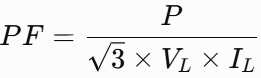
For a balanced three-phase system, engineers can calculate apparent power using line-to-line voltage and line current.

[
S=\sqrt{3}\times V_L\times I_L
]
The power factor formula is:
[
PF=\frac{P}{\sqrt{3}\times V_L\times I_L}
]
Where:
- P = Total three-phase active power (W)
- (V_L) = Line-to-line voltage (V)
- (I_L) = Line current (A)
- √3 ≈ 1.732
Calculation example
Consider a balanced three-phase electrical system with:
| Parameter | Value |
|---|---|
| Line Voltage | 400 V |
| Line Current | 20 A |
| Total Active Power | 11,085 W |
Step 1: Calculate apparent power.
[
S=1.732\times400\times20
]
[
S\approx13,856\ VA
]
Step 2: Calculate power factor.
[
PF=\frac{11085}{13856}
]
[
PF\approx0.8
]
The three-phase power factor is approximately 0.8.
This formula applies to balanced three-phase systems when line voltage and line current are used.
How Do You Calculate Power Factor in an Unbalanced Three-Phase System?
A balanced three-phase formula should not be applied directly to an unbalanced system.
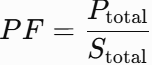
In an unbalanced system, the three phases may have different voltage and current values. Engineers should use the total measured active power and the appropriate total apparent power.
For a four-wire system, apparent power can be calculated using the phase values:

[
S_{\text{total}}=S_A+S_B+S_C
]
Where:
- (S_A) = Phase A apparent power
- (S_B) = Phase B apparent power
- (S_C) = Phase C apparent power
For each phase:
[
S_A=V_{AN}\times I_A
]
[
S_B=V_{BN}\times I_B
]
[
S_C=V_{CN}\times I_C
]
The total power factor is then:
[
PF=\frac{P_{\text{total}}}{S_{\text{total}}}
]
This arithmetic sum is a common way to calculate apparent power for a four-wire system. For other system configurations, engineers should follow the applicable power measurement method and analyzer definition.
When voltage and current waveforms contain harmonics, engineers should also use true power factor measurements rather than assume that the fundamental-frequency phase angle gives the complete result.
How Do You Calculate Power Factor from Active and Reactive Power?
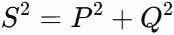
Engineers can also calculate apparent power from active power and reactive power in a sinusoidal system.
The relationship is:
[
S^2=P^2+Q^2
]
Therefore:
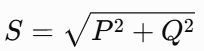
[
S=\sqrt{P^2+Q^2}
]
Where:
- P = Active power (kW)
- Q = Reactive power (kvar)
- S = Apparent power (kVA)
The power factor can then be calculated as:
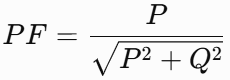
[
PF=\frac{P}{\sqrt{P^2+Q^2}}
]
Calculation example
Assume an electrical system has:
- Active power: 80 kW
- Reactive power: 60 kvar
First, calculate apparent power:
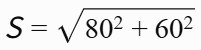
[
S=\sqrt{80^2+60^2}
]
[
S=\sqrt{10000}=100\ kVA
]
Then calculate power factor:
[
PF=\frac{80}{100}=0.8
]
The calculated power factor is 0.8.
This method uses the power triangle relationship for sinusoidal conditions. In systems with significant waveform distortion, the simple relationship between P, Q, and S may not describe all measured power components.
What Is the Difference Between Leading and Lagging Power Factor?
Power factor can be described as leading or lagging according to the phase relationship between voltage and current.
| Type | Phase Relationship | Common Load |
|---|---|---|
| Lagging PF | Current lags voltage | Induction motors and transformers |
| Leading PF | Current leads voltage | Capacitor banks and overcompensated systems |
| Unity PF | Voltage and current are in phase for the fundamental component | Resistive loads under sinusoidal conditions |
Inductive loads usually have lagging power factor because they require magnetizing current.
Capacitive loads can produce leading power factor. Excessive capacitive compensation may cause the system to operate with a leading power factor.
Engineers should check both the PF value and its leading or lagging status when evaluating an electrical system.
What Information Is Needed to Calculate Power Factor?
The required data depends on the calculation method.
| Calculation Method | Required Parameters |
|---|---|
| Basic PF calculation | Active power and apparent power |
| Single-phase calculation | Voltage, current, active power |
| Balanced three-phase calculation | Line voltage, line current, total active power |
| Power triangle calculation | Active power and reactive power |
| Unbalanced three-phase calculation | Actual phase measurements and total active power |
For field measurements, engineers should record voltage and current under the same operating conditions.
Incorrect phase connections, mismatched current clamps, and changing loads can affect the calculated result.
What Instruments Can Measure Power Factor?
A digital power quality analyzer can measure active power, reactive power, apparent power, and power factor.
It can also provide voltage and current readings for single-phase and three-phase electrical systems.
For example, the Wrindu RDCR5000 Digital Power Quality Analyzer supports four voltage channels and four current channels. Its measurement functions include power parameters, harmonic analysis, waveforms, and three-phase imbalance analysis.
These measurements help engineers compare calculated power factor with instrument readings and investigate abnormal electrical conditions.
Frequently Asked Questions
What Is the Formula for Power Factor?
The basic formula is PF = P/S, where P is active power and S is apparent power.
How Do You Calculate Power Factor Without a Power Analyzer?
You can calculate power factor if you know the active power and apparent power. You can also use voltage and current measurements with the appropriate single-phase or balanced three-phase formula.
What Is the Power Factor of a 230 V, 10 A, 1,840 W Load?
The apparent power is 2,300 VA. The power factor is 1,840/2,300 = 0.8.
Why Is √3 Used in the Three-Phase Power Factor Formula?
The factor √3, approximately 1.732, comes from the relationship between line voltage, phase voltage, and three-phase apparent power in a balanced system.
Can Power Factor Be Calculated from Reactive Power?
Yes. Under sinusoidal conditions, engineers can calculate apparent power using P and Q, then divide active power by apparent power.
Conclusion
Power factor can be calculated using active power and apparent power. Single-phase systems use voltage multiplied by current, while balanced three-phase systems use √3 multiplied by line voltage and line current.
For unbalanced systems or systems with harmonic distortion, engineers should use suitable measurement methods rather than rely on simplified balanced-system formulas.
