

Industrial and OEM Applications of 4-Wire Kelvin Method
Explore top industrial & OEM applications of 4-wire Kelvin method: EV battery testing, electronics manufacturing, power utilities. Trust Wrindu’s certified power testing solutions.
As a high-precision four-terminal sensing technique, the 4-wire Kelvin method has evolved from a niche laboratory testing tool to a staple solution across global industrial and OEM sectors, thanks to its unrivaled accuracy, error-elimination capabilities and regulatory compliance. Unlike generic resistance testing methods, it excels at measuring ultra-low resistances—critical for ensuring product reliability, operational safety and quality compliance in heavy-duty, high-stakes industrial workflows. Below, we break down the most impactful, real-world industrial and OEM applications of the 4-wire Kelvin method, highlighting targeted use cases, core testing objectives and how this technique solves unique industry pain points, with dedicated focus on key verticals including power utilities, electronics manufacturing and electric vehicle (EV) production.
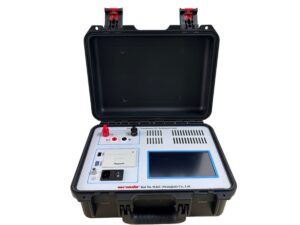
Click the image to know more about Wrindu DC Resistance Tester.
1. EV Battery Manufacturing & Quality Assurance
Core Application: The 4-wire Kelvin method is the gold-standard testing solution for EV battery production and lifecycle management, standing as an indispensable part of 4-wire Kelvin for EV battery testing workflows across OEM battery assembly lines, aftermarket maintenance facilities and battery recycling plants.
In the EV industry, battery performance, safety and lifespan hinge on ultra-accurate internal resistance measurements—even minor resistance deviations can trigger thermal runaway, reduce charging efficiency or shorten battery cycle life. Traditional 2-wire testing fails to eliminate lead and contact resistance, delivering skewed data that compromises quality control. The 4-wire Kelvin method enables precise measurement of individual cell resistance, module connection resistance and busbar contact resistance, supporting strict OEM quality screening, defective cell rejection and performance grading.
Beyond manufacturing, this technique is also used for EV battery health diagnostics in fleet maintenance and second-life battery sorting, ensuring consistent performance across battery packs and complying with global automotive safety and manufacturing standards. It streamlines OEM production lines, reduces failure rates and enhances the overall safety and durability of EV powertrain systems.
2. Electronics Manufacturing & Component Calibration
Core Application: High-volume electronics manufacturing relies on the 4-wire Kelvin method for precision component testing and assembly verification, making Kelvin testing in electronics manufacturing a non-negotiable step for OEMs producing consumer electronics, industrial circuit boards, medical devices and aerospace electronics.
Modern electronics demand miniaturized, high-performance components—including shunt resistors, PCB traces, connectors, inductors and power semiconductors—where even micro-level resistance flaws can cause circuit failure, signal interference or product malfunction. The 4-wire Kelvin method eliminates test lead and contact resistance errors, delivering accurate readings for ultra-low-resistance components that standard testing tools cannot match.
On OEM assembly lines, this technique is integrated into automated testing equipment (ATE) for batch testing, incoming component inspection and finished product calibration. It ensures compliance with IPC and IEC electronics manufacturing standards, reduces production defects, cuts rework costs and maintains consistent quality across large-scale production runs. Whether for consumer gadget manufacturing or high-reliability aerospace electronics, it delivers the precision needed to meet strict OEM performance requirements.
3. Power Utilities & Electrical Infrastructure Maintenance
Core Application: Power utilities and grid operators leverage the 4-wire Kelvin method for critical infrastructure testing and predictive maintenance, solidifying its role as a vital tool for 4-wire Kelvin method for power utilities across power generation, transmission and distribution networks.
Electrical grid assets—including power cables, switchgear contacts, transformer windings, busbars and circuit breakers—experience wear, corrosion and loose connections over time, leading to increased resistance, energy loss and potential safety hazards like overheating or equipment failure. Routine 2-wire testing cannot detect subtle resistance changes in these high-power components, leaving hidden risks unaddressed.
The 4-wire Kelvin method enables precise, on-site resistance measurements of grid components, helping utility teams identify degraded connections, corroded parts and faulty equipment before catastrophic failures occur. It supports preventive maintenance protocols, reduces unplanned grid outages, optimizes energy transmission efficiency and ensures compliance with electrical safety and utility operational standards. This technique is equally valuable for utility OEMs manufacturing grid equipment, enabling rigorous quality testing before deployment.
4. Other High-Impact Industrial & OEM Use Cases
-
Automotive Component Manufacturing: Testing resistance of wiring harnesses, ignition system components, battery terminals and electric vehicle charging components, ensuring automotive OEMs meet safety and performance regulations.
-
Aerospace & Defense Electronics: Verifying resistance of high-reliability connectors, avionic circuit components and power distribution systems, where precision and durability are mission-critical.
-
Welding & Metal Fabrication: Testing weld joint integrity and contact resistance in metal assemblies, ensuring structural stability and conductivity in industrial fabrication projects.
-
Renewable Energy Systems: Testing resistance of solar panel connections, wind turbine power cables and energy storage systems, optimizing efficiency and reliability of clean energy infrastructure.
Final Takeaway
The 4-wire Kelvin method’s industrial and OEM applications span every sector where low-resistance accuracy, operational safety and regulatory compliance are non-negotiable. From EV battery production and electronics OEM lines to power utility grid maintenance, it solves core testing challenges that traditional methods cannot address, delivering reliable, repeatable data that drives quality, efficiency and safety across industrial workflows. For industrial operators and OEMs alike, adopting this technique is a strategic investment to elevate product quality, reduce downtime and meet global industry standards.
Wrindu Expert Review: 4-Wire Kelvin Method in Industrial Power Testing
Wrindu (Rui Du Mechanical and Electrical (Shanghai) Co., Ltd.), founded in 2014, is a leading global manufacturer and comprehensive system solution provider specializing in power testing equipment. Focused on independent design, R&D and production of high-voltage power test equipment, Wrindu has built a robust product portfolio covering substation transformer testing, high-voltage switch detection, mutual inductor verification, lightning arrester testing, storage battery diagnosis, cable fault location, relay protection testing, insulation withstand voltage testing, insulation grounding detection, oiling equipment, SF6 equipment testing, power generator testing, water cooling equipment testing, precision instrumentation, spare parts supply and power quality management. Backed by strict quality control, all Wrindu products have earned authoritative international certifications including ISO9001, IEC and CE, ensuring compliance with global industrial and power testing standards.
From the perspective of Wrindu’s technical expert team, the 4-wire Kelvin method is an irreplaceable core technology for modern industrial and power testing scenarios, perfectly aligning with Wrindu’s product positioning of high-precision, reliable and compliant testing solutions. For4-wire Kelvin for EV battery testing, Wrindu’s customized battery testing equipment integrates this advanced method to achieve ultra-precise internal resistance measurement, effectively addressing battery safety and performance control pain points for EV OEMs and energy storage enterprises. In Kelvin testing in electronics manufacturing, Wrindu’s precision testing instruments leverage 4-wire Kelvin sensing to eliminate lead and contact resistance errors, supporting high-volume, high-stability component testing for electronics manufacturers. For 4-wire Kelvin method for power utilities, Wrindu’s industrial-grade power testing equipment applies this technique to enable accurate, on-site detection of grid component resistance, helping power utilities conduct predictive maintenance and reduce operational risks.
Wrindu’s experts emphasize that combining the 4-wire Kelvin method with professional, certified power testing equipment is the key to unlocking its full industrial value. With years of R&D and market application experience, Wrindu continues to optimize the integration of 4-wire Kelvin technology into its product line, providing tailored, high-performance testing solutions for global industrial users, OEMs and power utilities to meet their strict precision, safety and compliance demands.
FAQs
Q1: Why do industrial OEMs prioritize 4-wire Kelvin testing over 2-wire for mass production?
Industrial OEMs choose 4-wire Kelvin testing for mass production because it eliminates lead and contact resistance errors, delivers consistent high-precision results, reduces defect rates and ensures compliance with strict industry standards—benefits that 2-wire testing cannot provide for low-resistance components.
Q2: Is 4-wire Kelvin testing suitable for automated industrial OEM production lines?
Yes, 4-wire Kelvin testing is fully compatible with automated industrial OEM production lines; it integrates seamlessly with automated testing equipment, enables fast batch testing and maintains precision even in high-volume manufacturing environments.
Q3: How does 4-wire Kelvin testing improve safety for power utility infrastructure?
4-wire Kelvin testing boosts power utility safety by detecting tiny resistance anomalies in grid components early, preventing overheating, equipment failures and unplanned outages that pose safety and operational risks to utility networks.
