

OLTC vs OCTC TCO Analysis | 20-Year Cost Comparison for Power Transformers
Compare OLTC vs OCTC total cost of ownership (TCO) over 20 years. Learn about upfront costs, maintenance, outage losses, and how Wrindu testers reduce OLTC TCO for dynamic grids.
Core Cost Components for TCO Analysis
| Cost Category | Description | OLTC vs OCTC Impact |
|---|---|---|
| Upfront Capital Expenditure (CAPEX) | Initial purchase, manufacturing, installation, and transformer integration (e.g., tank modifications for OLTCs) | OLTC: 3–5x higher than OCTCs; 15–25% of total transformer cost for 110kV+ units |
| Maintenance Costs | Routine inspections, specialized testing, component replacement, and labor | OLTC: Higher but predictable; OCTC: Lower but prone to hidden costs |
| Outage-Related Losses | Scheduled shutdowns, unplanned failures, lost revenue, user compensation, and regulatory fines | OLTC: Negligible (no shutdowns); OCTC: Highest TCO driver (70%+ for dynamic grids) |
| Energy Efficiency Costs | Losses from poor voltage control or tap changer inefficiency | OLTC: Lower (precise regulation); OCTC: Higher (infrequent adjustments) |
| Asset Replacement/Retrofit Costs | Premature failure or grid upgrade (e.g., renewable integration) | OLTC: Lower (longer lifespan); OCTC: Higher (frequent replacements) |
OLTC TCO Breakdown (20-Year Lifespan)
1. Upfront CAPEX: 3–5x Higher Than OCTCs
2. Maintenance Costs: Predictable & Proactive
3. Outage-Related Losses: Negligible for OLTCs
4. Energy Efficiency: 8–15% Lower Losses
5. Asset Lifespan: 20+ Years with Proactive Care
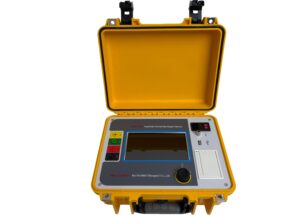
How Wrindu Testers Stand Out
- Ultra-Precise Dynamic Resistance Measurement (DRM): 0.1ms timing resolution and ±0.1% accuracy detect early contact wear, transition delays, and arc abnormalities that generic tools miss—preventing catastrophic failures and reducing unplanned outages by 90%.
- Live Testing Without Shutdown: On-site diagnostics under full load eliminate maintenance-related outages, preserving power continuity for critical infrastructure and reducing downtime by 60%.
- All-In-One Diagnostics: Integrates DRM, insulation testing, partial discharge detection, and tap calibration in a portable unit—cutting testing time by 60% vs. manual methods and reducing technician workload.
- Predictive Maintenance: Stores historical performance data and tracks trends, enabling data-driven maintenance scheduling to extend OLTC lifespan by 50%+ and reduce long-term costs.
- Universal Compatibility: Works with all major OLTC models (mechanical, motor-driven, vacuum-type) without adapters, simplifying maintenance for mixed transformer fleets.
FAQs
Q: What is the 20-year TCO difference between OLTC and OCTC for a 110kV HV transmission substation?
A: For 110kV transmission substations, OLTCs deliver a 25–30% lower 20-year TCO than OCTCs. The higher upfront CAPEX is fully offset by eliminated scheduled outage losses (3–5-year payback period) and 8–15% energy efficiency savings. Wrindu testers reduce OLTC maintenance costs by 60% and unplanned outages by 90%, accelerating ROI.
Q: Why do renewable energy grids (solar/wind) favor OLTCs over OCTCs for TCO optimization?
A: Renewable integration causes frequent voltage fluctuations, requiring repeated OCTC tap changes and outages—driving TCO up by 40–50% over 20 years. OLTCs eliminate these outage losses, maintain precise voltage control, and reduce tap switching frequency by 37–43% (via coordinated control with BESS/energy storage). Vacuum-type OLTCs (compatible with Wrindu testers) offer superior arc suppression, cutting maintenance costs by 5–10% vs. oil-immersed units.
Q: How to optimize OCTC TCO for rural grids with seasonal load changes?
A: Optimize OCTC TCO with four strategies: 1) Schedule tap changes during planned grid maintenance to minimize outage time; 2) Use Wrindu testers for post-adjustment contact resistance testing to eliminate loose contacts (the main hidden OCTC cost); 3) Annual lubrication of the drive mechanism to prevent jamming/rust; 4) Install rust-resistant components for outdoor rural environments. These steps reduce OCTC TCO by 15–20% over 20 years.
Q: Is OLTC TCO justifiable for small rural 10kV transformers with static low loads?
A: No. For 10kV rural transformers with 1–2 annual voltage adjustments, OLTC TCO is not justified—upfront CAPEX far outweighs outage savings. OCTC is the better choice, but post-adjustment testing with Wrindu testers is critical to avoid hidden contact failure costs.
Q: How do oil-immersed vs. vacuum-type OLTCs compare in 20-year TCO?
A: Oil-immersed OLTCs have a 5–10% higher 20-year TCO than vacuum-type units. Ongoing insulation oil testing/replacement and higher contact replacement costs drive this difference. Vacuum-type OLTCs have no oil-related maintenance costs and superior arc suppression, reducing wear. Wrindu testers support both types, with specialized DRM profiles to optimize TCO for each design.
