What Are the Key Challenges in Submarine Oil-Filled Cable Testing?
Learn about the challenges of testing submarine oil-filled cables, including distance, pressure, partial discharge (PD) detection, and the equipment needed for accurate diagnostics.
Submarine oil-filled cables are used in offshore energy transmission, typically for high-voltage (HV) applications. These cables face unique testing challenges due to their long distances, high pressure, and the complex nature of their insulation systems. Understanding these challenges is essential for ensuring reliable operation and preventing failures.
How Does Distance Affect Submarine Cable Testing?
One of the most significant challenges in testing submarine cables is their long distance, which can extend over hundreds or even thousands of kilometers. The sheer length of these cables introduces several complications:
-
Signal Degradation: Over long distances, electrical signals may degrade, making it harder to detect faults or accurately assess the cable’s condition.
-
Increased Testing Time: Longer cables require more time to test, as each segment needs to be evaluated individually.
-
Current Losses: Long cables can also experience voltage and current losses, which can interfere with test results and reduce testing accuracy.
Why Is Pressure a Concern in Submarine Cable Testing?
Submarine cables are exposed to high underwater pressure, which can affect their insulation and overall performance. When testing these cables, pressure-related challenges include:
-
Pressure-Related Insulation Breakdown: High underwater pressure can lead to insulation degradation, especially in oil-filled cables, making the testing process more complex.
-
Leakage Detection: Detecting leaks in the oil insulation becomes more difficult under pressure, which complicates fault detection.
-
Specialized Equipment Required: The testing equipment needs to be designed to handle the extreme pressure found at great ocean depths.
How Does Partial Discharge (PD) Testing Help in Submarine Cable Diagnostics?
Partial Discharge (PD) testing is critical in submarine cable diagnostics, especially for oil-filled cables. PD testing detects electrical discharges within the insulation, which can indicate potential faults. For submarine cables, PD testing faces several challenges:
-
Detection Sensitivity: The long distance and pressure conditions can make it harder to detect partial discharges, requiring highly sensitive PD detection equipment.
-
Environmental Noise: Offshore environments can introduce electrical noise that can interfere with PD signals, making it difficult to differentiate between actual discharges and noise.
-
Real-time Monitoring: Real-time PD monitoring is essential for submarine cables, as issues may develop over time, potentially leading to catastrophic failures.
What Equipment Is Required for Submarine Oil-Filled Cable Testing?
Testing submarine oil-filled cables requires specialized equipment that can handle the unique conditions of the environment. Common equipment includes:
-
High-Voltage Testers: These are used to apply the required testing voltage to assess the insulation’s integrity.
-
Dissolved Gas Analysis (DGA) Systems: DGA systems analyze the gases in the cable’s oil to identify signs of overheating or arcing.
-
PD Detection Systems: These are used to measure partial discharge activity, which is critical for identifying weak points in the insulation.
The equipment used must be capable of operating at extreme depths and high pressure, ensuring that testing is accurate and reliable despite the challenging
conditions.
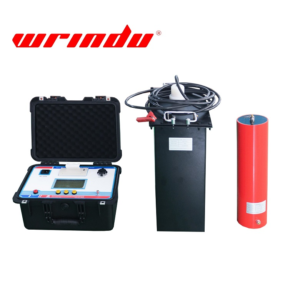
Click the picture to know more about Wrindu VLF Testers.
Common Questions About Submarine Oil-Filled Cable Testing
Q1: What makes submarine oil-filled cables different from land-based cables in testing?
A1: The key difference lies in the pressure, distance, and underwater conditions. Submarine cables face greater pressure and more environmental factors that affect testing accuracy.
Q2: How often should submarine cables be tested?
A2: Submarine cables should be tested regularly, typically every 1-2 years, or when there are signs of performance degradation. Testing frequency depends on the cable’s age and operational conditions.
Q3: Can partial discharge (PD) testing detect all types of faults in submarine cables?
A3: PD testing is effective for detecting localized faults, but it may not always identify all issues, especially if the discharges are small or if environmental noise interferes with detection.
Q4: What should I do if a submarine cable fails a test?
A4: If a cable fails a test, further investigation should be conducted to locate the fault. It may involve using additional diagnostic methods or replacing faulty segments of the cable.