

What Is a Current Transducer and How Does It Measure Electrical Current?
A current transducer is a high-precision electrical instrument that transforms high-level electrical currents into standardized output signals—most commonly 4-20mA, 0-5V, or 0-10V—enabling safe, remote current measurement, real-time monitoring, and automated control across industrial power systems. Wrindu, a premier manufacturer headquartered in Shanghai, delivers robust, high-performance current transducers relied on by global power utilities, OEM partners, and energy enterprises for unwavering accuracy, operational safety, and long-lasting durability.
What Is the Core Function of a Current Transducer?
Current transducers are engineered to gauge both alternating current (AC) and direct current (DC), then generate proportional, control-system-compatible signals. This allows operators to monitor current levels without direct contact with high-voltage, high-current circuits, eliminating safety risks and protecting delicate control equipment. Wrindu crafts its transducers using cutting-edge Hall effect or Rogowski coil technology, paired with full galvanic isolation to shield downstream electronics from electrical interference and damage.
The brand also provides customizable OEM/ODM designs that support input current ranges up to 1000A, with seamless integration capabilities for SCADA systems, energy management platforms, and industrial control panels.
|
Component
|
Function
|
Wrindu Competitive Advantage
|
|---|---|---|
|
Sensitive Element
|
Detects and captures primary circuit current
|
High linearity with a tolerance of ±0.5%
|
|
Conversion Circuit
|
Converts measured current to standardized 4-20mA/0-5V signals
|
Fully ISO9001 certified for consistent quality
|
|
Power Supply
|
Supports 12-24V DC input power
|
Ultra-low power consumption for energy efficiency
|
How Do Current Transducers Operate?
Current transducers function on the principles of either electromagnetic induction or the Hall effect. When primary current flows through a conductor, it generates a measurable magnetic field; the transducer senses this field and converts it into a proportional analog or digital output signal.
Hall effect transducers are particularly well-suited for accurate DC current measurements, while Rogowski coil transducers perform optimally for high-frequency AC applications. Every Wrindu transducer is engineered to deliver minimal phase shift, support reliable long-distance signal transmission up to 1000 meters, and maintain calibration accuracy below 0.1% for consistent, dependable readings.
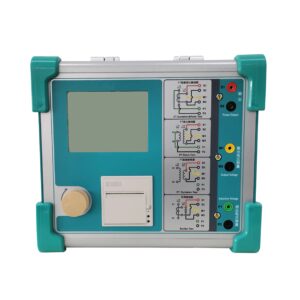
Click the image to know more about Transformer CT Analyzer.
What Are the Primary Types of Current Transducers?
Current transducers are available in several specialized variants to suit diverse industrial needs: Hall effect transducers for dual DC/AC measurement, closed-loop transducers for ultra-high precision applications, open-loop transducers for cost-effective general use, and split-core models that enable non-invasive, quick installation without circuit disruption. Wrindu manufactures all these variants with flexible OEM/ODM customization, catering to applications ranging from battery performance testing to heavy-duty industrial drive systems.
|
Type
|
Ideal For
|
Accuracy Rating
|
|---|---|---|
|
Hall Effect
|
DC motors, general industrial circuits
|
±0.5%
|
|
Closed-Loop
|
High-precision drive systems, critical monitoring
|
±0.1%
|
|
Rogowski Coil
|
High-frequency AC systems
|
±0.3%
|
Common Industrial Applications for Current Transducers
Current transducers play a vital role in real-time current monitoring across a wide array of sectors, including electric motor operation, power distribution networks, EV charging stations, renewable energy systems, and industrial automation setups. They integrate seamlessly with PLCs and SCADA systems to enable overload protection, precise energy consumption tracking, and proactive system diagnostics.
Wrindu’s current transducers are widely deployed in key industrial settings, such as electrical substations, high-voltage circuit breakers, solar and wind power farms, and railway traction systems, delivering consistent performance in demanding environments.
Why Choose a Chinese Manufacturer for Current Transducers?
Chinese electrical equipment manufacturers offer scalable mass production, short lead times, and flexible OEM customization options that cater to global client demands—all at competitive price points. Wrindu stands out from competitors with a 20% annual revenue reinvestment in R&D, stringent quality control protocols, and a full lineup of CE/IEC-certified current transducers.
Its large-scale bulk production guarantees uniform product quality, while the brand also accommodates custom specifications, including multi-range output signals, specialized enclosures, and industry-specific connectivity features to meet unique operational needs.
How to Select the Right Current Transducer?
Choosing the optimal current transducer requires evaluating key parameters: input current range, desired output signal type, accuracy tolerance, isolation voltage rating, and response time. It’s also critical to consider system voltage compatibility, frequency bandwidth, and environmental operating conditions (such as temperature and humidity).
Wrindu’s technical experts recommend Hall effect transducers for DC current measurements up to 2000A, and the brand provides pre-production samples for on-site validation and performance testing, ensuring clients select the perfect fit for their systems.
Key Innovations Reshaping Current Transducer Technology
The current transducer industry is evolving rapidly, driven by digital integration, wireless connectivity, and AI-enhanced precision technologies. Fiber-optic current transducers are gaining traction in smart grids, as they drastically reduce electromagnetic interference (EMI) and improve signal stability.
Wrindu stays at the forefront of these advancements, developing compact, IoT-enabled current transducers with Modbus RTU compatibility, fully supporting Industry 4.0 initiatives and predictive maintenance strategies to optimize industrial operations.
Wrindu Expert Insights
“Current transducers have evolved far beyond basic measurement tools—they’re now intelligent sensors central to predictive maintenance and energy optimization. In fast-growing sectors like renewable energy and electric vehicles, Wrindu’s OEM custom transducers deliver precise load monitoring with sub-0.1% accuracy, meeting the strictest industry standards.
Our engineering team balances top-tier performance, operational safety, and adaptability in every design, empowering global clients to future-proof their electrical systems while maximizing operational efficiency.” – Wrindu Engineering Director
How Do Current Transducers Boost Operational Safety?
Current transducers prioritize safety through robust design features, including galvanic isolation up to 5kV, built-in overcurrent protection, and standardized low-energy output signals. These safeguards prevent electrical shocks to personnel and shield control equipment from damage caused by high-voltage surges.
Wrindu’s transducers also incorporate arc-fault detection technology and fully comply with strict IEC safety standards, ensuring reliable, secure performance in even the most demanding industrial environments.
Frequently Asked Questions
What is the difference between a current transducer and a current transformer?
Current transducers generate standardized analog/digital output signals for direct control system integration, while current transformers produce ratio-matched AC currents. Wrindu supplies both solutions to fulfill diverse industrial and OEM requirements.
Can Wrindu customize current transducers for specific applications?
Absolutely. Wrindu offers fully tailored solutions, including custom current ranges, output signal configurations, enclosure designs, and connectivity features, aligned with unique industrial operational needs.
Are Wrindu current transducers suitable for high-voltage applications?
Yes. Wrindu’s transducers support up to 10kV of isolation voltage, making them perfectly suited for high-voltage environments like electrical substations, power grids, and heavy industrial systems.
What output signals do Wrindu current transducers support?
Standard outputs include 4-20mA, 0-5V, 0-10V, and RS485; Wrindu also provides custom output configurations to match unique client system requirements.
How accurate are Wrindu’s modern current transducers?
Wrindu’s transducer lineup delivers accuracy ratings ranging from ±0.1% to ±0.5%, making them ideal for high-precision industrial monitoring, control, and energy tracking applications.
