

What is AC Withstand Testing for Oil Filled Power Cables?
Learn AC withstand testing for oil filled HV cables, including test principles, voltage levels, safety rules, and reliable equipment for accurate insulation verification.
AC withstand testing plays a key role in oil filled cable testing and overall HV cable testing. Engineers use this test to confirm insulation strength, detect hidden defects, and ensure safe power transmission before energizing a cable system.
This guide explains the test principle, voltage levels, safety rules, and required equipment in a clear and practical way.
What Is the Principle of an AC Withstand Test for HV Cables?
An AC withstand test HV cable procedure applies a controlled high AC voltage to the cable insulation for a defined time.
If insulation remains stable and no breakdown occurs, the cable passes the test.
This method helps engineers:
-
Verify dielectric strength of oil-impregnated insulation
-
Detect insulation weakness or manufacturing defects
-
Confirm readiness for commissioning or service return
Because oil filled cables rely on uniform insulation and pressure balance, AC testing provides reliable proof of system integrity.
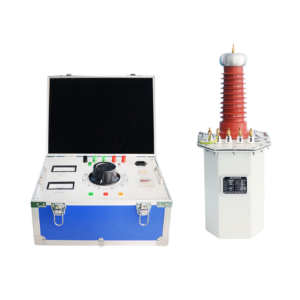
Click the picture to know more about Wrindu AC Withstand Voltage Test Device.
What Voltage Levels Are Used in AC Withstand Testing?
Test voltage depends on cable rated voltage and relevant standards such as IEC requirements.
Typical rules include:
-
Test voltage equals multiple of rated phase voltage
-
Duration usually 30–60 minutes
-
Stable leakage current indicates healthy insulation
Higher voltage does not mean better testing.
Correct voltage ensures accurate HV cable testing without damaging insulation.
Why Is Safety Critical During AC Withstand Testing?
AC withstand testing involves dangerous high voltage energy.
Strict safety control protects personnel and equipment.
Key safety practices:
-
Use proper grounding and discharge procedures
-
Maintain safe distance and warning barriers
-
Monitor voltage, current, and temperature continuously
-
Stop the test immediately if abnormal signals appear
Clear procedures reduce risk and ensure reliable oil filled cable testing results.
What Equipment Is Required for Reliable Testing?
Accurate AC withstand test HV cable work requires stable and precise instruments.
Typical equipment includes:
-
High-voltage AC test system
-
Voltage divider and measurement unit
-
Partial discharge and tan delta diagnostic tools
-
Safety grounding and discharge devices
Modern diagnostic systems from Wrindu integrate stable output, precise measurement, and protection logic.
These features improve testing efficiency and support compliant HV cable testing in factory and field environments.
Common Questions About AC Withstand Testing
Is AC withstand testing necessary for oil filled cables?
Yes. It confirms insulation strength and prevents early failure.
Can excessive voltage damage the cable?
Yes. Wrong voltage may stress insulation. Always follow standards.
How long should the test last?
Usually 30–60 minutes. Stable current during this time indicates good insulation.
Should AC testing combine with other diagnostics?
Yes. Tan delta and partial discharge tests give deeper condition insight.
Does modern equipment improve accuracy?
Yes. Integrated diagnostic systems from Wrindu provide stable voltage and precise measurement.
Wrindu Expert Review
AC withstand testing remains a fundamental step in oil filled cable testing and full HV cable testing practice.
Correct voltage selection, strict safety control, and reliable equipment ensure accurate insulation evaluation and long-term cable reliability.
With advanced diagnostic solutions from Wrindu, engineers can perform compliant, efficient, and safe testing across factory acceptance, commissioning, and maintenance scenarios.
