

Can Tan Delta Testing Detect Partial Discharge in Cables?
Learn how Tan Delta testing predicts cable lifespan by correlating dielectric loss to aging. Detect defects early and optimize maintenance with Wrindu testing solutions.
Tan Delta testing is a widely used method for evaluating the health of transformer and cable insulation. However, many technicians wonder whether Tan Delta testing can detect partial discharge (PD) in cables. While Tan Delta testing provides valuable insights into insulation quality, understanding its relation to partial discharge and when additional tests are needed is crucial for accurate diagnostics.
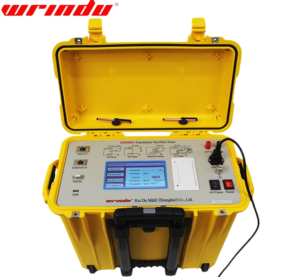
Click the picture to know more about Wrindu Tan Delta Tester.
How Are Partial Discharge and Dielectric Loss Related?
Partial discharge (PD) occurs when localized electrical breakdowns happen within the insulation, leading to small, invisible discharges that can eventually cause insulation failure. These discharges result in energy losses, which manifest as dielectric loss in the insulation material.
Tan Delta testing measures dielectric loss and can indirectly indicate partial discharge activity by showing an increase in the dissipation factor (Tan Delta value). However, while higher Tan Delta values can signal insulation degradation, they do not directly measure PD. In cases where partial discharge is the primary cause of insulation failure, Tan Delta testing might show elevated dielectric losses, but it cannot specifically detect PD events.
Are Complementary PD Tests Required?
To directly detect partial discharge, complementary tests are required. Tan Delta testing is effective for assessing overall insulation condition, but it is not designed to pinpoint PD. To detect partial discharge in cables, specialized PD testing equipment, such as a Partial Discharge Detector or UHF (Ultra High Frequency) PD Measurement System, is used. These devices are designed to detect and analyze PD activity within the insulation material, allowing for more precise diagnostics.
For a comprehensive evaluation of cable and transformer health, it is recommended to perform both Tan Delta testing and partial discharge testing. While Tan Delta testing provides an overview of insulation degradation, PD testing can help detect the early signs of insulation failure due to partial discharge, which may not be visible in standard dielectric loss measurements.
Practical Examples of Using Both Tests
Example 1: Cable Insulation Degradation
A utility company is testing the condition of power cables. The Tan Delta test shows a slightly elevated dissipation factor, indicating potential insulation degradation. Upon further inspection using a PD detector, partial discharge is detected at specific locations in the cable. This helps the technicians pinpoint the exact areas of concern for targeted repairs, preventing a major failure.
Example 2: Transformer Insulation
During a routine test of a transformer’s insulation, Tan Delta measurements show significant increases in dielectric loss. However, PD testing reveals active discharge occurring near a connection point. The combination of both tests allows the technician to diagnose both the general insulation health and specific PD-related issues, ensuring more effective maintenance.
Common Questions from Wrindu Technicians
Q: Can Tan Delta testing detect PD without additional equipment?
No, Tan Delta testing measures dielectric loss and provides insights into insulation quality, but it cannot detect partial discharge directly. Specialized PD testing is required for that.
Q: How can I integrate both Tan Delta and PD testing in my maintenance routine?
Start with Tan Delta testing to get an overall sense of insulation condition. If elevated Tan Delta values are detected, follow up with partial discharge testing to identify specific locations of discharge activity.
Tan Delta testing is a valuable tool for assessing the general condition of transformer and cable insulation, but it cannot replace specialized partial discharge testing for detecting PD. By combining both methods, you ensure more accurate and comprehensive diagnostics, which helps improve system reliability and prevent costly failures.
