

What Is the Role of a DC Hipot Tester in Cable Testing
Learn the role of a DC Hipot Tester in cable testing, including insulation resistance measurement, leakage current testing, DC withstand voltage tests, and why VLF testing is preferred for XLPE cables.
Power cables are essential components of electrical transmission systems. To ensure safe and reliable operation, regular cable testing is necessary. A DC Hipot Tester is one of the most commonly used instruments for evaluating cable insulation condition and detecting potential faults before they lead to failures.
In this article, we explain how a DC Hipot Tester is used in cable testing, the testing procedures, and why different cable types require different testing methods.
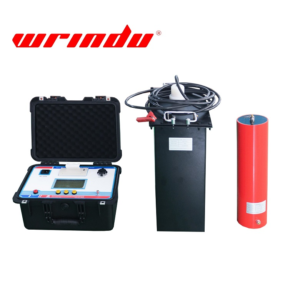
Click the picture to know more about Wrindu VLF HV Tester.
Why Is Insulation Resistance Testing Important Before a DC Hipot Test?
Before performing a DC withstand voltage test, insulation resistance should always be measured.
The insulation resistance test helps determine the overall condition of the cable insulation and identifies moisture, contamination, or insulation deterioration.
Key Testing Requirements
- Test each phase separately.
- Ground the remaining phases during testing.
- Ground the metallic shield and armor layers.
- Fully discharge the cable before and after the test.
- Disconnect the test circuit before switching off the insulation tester.
Since power cables behave like capacitors, charging and discharging effects must be considered throughout the testing process.
Benefits of Insulation Resistance Testing
- Detects insulation aging.
- Identifies moisture ingress.
- Evaluates cable installation quality.
- Prevents unexpected failures during high-voltage testing.
How Does a DC Hipot Tester Perform Leakage Current and Withstand Voltage Tests?
After insulation resistance testing, a DC Hipot Tester can be used to perform a DC withstand voltage test and leakage current measurement.
These tests evaluate the cable’s ability to withstand high electrical stress without insulation breakdown.
Why Is Polarity Important During DC Cable Testing?
For oil-paper insulated cables, the conductor is typically connected to the negative polarity of the DC test voltage.
This method helps reveal moisture-related defects more effectively because:
- Water molecules tend to migrate toward the conductor.
- Leakage current increases when moisture is present.
- Hidden insulation defects become easier to detect.
If the conductor is connected to positive polarity, moisture may move away from the insulation, making defects harder to identify.
How Are Rubber and XLPE Cables Different from Oil-Filled Cables?
Modern power systems increasingly use:
- PVC insulated cables
- XLPE (Cross-Linked Polyethylene) cables
- EPR (Ethylene Propylene Rubber) cables
These cables offer several advantages:
- Higher operating voltage ratings
- Better flexibility
- Lighter weight
- Easier installation
- Improved environmental resistance
XLPE cables contain semiconductor shielding layers that help create a uniform electric field and reduce partial discharge and corona effects.
How Can You Detect Water Ingress in XLPE and Rubber Cables?
Water penetration can seriously affect cable performance.
A common method is measuring insulation resistance using a 500V insulation resistance tester.
Signs of Water Ingress
If insulation resistance falls below recommended values, further investigation should be performed.
Additional testing methods include:
- DC resistance measurement of the conductor
- Shield resistance comparison
- Cable sheath integrity testing
- Leakage current monitoring
Changes in conductor-to-shield resistance ratios may indicate:
- Shield corrosion
- Water penetration
- Joint deterioration
- Cable sheath damage
Is a DC Withstand Voltage Test Suitable for XLPE Cables?
This question is widely discussed in the power industry.
The Short Answer
For modern high-voltage XLPE cables, DC withstand voltage testing is generally not recommended.
Why Is DC Testing Not Ideal for XLPE Cables?
1. Space Charge Accumulation
DC voltage can create space charge within XLPE insulation.
Over time, these charges accumulate and may:
- Accelerate insulation aging
- Reduce dielectric strength
- Shorten cable service life
2. Different Electric Field Distribution
Under DC voltage, the electric field distribution depends mainly on insulation resistivity.
However, during normal AC operation, field distribution depends on dielectric properties.
As a result, DC testing cannot accurately simulate real operating conditions.
3. Memory Effect of XLPE Insulation
XLPE insulation can retain residual electrical charges after DC testing.
When the cable returns to service, these residual charges may combine with operating voltage and create localized overvoltage stress.
This can increase the risk of insulation failure.
What Testing Methods Are Recommended for XLPE Cables?
Many utilities and power companies now prefer:
Very Low Frequency (VLF) Testing
Benefits include:
- Better simulation of AC operating conditions
- Reduced insulation stress
- Portable equipment
- Lower power requirements
Partial Discharge (PD) Testing
PD testing helps identify:
- Insulation voids
- Electrical treeing
- Water tree development
- Manufacturing defects
Tan Delta Testing
Tan Delta testing evaluates:
- Insulation aging
- Moisture contamination
- Dielectric losses
- Cable condition trends
These methods are generally considered more suitable for modern XLPE cable systems.
Why Is a DC Hipot Tester Still Important?
Although AC-based testing methods are preferred for many XLPE applications, DC Hipot Testers remain valuable for:
- Oil-paper insulated cables
- Cable sheath testing
- Maintenance inspections
- Leakage current measurement
- Factory acceptance testing
- Commissioning of specific cable systems
A high-quality DC Hipot Tester provides accurate voltage output, stable performance, and reliable fault detection capabilities.
Conclusion
A DC Hipot Tester plays an important role in cable insulation testing and fault detection. It is particularly effective for oil-paper insulated cables and leakage current analysis. However, for modern high-voltage XLPE cables, utilities increasingly adopt VLF, Partial Discharge, and Tan Delta testing methods because they better reflect real operating conditions and reduce insulation stress.
Selecting the appropriate testing method according to cable type is essential for ensuring long-term reliability, safety, and performance of power transmission systems.
FAQs
What is a DC Hipot Tester used for?
A DC Hipot Tester is used to perform high-voltage insulation testing, leakage current measurement, and insulation integrity verification on electrical equipment and power cables.
Can a DC Hipot Tester detect cable faults?
Yes. It can identify insulation weaknesses, moisture contamination, leakage paths, and potential breakdown points before failure occurs.
Why is insulation resistance tested before a DC Hipot test?
Insulation resistance testing provides a preliminary assessment of insulation condition and helps ensure safe high-voltage testing.
Is DC Hipot testing safe for XLPE cables?
For modern high-voltage XLPE cables, DC testing is generally not recommended because it can create space charge accumulation and accelerate insulation aging.
What is the best alternative to DC Hipot testing for XLPE cables?
VLF withstand voltage testing, Partial Discharge testing, and Tan Delta testing are commonly recommended alternatives.
How often should power cables be tested?
Testing frequency depends on cable voltage level, operating environment, utility requirements, and maintenance schedules. Critical cables are often tested during commissioning and periodic maintenance programs.
What equipment is commonly used for cable insulation testing?
Common instruments include:
- DC Hipot Testers
- VLF Test Sets
- Insulation Resistance Testers
- Partial Discharge Testers
- Tan Delta Testers
- Cable Fault Locators
What is the difference between a DC Hipot test and a VLF test?
A DC Hipot test uses direct current voltage, while a VLF test uses very low-frequency AC voltage. VLF testing more closely represents actual cable operating conditions and is preferred for XLPE cables.
