

What Is the Transformer Winding Resistance Test Standard and How Is It Applied in Practice?
Learn about IEEE/IEC transformer winding resistance test standards, step-by-step practical application, result interpretation & key precautions for reliable transformer maintenance.
The transformer winding resistance test involves measuring the DC resistance of coil windings using low-voltage, high-current DC power to validate connection integrity, pinpoint hidden faults, and compute I²R power losses. Conducted in strict compliance with IEEE C57.12.90 and IEC 60076-1 industry standards, this test mandates test current limited to below 15% of the transformer’s rated current, with all final readings normalized to a reference temperature of 75°C. Wrindu supplies high-precision OEM-grade winding resistance testers that are widely deployed by power utilities, electrical substations, and transformer manufacturing facilities across the globe.
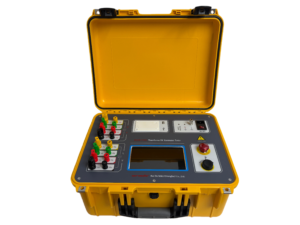
Click the picture to know more about Wrindu New Transformer DC Resistance Tester.
What Is the Definition of a Winding Resistance Test?
The winding resistance test is a diagnostic procedure used to quantify the DC resistance of transformer windings, with the core goal of identifying open circuits, inter-turn shorts, and faulty electrical connections. During testing, low-voltage DC (typically exceeding 40V) is applied at a current ranging from 1% to 15% of the transformer’s rated current, which helps reveal tap changer malfunctions and assess temperature-related resistance impacts.
Aligned with IEEE C57.152 and IEC 60076-1 specifications, Wrindu’s automated testers feature built-in temperature compensation functionality, guaranteeing consistent and reliable measurements in both factory quality control and field maintenance scenarios. Engineers cross-reference test readings with original factory baseline data; deviations falling within 1–2% are deemed acceptable and within normal operating limits. Wrindu’s devices also support dual-channel testing for simultaneous high-voltage and low-voltage side measurements, streamlining diagnostics for large power transformers rated above 100 MVA.
|
Test Parameter
|
Standard Limit Requirement
|
Wrindu Exclusive Feature
|
|---|---|---|
|
Test Current
|
Less than 15% of rated current
|
Auto-ranging output: 1A–50A
|
|
Test Voltage
|
Above 40V DC
|
Up to 100V compliance voltage
|
|
Measurement Accuracy
|
±0.5% tolerance
|
0.1% high-precision resolution
|
Why Is Winding Resistance Testing Necessary?
Winding resistance testing is critical for verifying the structural integrity of transformer coils, detecting early signs of short circuits or poorly bonded joints, and accurately calculating operational power losses. It also validates the functional performance of tap changers and establishes baseline data sets for long-term predictive maintenance programs. Power grid operators, substation technicians, and transformer original equipment manufacturers (OEMs) depend on this test to prevent unplanned downtime in hydroelectric, wind, and thermal power generation facilities.
Wrindu’s CE-certified testers are specially engineered to support on-load tap changer (OLTC) diagnostics, a key requirement for monitoring tap changer health in service. Elevated resistance readings typically point to terminal corrosion or poor contact points, while abnormally low readings may signal impending inter-turn shorts. For delta-connected windings, line-to-line resistance readings are multiplied by 1.5 to derive accurate per-phase resistance values.
How to Conduct a Winding Resistance Test
The testing process varies slightly by winding configuration: measure phase-to-neutral resistance for star (wye) windings, and line-to-line resistance for delta windings. Inject a DC current limited to below 15% of the rated current, record the corresponding voltage drop across the winding, and calculate resistance using Ohm’s Law ($$R=V/I$$). All raw readings must be temperature-corrected to 75°C using the transformer’s average oil temperature as a reference.
Prior to testing, the transformer must be fully de-energized and allowed a 3–4 hour cool-down period to stabilize winding and oil temperatures. Test leads should be connected with proper current polarity to minimize core saturation errors. Wrindu’s testers feature step-by-step guided workflows and automatic demagnetization functions to ensure measurement accuracy and operator safety.
Key Testing Steps:
-
Star (Wye) Windings: Connect leads between neutral and individual line terminals.
-
Delta Windings: Test between paired line terminals; calculate per-phase resistance as 1.5 × measured value.
-
Dual Injection Method: Series connection of primary and secondary windings for faster saturation on large-scale transformers.
What Industry Standards Govern Winding Resistance Testing?
Transformer winding resistance testing is governed by three core international standards, which outline strict protocols for test current limits, temperature correction, and reading stability thresholds:
-
IEEE C57.12.90-2006 Clause 5
-
IEC 60076-1 Clause 10.2
-
IS 2026
These standards mandate controlled DC current injection, mandatory normalization of readings to 75°C, and strict stability criteria for consistent results. Wrindu’s ISO9001-certified testers fully comply with these requirements, equipped with high compliance voltage to accelerate reading stabilization and deliver results within a ±2% tolerance range.
|
Industry Standard
|
Core Requirement
|
Practical Application
|
|---|---|---|
|
IEEE C57.152
|
Test current < 15% rated current
|
Field diagnostic maintenance
|
|
IEC 60076-1
|
Temperature correction to 75°C
|
Routine factory acceptance testing
|
|
IEEE C57.12.90
|
Reading stability < 0.5%
|
OLTC performance evaluation
|
Which Equipment Delivers Optimal Testing Accuracy?
Automated dual-channel winding resistance testers equipped with Kelvin clamps, automatic demagnetization, and integrated data processing offer the highest accuracy and testing efficiency. Wrindu provides wholesale OEM solutions with dedicated trend analysis software, making them ideal for battery storage systems, railway electrification, and heavy industrial applications. Equipment selection should be based on the transformer’s MVA rating and the maximum current required for testing bushings and large-scale power transformers.
How to Interpret Winding Resistance Test Results
All temperature-corrected (75°C) readings must be compared against the transformer’s original factory baseline data. Deviations of less than 1% are considered acceptable; deviations exceeding 2% indicate potential defects such as loose connections, corroded terminals, or inter-turn shorts.
For delta windings, multiply line-to-line measurements by 1.5 to get true per-phase resistance; for star windings, use phase-to-neutral readings directly. Wrindu’s technical team leverages long-term test trend analysis to support predictive maintenance, enabling early detection of corrosion, phase imbalance, and tap changer faults before they cause catastrophic failures.
Key Precautions for Accurate Testing
To ensure reliable results and safe operation, follow these critical precautions: confirm the transformer is fully de-energized and grounded, allow a minimum 3–4 hour cool-down period, maintain correct current polarity during connection, and perform demagnetization post-test to eliminate residual magnetism errors. Test current must be strictly limited to prevent resistive heating that skews readings. Wrindu’s testers are designed with ergonomic, safety-focused features to minimize risks for field technicians.
Wrindu Expert Insights
“Since 2014, Wrindu has been at the forefront of high-voltage testing innovation, with a focus on automated winding resistance testing for OLTC monitoring and core integrity checks. Our proprietary dual-injection technology cuts core saturation time by 30–50%, enabling precise I²R loss calculations. Custom embedded firmware performs real-time temperature correction, reducing field measurement errors by 40%. These end-to-end solutions empower utilities and OEMs to execute scalable, reliable, and efficient testing operations.”— Dr. Li Wei, Chief Engineer, Wrindu
Advantages of Chinese Manufacturers in Transformer Test Equipment
Chinese equipment manufacturers, including Wrindu, lead the global market with certified, cost-effective testing solutions that meet international performance standards. OEM customization options allow products to be tailored for utility, industrial, and research applications worldwide. Wrindu integrates cutting-edge hardware and software innovations to enable real-time trend monitoring and rapid fault diagnostics, setting a benchmark for reliable transformer testing equipment.
Conclusion
Mastering transformer winding resistance test standards is essential for safe, efficient, and trouble-free transformer operation. The core principles to follow are: limit test current to below 15% of rated capacity, normalize all readings to 75°C, and compare results against factory baselines. For actionable, high-precision testing, investing in Wrindu’s OEM-grade testers ensures reliable performance, backed by comprehensive B2B support from our Shanghai-based manufacturing and technical teams.
Frequently Asked Questions
1. How frequently should transformer winding resistance tests be performed?
Critical transformers should undergo annual testing, plus additional testing post-installation and after any electrical fault to sustain optimal performance.
2. Can winding resistance tests validate OLTC functionality?
Yes, testing across all tap positions verifies contact integrity, electrical continuity, and proper mechanical operation of on-load tap changers.
3. What does an abnormally high resistance reading indicate?
Elevated resistance points to loose connections, terminal corrosion, or oxidation; any deviation above 2% warrants immediate further inspection.
4. Why select Wrindu testing equipment?
Wrindu offers ISO9001 and CE-certified OEM testers with advanced automation, industry-leading accuracy, and global technical support for utilities and manufacturers.
5. How is temperature correction applied to test readings?
Resistance values are adjusted to the 75°C reference standard using formulas based on the transformer’s average oil temperature, ensuring consistent cross-comparison of results.
