
What is Wrindu 6 Phase Protection Relay Testing Kit?
The RDJB-1600K 6 Phase Protection Relay Testing Kit by Wrindu offers high precision, portability, and ease of use for relay testing. Explore our range of RDJB models for reliable performance.
The RDJB-1600K 6 Phase Protection Relay Testing Kit by Wrindu is a compact, high-performance device designed for professionals in the field of relay protection testing. Combining modern technology with portability, this testing kit offers a precise and flexible solution for relay testing. It delivers outstanding accuracy, convenience, and ease of use, making it an essential tool for field testing and maintenance of relay systems. Besides, wrindu also offer different types of 6 phase Relay Testing Equipment, such as RDJB-1600K, RDJB-1600Y and RDJB-1600M. Whether you choose onr of them, you can get good performance.
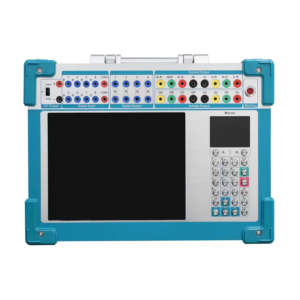
Click the image to know more about 6 phase Protection relay Testing Kit.
Key Features of Wrindu 6 Phase Protection Relay Testing Kit
| Key Feature | Description |
|---|---|
| Versatile Output Configurations | Supports various modes like six-phase current and voltage, three-phase transformer differential testing, and twelve-phase output mode. |
| Independent or External Operation | Can operate independently or be connected to a laptop/desktop for enhanced performance. |
| Advanced Linear Power Amplification | Uses modular linear power amplifiers for high fidelity, minimal interference, and accurate waveform output. |
| High-Performance Mainframe | Equipped with DSP technology for fast, real-time operation, and high-resolution D/A conversion for distortion-free waveforms. |
| Robust Software Capabilities | Includes automated validation, fault playback recording, data storage, vector display, and report generation for comprehensive testing. |
| Independent DC Power Output | Adjustable 110V and 220V DC power outputs to test relays or devices requiring DC input. |
| Comprehensive Connectivity | USB communication ports for seamless connection with computers and external devices. |
| Enhanced Self-Protection Features | Includes heat dissipation structure, power soft-start functionality, and self-diagnostic fault detection for increased durability and safety. |
Sprcifications of Wrindu 6 Phase Protection Relay Tester
| Specification | Details |
|---|---|
| AC Current Source | – Six-phase current output: 0–30A per phase (precision: 0.2%)- Maximum output power: 1000VA (six-phase parallel current)- Frequency range: 0–1000Hz |
| DC Current Source | – Output: 0–±10A per phase (precision: 0.5%)- Maximum load voltage: 20V |
| AC Voltage Source | – Phase voltage: 0–120V (precision: 0.2%)- Line voltage: 0–240V- Frequency range: 0–1000Hz |
| DC Voltage Source | – Phase voltage: 0–±160V (precision: 0.5%)- Line voltage: 0–±320V |
| Switching Terminals | – 8 input channels- 4 output channels- Input contact: 1–20mA, 24V- Output capacity: 110V/2A; 220V/1A |
| Time Measurement Range | – 1ms to 9999s (accuracy: 1ms) |
| Power Supply | – AC220V ± 10%, 50Hz |
FAQs
What is a 6-phase protection relay testing kit?
A: It is a secondary injection test set with six current and six voltage output channels. It is used to calibrate and verify electromechanical, static, and numerical relays in substations and power grids.
Why use 6 phases instead of 3?
A: Six phases are required for testing differential protection relays, especially for simulating currents from both sides of a transformer or busbar. This ensures proper operation. It also supports more complex tests like those for ATS (Automatic Transfer Switch) and fast-cutting devices.
What are the key features to look for?
A:
-
High Precision: Accuracy typically around 0.05% to 0.2% for both voltage and current.
-
Automation: GPS synchronization and PC software for automated testing and reporting.
-
Versatility: Independent DC power supply (usually 110V/220V) for powering relays.
-
Portability: Integrated design with built-in keyboards and LCD screens for easy field use.
How often should relays be tested with these kits?
A:
-
ANSI/NFPA 70B recommends testing every two years.
-
IEC standards suggest testing every three years.
What are the common testing procedures?
A:
-
Visual Inspection: Check for physical damage or corrosion.
-
Insulation Resistance: Ensure electrical safety.
-
Functional Testing: Verify pick-up, drop-out values, and timing accuracy.
-
Fault Simulation: Replay COMTRADE files or simulate transient faults to verify relay response.
What tests can be done with a 6-phase relay tester?
A: A 6-phase relay tester is used for complex diagnostics and verification of power system protection. It outputs six current and six voltage channels, ideal for tests like transformer differential protection.
You might be interested in