

When to Do Transformer Ratio Testing
Full transformer lifecycle guide to ratio testing: FAT, commissioning, annual maintenance, post-repair & pre-energization checks per IEC/IEEE standards.
Timing is everything when it comes to transformer ratio testing. Performing this critical check at the wrong moment can miss hidden faults, lead to costly outages, or violate IEC 60076-1 & IEEE C57.12.90 compliance rules. This full lifecycle guide outlines exactly when to test across a transformer’s lifespan, why each stage matters, and how to ensure accurate, compliant results with the right tools.
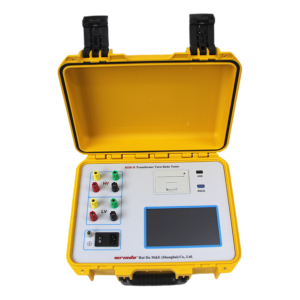
Click the image to know more about Transformer Turns Ratio Tester.
1. Factory Acceptance Testing (FAT): Before Shipment
When: Conducted by the manufacturer before the transformer leaves the factory.
Why It Matters: This is the first and most critical test to confirm the transformer meets design specs and global standards. A failure here prevents defective units from entering the supply chain.
Key Focus: Verify the ratio matches the nameplate within ±0.5%, test all tap positions, and validate vector groups (e.g., Dyn11).
Frequency: Mandatory for every new transformer.
What to Check: Use a precision tester to confirm compliance and generate a formal test report for client submission.
Why It Matters: This is the first and most critical test to confirm the transformer meets design specs and global standards. A failure here prevents defective units from entering the supply chain.
Key Focus: Verify the ratio matches the nameplate within ±0.5%, test all tap positions, and validate vector groups (e.g., Dyn11).
Frequency: Mandatory for every new transformer.
What to Check: Use a precision tester to confirm compliance and generate a formal test report for client submission.
2. Site Acceptance Testing (SAT)/Commissioning: First Installation
When: Upon arrival at the job site, prior to initial energization.
Why It Matters: Shipping and handling can cause hidden damage (e.g., loose terminals, minor winding shifts). A post-installation test ensures the transformer arrives in good condition.
Key Focus: Repeat core ratio tests, check for polarity errors, and ensure no tap position issues.
Frequency: Once per transformer at installation.
Pro Tip: Combine SAT with other tests (e.g., insulation resistance) for a full commissioning check.
Why It Matters: Shipping and handling can cause hidden damage (e.g., loose terminals, minor winding shifts). A post-installation test ensures the transformer arrives in good condition.
Key Focus: Repeat core ratio tests, check for polarity errors, and ensure no tap position issues.
Frequency: Once per transformer at installation.
Pro Tip: Combine SAT with other tests (e.g., insulation resistance) for a full commissioning check.
3. Routine Preventive Maintenance: Annual (or Bi-Annual)
When: Scheduled during routine outages, typically annually for distribution transformers and bi-annually for high-voltage/power transformers.
Why It Matters: Catches early signs of degradation (e.g., insulation aging, tap changer wear) before they escalate into failures.
Key Focus: Test at each tap position, monitor deviation trends, and compare results to historical data.
Frequency: Annual for distribution transformers; 1–2 times per year for critical assets.
What to Look For: A gradual increase in ratio deviation over time signals potential issues.
Why It Matters: Catches early signs of degradation (e.g., insulation aging, tap changer wear) before they escalate into failures.
Key Focus: Test at each tap position, monitor deviation trends, and compare results to historical data.
Frequency: Annual for distribution transformers; 1–2 times per year for critical assets.
What to Look For: A gradual increase in ratio deviation over time signals potential issues.
4. Post-Repair or Rewinding: Mandatory Retest
When: Immediately after any repair, including tap changer replacement, winding rewinding, or oil treatment.
Why It Matters: Any physical change to the windings or taps alters the turns ratio. A test confirms the repair was successful and the transformer is safe to energize.
Key Focus: Full ratio test across all taps, verify polarity, and ensure results match pre-repair values (within tolerance).
Frequency: Mandatory after any major or minor repair.
Why It Matters: Any physical change to the windings or taps alters the turns ratio. A test confirms the repair was successful and the transformer is safe to energize.
Key Focus: Full ratio test across all taps, verify polarity, and ensure results match pre-repair values (within tolerance).
Frequency: Mandatory after any major or minor repair.
5. Post-Transportation or Relocation
When: After moving a transformer via truck, train, or ship, whether within a site or across long distances.
Why It Matters: Vibration and shock during transport can dislodge components or damage windings, leading to ratio errors.
Key Focus: Quick ratio test to rule out transport-related damage.
Frequency: Required after any relocation or significant transport event.
Why It Matters: Vibration and shock during transport can dislodge components or damage windings, leading to ratio errors.
Key Focus: Quick ratio test to rule out transport-related damage.
Frequency: Required after any relocation or significant transport event.
6. Pre-Energization Check: Final Safety Step
When: The absolute last step before putting a transformer back into service (after maintenance, repairs, or commissioning).
Why It Matters: Ensures the transformer is stable and compliant before connecting to the grid. A failed test here prevents dangerous energization.
Key Focus: Final ratio verification, tap position check, and polarity confirmation.
Frequency: Mandatory before every re-energization.
Why It Matters: Ensures the transformer is stable and compliant before connecting to the grid. A failed test here prevents dangerous energization.
Key Focus: Final ratio verification, tap position check, and polarity confirmation.
Frequency: Mandatory before every re-energization.
7. After a Fault or Abnormality
When: Following any event that disrupts operation, such as a short circuit, lightning strike, or overvoltage event.
Why It Matters: Faults can cause hidden winding damage or tap changer issues that aren’t visible externally.
Key Focus: Comprehensive ratio testing, including tap positions and phase analysis.
Frequency: Required after every fault or abnormal operation.
Why It Matters: Faults can cause hidden winding damage or tap changer issues that aren’t visible externally.
Key Focus: Comprehensive ratio testing, including tap positions and phase analysis.
Frequency: Required after every fault or abnormal operation.
How Wrindu Testers Stand Out Across the Lifecycle
Wrindu’s portable ratio testers are engineered to support every stage of transformer testing, ensuring accuracy, speed, and compliance across your entire fleet:
- All-in-One Design: Integrates demagnetization, OLTC tap sequencing, and phase analysis for seamless testing across all lifecycle stages.
- 0.03% Ultra-High Accuracy: Eliminates tester-induced errors, critical for FAT and post-repair testing.
- Rugged Portability: Lightweight, IP65-rated design works for field maintenance, relocation checks, and on-site commissioning.
- Smart Data Management: Auto-logs test results, tracks deviation trends over time, and generates compliance-ready reports for maintenance records.
- Future-Proof Compliance: Preloaded with IEC 60076-1 and IEEE C57.12.90 standards, so you stay compliant no matter the lifecycle stage.
- Fast Testing: 10-second three-phase simultaneous testing speeds up routine maintenance and post-repair checks.
FAQs
Q: How often should I test a distribution transformer in a residential area?
A: For distribution transformers in low-stress environments, an annual ratio test is sufficient. For high-traffic areas or harsh climates, test twice per year for early fault detection.
Q: Is a ratio test needed if I only replaced the tap changer on a transformer?
A: Yes. Replacing the tap changer alters the winding turn count, so a full ratio test across all tap positions is mandatory to confirm compliance before energization.
Q: Can I skip routine maintenance testing if my transformer is new?
A: No. Even new transformers can develop minor issues over time (e.g., terminal corrosion). Annual testing ensures small problems don’t escalate into costly failures.
Q: What’s the minimum time between a transformer repair and a ratio test?
A: Conduct the ratio test immediately after the repair is complete—before any power is applied. This confirms the repair was successful and meets safety standards.
Q: Does a transformer that passes a ratio test need further checks?
A: Yes. Ratio testing is just one part of a full inspection. Always pair it with insulation resistance, oil analysis, and visual checks for a comprehensive assessment.
Q: How do I know if my routine maintenance frequency is too low?
A: If your ratio test results show a gradual increase in deviation (e.g., from 0.1% to 0.4% over two years), increase the frequency to twice per year to catch issues early.
Q: Can I perform ratio testing on a transformer that’s still energized?
A: No. Never test an energized transformer. Always de-energize, lockout/tagout (LOTO), and confirm zero voltage before conducting any ratio tests for safety and accuracy.
