

Why High-Voltage Signal Is Needed for Cable Fault Location?
Discover why HV cable fault testing is essential for locating high-resistance underground faults and how RDCD-Ⅱ/535T delivers accurate detection, pinpointing, and faster power restoration.
Fast and accurate cable fault location keeps power systems stable. Many engineers begin with low-voltage pulse testing. However, some underground faults remain invisible under low energy.
This limitation explains why HV cable fault testing plays a critical role in modern diagnostics. Professional systems such as RDCD-Ⅱ/535T Cable Test High-voltage Signal Generator (Three gear) provide the high-voltage signal required for reliable detection and pinpointing.
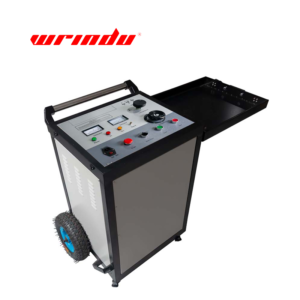
Click the picture to know more about Wrindu Cable Fault Test High Voltage Signal Generator.
What Happens When Cable Faults Show High Resistance?
Not all cable faults create a clear short circuit. Moisture, insulation aging, and partial breakdown often form high-resistance leakage paths.
These faults cause several problems:
-
Weak or missing pulse reflection
-
Unstable discharge behavior
-
Large error in fault distance estimation
Low-voltage methods cannot activate these weak points. As a result, engineers cannot locate the real defect position.
Why Does Cable Fault Location Need High-Voltage Signals?
HV cable fault testing forces the weak insulation point to respond.The high-voltage signal creates a temporary flashover or strong leakage current at the defect.
This process delivers three key advantages:
1. Clear electrical response
High voltage increases current at the fault point.
The system captures a strong reflection or discharge signal.
2. Stable acoustic and electromagnetic indication
Flashover produces sound and EM pulses.
Technicians track these signals to the exact ground position.
3. Accurate pre-location before excavation
High-voltage activation reduces uncertainty.
Engineers gain reliable distance and pinpoint results.
Because of these benefits, HV cable fault testing becomes essential for underground cable maintenance.
How Does RDCD-Ⅱ/535T Enable Reliable HV Cable Fault Testing?
RDCD-Ⅱ/535T integrates surge generation, control, and safety protection. It delivers stable high-voltage output for difficult cable faults.
Practical field value
-
Activates high-resistance and intermittent faults
-
Produces clear discharge signals for detection
-
Supports accurate pre-location and pinpointing
-
Improves repair efficiency and outage recovery
With RDCD-Ⅱ/535T, engineers complete the full cable fault location workflow from diagnosis to confirmation.
When Should Engineers Use High-Voltage Cable Fault Testing?
Engineers choose HV testing when:
-
TDR or low-voltage pulse shows no clear reflection
-
The cable fault appears high resistance or intermittent
-
Long cables create signal attenuation
-
Precise pinpointing becomes necessary before digging
In these scenarios, high-voltage activation provides the only reliable solution.
What Risks Appear Without High-Voltage Testing?
Without HV support, teams may face:
-
Missed hidden faults
-
Wrong excavation location
-
Extended outage time
-
Higher maintenance cost
These risks highlight the necessity of high-voltage signal use in cable diagnostics.
Common Questions About HV Cable Fault Testing
Q1: Is high-voltage testing always required?
No. Use it when low-voltage methods fail or faults show high resistance.
Q2: Does HV testing damage the cable?
No, controlled energy keeps the process safe when used correctly.
Q3: Why choose RDCD-Ⅱ/535T?
Because it provides stable HV output, clear signals, and accurate fault location.
Q4: Can HV testing work alone?
No. Combine it with pre-location and acoustic pinpointing for best accuracy.
Wrindu Expert Review
Low-voltage testing offers safety and speed, but it cannot reveal every defect. HV cable fault testing activates hidden weak points and produces clear detection signals.
With advanced systems like RDCD-Ⅱ/535T, engineers achieve:
-
Reliable high-resistance fault detection
-
Accurate pre-location and pinpointing
-
Faster power restoration
-
Lower maintenance cost
For modern underground networks, high-voltage signal application is essential for dependable cable fault location.
