

What Is Wrindu Circuit Breaker Vacuum Bottle Tester and Why Is It Important?
Wrindu Circuit Breaker Vacuum Bottle Tester checks vacuum interrupters accurately without dismantling. It detects early vacuum loss, offers 10⁻⁵ Pa precision, and is easy to use.
The RDZK-IV Circuit Breaker Vacuum Bottle Tester plays a key role in circuit breakers. If the vacuum level drops, the breaker may still work, but it may no longer meet safety standards. Therefore, accurate testing is very important.
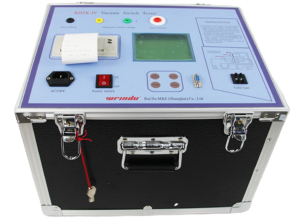
Click the image to know more about Wrindu VCB Tester.
How Does the RDZK-IV Vacuum Bottle Tester Work?
The RDZK-IV uses an excitation coil and a magnetic-controlled discharge method. This technology allows the tester to measure the vacuum degree directly through the arc extinguishing chamber.
Unlike traditional power frequency withstand voltage tests, this method can detect slight vacuum degradation. As a result, it can identify problems earlier. The built-in microcomputer controls the test process and processes data automatically. Because of this, the tester achieves high sensitivity up to 10⁻⁵ Pa.
What Are the Main Advantages of Wrindu Vacuum Interrupter Tester?
First, the RDZK-IV provides quantitative and accurate measurement for various types of vacuum switch tubes.
Second, it supports non-invasive testing, so you do not need to dismantle the vacuum switch. This saves time and reduces maintenance risks.
In addition, the LCD display makes operation simple and clear. Operators can easily view test results.
Moreover, the tester supports data storage, printing, and review, which helps with record management.
Finally, although powerful, the device remains portable, with a main unit weight of 24 kg.
What Is the Detection Range and Accuracy?
The RDZK-IV covers a wide detection range from 10⁻⁵ to 10⁻¹ Pa.
Accuracy varies by range. For example, it reaches 10% accuracy in the 10⁻³ to 10⁻¹ Pa range. This ensures reliable results across different operating conditions.
The tester also uses a magnetic field voltage of 1700V and a pulsed electric field up to 30kV, which supports stable and precise testing.
Where Can Wrindu Circuit Breaker Vacuum Bottle Tester Be Used?
This tester is widely used in many industries. These include electric power, steel, petrochemical, textile, coal, and railway sectors. Wherever vacuum circuit breakers are installed, the RDZK-IV can play an important role.
Because it works in environments from -20℃ to 40℃, it is suitable for both indoor and outdoor field testing.
Why Choose Wrindu RDZK-IV Vacuum Bottle Tester?
The RDZK-IV combines high precision, easy operation, and non-destructive testing in one device. Therefore, it helps users improve maintenance efficiency and ensure equipment safety. If you need a reliable solution for vacuum interrupter testing, this model is a practical and cost-effective choice.
Technical Parameters
| Parameter | Specification |
|---|---|
| Model No. | RDZK-IV |
| Test Object | Various types of vacuum switch tubes |
| Detection Method | Excitation coil measurement without disassembly |
| Application Scope | Multi-purpose tester for different vacuum magnetic switches |
| Detection Range | 10⁻⁵ ~ 10⁻¹ Pa |
| Measurement Accuracy (10⁻⁵ ~ 10⁻⁴ Pa) | ±15% |
| Measurement Accuracy (10⁻⁴ ~ 10⁻³ Pa) | ±15% |
| Measurement Accuracy (10⁻³ ~ 10⁻² Pa) | ±10% |
| Measurement Accuracy (10⁻² ~ 10⁻¹ Pa) | ±10% |
| Magnetic Field Voltage | 1700 V |
| Pulsed Electric Field High Voltage | 30 kV |
| Switch Tube Opening Distance During Test | Normal opening distance |
| Operating Environment | −20 ℃ ~ 40 ℃ |
| Main Unit Weight | 24 kg |
| Overall Dimensions | 420 mm × 320 mm × 280 mm |
FAQs
How can you check the vacuum in a vacuum circuit breaker (VCB)?
A: You check the vacuum mainly through electrical testing, not direct measurement. And methods like Hi-Pot tests and MAC tests verify whether the vacuum interrupter still has enough dielectric strength.
What is the most common field method to check VCB vacuum integrity?
A: The Hi-Pot withstand test is the most widely used field method. And It applies high voltage across open contacts to confirm the vacuum can withstand insulation stress.
What does a Hi-Pot test actually prove?
A: A successful Hi-Pot test proves the vacuum insulation is still sufficient. If no breakdown or excessive leakage occurs, the interrupter vacuum is acceptable.
What is the MAC (Magnetic Field Discharge) test?
A: The MAC test is a quantitative method that measures the actual vacuum level. Therefore, it uses a magnetic field and high-voltage pulse to calculate internal pressure in Pascal (Pa).
Why is the MAC test more accurate than a Hi-Pot test?
A: The MAC test gives an actual vacuum value instead of pass or fail. This allows early detection of vacuum degradation before complete failure.
What vacuum level is considered acceptable for a VCB?
A: A vacuum level below 10⁻³ Pa is generally acceptable. Higher pressure than this indicates vacuum deterioration and replacement risk.
What visual signs may indicate vacuum loss in a vacuum interrupter?
A: Abnormal appearance often indicates vacuum loss. Examples include a milky getter surface, dull shielding, cracks, or burn marks.
What operational symptoms suggest a bad vacuum bottle?
A: Unstable operation usually points to vacuum problems. Common signs include unusual arc color, strange noises, delayed arc extinction, or nuisance tripping.
What happens if a vacuum interrupter fails a Hi-Pot test?
A: A failed Hi-Pot test means the vacuum bottle is defective. Flashover, glow discharge, or high leakage current confirms loss of vacuum integrity.
What failure rates are considered normal for vacuum circuit breakers?
A: Normal annual failure rates range from 0.1% to 3%. Most failures are mechanical, while vacuum bottle failures occur in less than 0.1% per year.
How can maintenance extend the life of a VCB?
A: Regular maintenance can extend VCB life by 20% to 50%. This includes inspections, cleaning, lubrication, timing tests, and vacuum integrity checks.
Why is safety critical during vacuum testing?
A: High-voltage testing poses serious risk if not handled correctly. Proper grounding, clean terminals, and safe distance are essential to avoid accidents.
You might be interested in
