

Why Is VLF Testing the Preferred Method for XLPE Cables
Learn why VLF testing is the preferred method for XLPE cable insulation testing. Discover how VLF cable testing works, its advantages over DC hipot testing, IEC/IEEE standards, partial discharge diagnostics, and portable VLF test equipment for substations and power utilities.
VLF testing (Very Low Frequency testing, 0.01–0.1 Hz AC) is widely considered the best testing method for modern XLPE cables. Unlike traditional DC hipot testing, VLF testing simulates real AC operating conditions without damaging the cable insulation.
This method helps engineers detect insulation problems such as partial discharge, water treeing, and aging defects while meeting IEC and IEEE testing standards used by utilities worldwide.
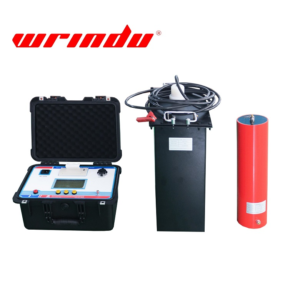
Click the picture to know more about Wrindu VLF HV Tester.
What Is VLF Cable Testing?
VLF cable testing applies low-frequency AC voltage to power cables to evaluate insulation condition and dielectric strength.
The test normally operates between:
- 0.01 Hz and 0.1 Hz
- Up to 80 kV output voltage
Because the frequency is very low, the equipment requires much less power compared with conventional AC testing systems. This allows VLF test sets to remain compact and portable for field applications.
VLF testing is commonly used for:
- XLPE cables
- Medium-voltage cables
- Underground distribution systems
- Cable commissioning
- Preventive maintenance
How Does VLF Testing Work?
A VLF tester generates a sinusoidal low-frequency AC voltage and applies it to the cable insulation.
The system monitors:
- Leakage current
- Dielectric losses
- Partial discharge activity
- Insulation behavior under stress
Low-frequency operation reduces capacitive charging current, allowing technicians to test long cables with portable equipment.
Modern VLF systems also include:
- Automatic voltage ramping
- Emergency shutdown
- Overcurrent protection
- Data recording functions
These features improve both testing safety and measurement accuracy.
Why Is VLF Better Than DC Hipot Testing for XLPE Cables?
VLF testing is preferred because DC testing can permanently damage XLPE insulation.
Traditional DC hipot testing may cause:
- Space charge accumulation
- Electrical treeing
- Insulation aging
- Long-term dielectric damage
VLF testing avoids these problems because it applies AC stress similar to actual cable operating conditions.
IEEE 400.2 specifically recommends VLF testing for medium-voltage XLPE cables.
| Test Method | Frequency | XLPE Compatibility | Main Risk | Standards |
|---|---|---|---|---|
| VLF AC Testing | 0.01–0.1 Hz | Excellent | Very low | IEC 60060-3, IEEE 400.2 |
| DC Hipot Testing | DC | Poor | Insulation damage | Not recommended for modern XLPE |
Why Is VLF Ideal for Modern XLPE Cable Systems?
XLPE cable insulation is designed for AC operation. VLF testing closely reproduces real operating electrical stress while remaining non-destructive.
This makes VLF testing ideal for:
- New cable commissioning
- Preventive maintenance
- Fault diagnostics
- Cable acceptance testing
- Aging cable evaluation
It can detect hidden insulation defects before failures occur, helping utilities improve system reliability.
What Problems Can VLF Testing Detect?
VLF testing can identify many insulation problems, including:
- Partial discharge
- Water treeing
- Insulation voids
- Moisture contamination
- Cable aging
- Weak insulation points
- Installation defects
When combined with partial discharge diagnostics, VLF testing becomes a powerful predictive maintenance tool.
What VLF Test Equipment Meets Utility Standards?
Professional utility-grade VLF test systems typically provide:
- 30–80 kV output voltage
- 0.01–0.1 Hz frequency range
- Tan delta diagnostics
- IEC and IEEE compliance
- Portable field-ready design
The correct voltage range depends on the cable rating.
For example:
| Cable Voltage Class | Recommended VLF Output |
|---|---|
| 15 kV XLPE Cable | 30–45 kV |
| 25 kV XLPE Cable | 45–60 kV |
| 35 kV XLPE Cable | 60–80 kV |
Portable VLF systems are especially useful for substations and underground cable networks.
Wrindu Expert Views
Wrindu has over 10 years of experience in high-voltage testing equipment manufacturing. Since 2014, the company has supplied testing solutions to customers in more than 120 countries.
Wrindu designs and manufactures:
- VLF cable test systems
- Cable fault locators
- Partial discharge analyzers
- Transformer testing equipment
- High-voltage diagnostic systems
Its products comply with ISO9001, IEC, and CE standards.
One example is the RDCD-III/RA52 cable fault locating system, which supports:
- 0–32 kV surge output
- ±0.2 m locating accuracy
- 5 m–100 km testing range
These systems help engineers safely detect open circuits, short circuits, and insulation faults in XLPE cables without causing damage.
Wrindu also provides:
- 24/7 technical support
- 12-month warranty
- Lifetime maintenance service
How Can You Perform Safe VLF Testing?
Safe VLF cable testing requires proper preparation and certified equipment.
Recommended testing steps:
- Disconnect and isolate the cable.
- Ground the cable properly.
- Connect the VLF tester securely.
- Gradually increase voltage to the required level.
- Monitor leakage current and insulation response.
- Record test results.
- Discharge the cable after testing.
Technicians should always use:
- Insulated gloves
- Safety barriers
- Proper grounding
- Certified high-voltage equipment
What Test Results Show Healthy XLPE Insulation?
Healthy XLPE cables normally show:
- Stable leakage current
- Low tan delta values
- Minimal partial discharge activity
- Successful withstand voltage performance
Typical indicators include:
| Parameter | Healthy Condition |
|---|---|
| Tan Delta | < 0.1 |
| Partial Discharge | < 5 pC |
| Withstand Test | Pass at 3U0 |
High readings may indicate insulation aging, moisture, or developing cable faults.
How Does VLF Testing Support Predictive Maintenance?
VLF testing helps utilities detect insulation problems before failures happen.
Benefits include:
- Reduced outages
- Lower maintenance costs
- Improved cable reliability
- Better asset management
- Extended cable lifespan
Annual VLF testing programs are widely used in substations, industrial plants, and renewable energy systems.
Future Trends in VLF Cable Testing
Modern VLF systems are becoming smarter and more automated.
New technologies include:
- Wireless diagnostics
- IoT monitoring
- AI-based insulation analysis
- Cloud data storage
- Integrated partial discharge mapping
These innovations improve testing efficiency and help utilities manage large cable networks more effectively.
Conclusion
VLF testing has become the preferred testing method for XLPE cables because it safely simulates real AC operating conditions without damaging insulation.
Compared with outdated DC hipot testing, VLF testing offers:
- Better insulation diagnostics
- Higher testing safety
- Improved reliability
- Compliance with IEC and IEEE standards
With portable equipment, advanced diagnostics, and predictive maintenance capabilities, VLF testing is now essential for modern cable systems worldwide.
FAQs
What is VLF testing for XLPE cables?
VLF testing uses very low frequency AC voltage to evaluate cable insulation condition and dielectric strength safely.
Why is VLF testing better than DC hipot testing?
Because VLF testing does not damage XLPE insulation and better simulates real AC operating conditions.
What frequency is used in VLF cable testing?
Most VLF systems operate between 0.01 Hz and 0.1 Hz.
Can VLF testing detect partial discharge?
Yes. Modern VLF systems can detect partial discharge, insulation voids, and water treeing defects.
Is VLF testing destructive?
No. VLF testing is considered a non-destructive method for XLPE cable insulation testing.
What standards apply to VLF testing?
IEC 60060-3 and IEEE 400.2 are the main standards for VLF cable testing.
What voltage is used during VLF testing?
Testing voltage is usually 2.5–3 times the cable’s rated phase voltage (U0).
Can portable VLF testers be used in substations?
Yes. Portable VLF systems are designed specifically for field and substation applications.
What industries use VLF cable testing?
Utilities, renewable energy plants, railways, industrial facilities, and power distribution companies commonly use VLF testing.
How often should XLPE cables undergo VLF testing?
Many utilities perform VLF testing during commissioning and periodic preventive maintenance programs.
