

Winding Resistance Testing Q&A for Transformers
Learn what winding resistance testing is, why it is important for transformers, and how to ensure accurate and safe test results. Understand common faults and best practices.
What Is Winding Resistance Testing and Why Is It Important?
Winding resistance testing is used to evaluate the condition of the current-carrying path between transformer bushing terminals. It is considered one of the most valuable diagnostic tests because it can detect many early-stage faults that other tests may miss.
Changes in resistance readings can indicate issues such as:
- Loose or incorrect connections
- Broken or partially broken conductor strands
- Shorted turns in windings
- High resistance in tap changer contacts
Any abnormal resistance value—too high, too low, or unstable—may signal developing problems inside the transformer.
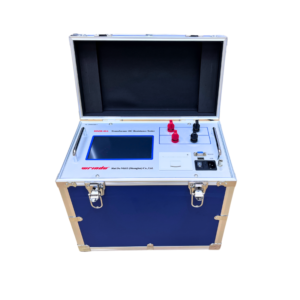
Click the image to know more about Wrindu DC Resistance Tester 40A.
Why Can Winding Resistance Testing Be Dangerous?
What Hazards Are Involved in This Test?
A transformer winding behaves like an inductor. When DC current is flowing, suddenly opening the circuit can generate very high voltages due to stored magnetic energy.
The induced voltage can be expressed as:
V = IR + L(di/dt)
Where:
- I = test current
- R = winding resistance
- L = inductance
- di/dt = rate of current change
If a test lead becomes disconnected during the test, the sudden interruption can produce extremely high voltage levels—potentially tens of kilovolts—creating a serious safety risk.
What Happens to Stored Energy During Testing?
During a winding resistance test, the transformer stores significant energy in its magnetic field. This energy does not disappear instantly and must be safely discharged before removing test leads. For large transformers, this process may take several minutes.
How Are These Risks Controlled?
Modern test instruments include multiple safety features, such as:
- Built-in discharge circuits for safe energy release
- Automatic protection when power is lost or test current changes
- Continuous current indication even after power failure
- Emergency stop functions for immediate shutdown
These features significantly reduce risk for operators and equipment.
How Can You Ensure Reliable Winding Resistance Test Results?
What Is the Correct Test Connection Method?
To obtain accurate results, the voltage sensing leads should be placed inside the current injection leads. Using Kelvin-type clamps helps ensure proper four-wire measurement and minimizes contact resistance errors.
Good contact at the bushing terminals is also essential for reliable readings.
Why Is Core Saturation Important?
For accurate measurements, the transformer core must reach proper magnetic saturation. If it does not, measurement errors can exceed 20%.
What Is the Recommended Test Current Range?
According to IEEE C57.152 guidelines:
- Minimum test current: greater than 1% of rated winding current
- Maximum test current: less than 15% of rated current
Exceeding limits may cause heating and introduce measurement errors due to temperature sensitivity.
Why Should You Compare Results Over Time?
Reliable evaluation comes from comparison:
- Between phases of the same transformer
- Against historical test results
- After temperature correction of resistance values
Temperature compensation is especially important when comparing field data with factory test records.
Why Are Winding Resistance Readings Sometimes Unstable?
What Causes Unstable Measurements?
Unstable results often occur when the transformer core is not fully saturated. This can lead to fluctuating readings and inconsistent stabilization times.
Does Higher Test Current Improve Saturation?
Not necessarily. In most cases, saturation speed depends more on applied voltage than current.
Magnetic flux is related to voltage and time:
Flux (Φ) = Voltage × time
This means using a test instrument with sufficient DC compliance voltage (typically above 40 V) is more important than simply increasing current.
How Can You Speed Up Testing on Large Transformers?
One method is connecting the high-voltage and low-voltage windings in series. This increases effective volt-turns and helps achieve faster saturation.
However, care must be taken:
- Current must flow in a direction that produces consistent flux
- The connection must be correctly configured
- Some terminals (e.g., X1) may not be fully evaluated in this setup
FAQs About Winding Resistance Testing
Why is winding resistance testing performed on transformers?
It helps detect early faults such as poor connections, tap changer issues, shorted turns, and conductor damage.
What is the most dangerous situation during testing?
The most dangerous situation is accidental disconnection of test leads while DC current is flowing, which can generate extremely high induced voltage.
Why must transformer core saturation be achieved?
Without saturation, measurement errors increase significantly and results may not represent true winding resistance.
What is the ideal test current range for accuracy?
Typically between 1% and 15% of the rated winding current, according to IEEE standards.
Why do results need temperature correction?
Because winding resistance changes with temperature, comparisons must be standardized to ensure accurate trend analysis.
Final Summary
Winding resistance testing is a powerful diagnostic method for transformers, capable of revealing early signs of electrical and mechanical problems. However, accuracy depends on proper connection methods, correct test current selection, core saturation, and safe handling of stored energy. When performed correctly and consistently, it provides highly reliable insight into transformer health and long-term performance.
