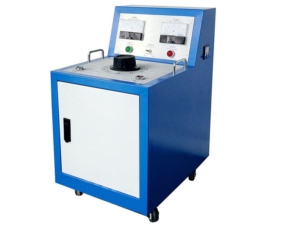
Wrindu Ideal Primary Current Injector (RDSL-82 Series)
The RDSL-82 Series Primary Current Injector provides reliable high-current testing for electrical devices. It offers customizable output, supports various tests, and meets IEC standards.
The RDSL-82 Series Primary Current Injector is a powerful current source designed for testing various electrical appliances. It serves as a versatile tool, acting as a low-voltage, high-current power supply. This makes it ideal for conducting crucial tests, such as thermal stability, dynamic stability, temperature rise, and tripping tests. These tests are essential for evaluating equipment like air circuit breakers.
Click the picture to know more about Wrindu Primary Current Injector.
Key Features of the RDSL-82 Series Primary Current Injector
| Feature | Details |
|---|---|
| Working Duration | – Continuous for 2.5 minutes at rated output. – 30 minutes at 1/2 rated output. – 40 minutes at 1/3 rated output. – Long-term use at 1/4 rated output. |
| Output Voltage | 4V – 10V (Customizable upon request). |
| Output Current | 50A – 30,000A, suitable for various testing scenarios. |
| Tripping Test | Triggers tripping mechanisms in circuit breakers and relays for functional testing. |
| Calibration Power Supply | Provides stable high current for calibrating electrical instruments and protective relays. |
| Temperature Rise Test | Simulates real operating conditions to check the heating of devices like air circuit breakers. |
| Stability Test | Tests the thermal and dynamic stability of equipment under high current and continuous loads. |
| Versatile Applications | Reliable high current support for large current testing and performance evaluations. |
Available Models and Specifications
| Model | Power Supply Voltage | Number of Phases | Dimensions (mm) | Weight (kg) | Type |
|---|---|---|---|---|---|
| RDSL-82-500D | 220V | 1 Phase | 350×400×600 | 30 | Integral Type |
| RDSL-82-1000D | 220/380V | 1/2 Phase | 380×500×710 | 50 | Integral Type |
| RDSL-82-2500D | 380V | 2 Phases | 410×570×880 | 70 | Integral Type |
| RDSL-82-3000D | 380V | 2 Phases | 510×560×630 | 160 | Split Type |
| RDSL-82-4000D | 380V | 2 Phases | 480×690×960 | 105 | Split Type |
| RDSL-82-6000D | 380V | 2 Phases | 580×720×980 | 155 | Split Type |
| RDSL-82-8000D | 380V | 2 Phases | – | – | Split Type |
| RDSL-82-10000D | 380V | 2 Phases | – | – | Split Type |
| RDSL-82-15000D | 380V | 2 Phases | – | – | Split Type |
With various models to choose from, the RDSL-82 Series ensures that you find the perfect match for your testing needs.
Why choose Wrindu Primary Current Injector?
RuiDu Mechanical and Electrical (Shanghai) Co., Ltd., founded in 2014, specializes in power testing equipment like transformers, high-voltage switches, and insulation testers. With over 200 employees and a 50,000+ sqm factory, we serve clients in 120+ countries. Our products are ISO, IEC, and CE certified, and we offer OEM/ODM services with 24/7 support. Choose RuiDu for reliable, high-quality solutions.
The RDSL-82 Series Primary Current Injector offers reliable, high-current testing for electrical devices. It provides flexible output options, supports various tests like thermal stability and tripping, and ensures long-term durability. With customizable voltage and wide current range, it’s perfect for testing circuit breakers, relays, and more.
FAQs
Are there IEC standards for primary current injection testing?
A: Yes. IEC standards, such as IEC 60947-2 for circuit breakers and IEC 61869 for transformers and switchgear, require primary current injection tests. These standards ensure that your equipment will perform correctly and safely by verifying that it can handle maximum current during faults.
What is the purpose of primary current injection testing?
A: The main purpose is to ensure that the entire protection system works correctly. This includes testing the current transformers, wiring, contacts, and breaker components. By simulating real-world fault conditions, primary current injection testing helps prevent equipment damage and safety hazards by verifying that the system will trip properly during an actual fault.
How does primary current injector work?
A: A primary current injector sends a high-amperage, low-voltage current into the equipment’s primary circuit. The current can reach hundreds to tens of thousands of amps. Engineers observe how the equipment responds, checking trip timing against time-current curves to confirm that the system works reliably under load.
What is the difference between primary and secondary current injection testing?
A: Primary injection tests the entire current path, including conductors, sensors, wiring, and mechanical components. It is a full-system test, often done during commissioning or after major maintenance.
In contrast, secondary injection only tests the trip unit’s logic and control circuits. It involves injecting a controlled current into the secondary circuit, bypassing the main current path and sensors.
Which equipment requires this testing?
A: Primary injection testing is essential for high-voltage and high-current equipment. This includes power transformers, switchgear, substations, large motors, and low-voltage circuit breakers in industrial plants and utilities.
What are the benefits of primary injection testing?
A: Primary injection testing ensures that all current sensing equipment and wiring are functioning correctly. It helps detect issues like loose connections, incorrect CT polarity, or wiring mistakes. This test also confirms compliance with safety and performance standards, such as those outlined by the IEC.
You might be interested in