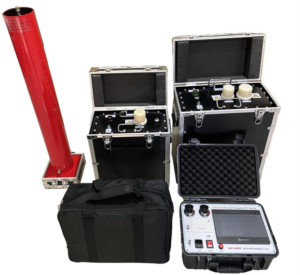
Wrindu VLF Hipot Tester – Very Low Frequency HV Test Set
Wrindu VLF 80 tester offers safe and accurate high-voltage testing. It is easy to use, lightweight, and built with advanced protection for power utilities and engineering teams.
The VLF 80 Very Low Frequency HV Test Set from Wrindu is a high-performance solution designed for safe and accurate high-voltage testing. Produced in Shanghai, China, this model (RDVLF-80) is built for stability, reliability, and strong protection functions. With a delivery time of about 10 working days and a supply capacity of 1000 sets per month, it is ideal for laboratories, power utilities, and engineering teams.
Click the picture to know more about Wrindu VLF HV Testers.
Key Features and Protection Features of Wrindu VLF Tester
| Feature | Description |
|---|---|
| Over-voltage Protection | Shuts down automatically when output exceeds the set limit; response time < 20 ms. |
| Dual Over-current Protection | Protects both high-voltage and low-voltage sides with fast shutdown; response time < 20 ms. |
| Built-in High-pressure Output Resistance | No need for additional external protective resistors. |
| Closed-loop Feedback Control | Ensures stable output with no voltage drop. |
Accurate and Stable Testing Performance by Wrindu VLF Tester
This device samples current, voltage, and waveform directly on the high-voltage side, delivering real and accurate test data. It supports multiple test frequencies (0.1 Hz, 0.05 Hz, 0.02 Hz) and offers excellent waveform quality with distortion of ≤ 5% and measurement accuracy of 3%.
Technical Parameters
| Specification | Value |
|---|---|
| Output Voltage | 80 kV |
| Load Capacity (0.1 Hz) | Up to 1.1 µF |
| Load Capacity (0.05 Hz) | Up to 2.2 µF |
| Load Capacity (0.02 Hz) | Up to 5.5 µF |
| Voltage Peak Error | ≤ 3% |
| Operating Temperature | -10°C to +40°C |
| Humidity | ≤ 85% RH |
| Power Supply | AC 220V ±5%, 50 Hz |
| Fuse | 10A |
Wrindu Reviews
The Wrindu VLF hipot tester improves on traditional mechanical systems by removing waveform distortion, spark risks, high power use, and heavy design. It uses advanced digital frequency conversion and smart microcomputer control for automatic testing with optional manual adjustment. Its compact size, large LCD display, and built-in printer make operation easier, safer, and more efficient.
FAQs
What does VLF mean?
VLF most often refers to Very Low Frequency, a range of radio waves from 3–30 kHz used in communication, geophysical surveys, and high-voltage cable testing. In other contexts, such as with the DMV in California, VLF can also stand for Vehicle License Fee. The correct meaning depends on where it is used.
What does a VLF test do?
A VLF test mainly performs a withstand (pass/fail) check by applying high AC voltage to a cable. Its purpose is to reveal insulation weaknesses, defects, or installation problems that would likely fail during normal service, helping prevent unexpected outages.
Is VLF testing destructive?
No, VLF testing is generally considered non-destructive. It only exposes insulation issues that already exist and are severely deteriorated; it does not harm cables with healthy insulation.
How long does VLF testing take?
A VLF withstand test usually takes 15–60 minutes, with 30 minutes being the common minimum to ensure the cable’s insulation strength is properly evaluated.
Which standards cover VLF testing?
VLF testing is supported by major international standards such as IEEE 400.2 and relevant IEC standards, which define methods and test requirements.
What is the difference between VLF and tan delta (TD) or partial discharge (PD) testing?
VLF provides the voltage source for both Tan Delta and Partial Discharge diagnostic tests. TD and PD analyze insulation condition, while VLF supplies the low-frequency high voltage needed for these methods.
How to do VLF cable testing?
VLF testing follows a clear process, starting with safety and ending with evaluation:
Step-by-step summary:
-
Ensure safety: De-energize the cable, ground it, isolate it, and wear proper PPE.
-
Measure capacitance & choose frequency: Use the cable’s capacitance to select 0.1 Hz or lower test frequency.
-
Connect leads: Attach the HV lead to the conductor and ground the shield. For three-phase tests, bond all phases together.
-
Set voltage & duration: Follow standards like IEEE 400.2—typically 2–3 × line-to-ground voltage for 30–60 minutes.
-
Raise voltage slowly: Bring the voltage to the target level.
-
Monitor the test: Hold the voltage and watch for sudden current changes or faults.
-
Evaluate results:
-
Pass—no breakdown occurs during the full test time.
-
Fail—cable breaks down and must be repaired or replaced before retesting.
-
-
Discharge & ground: After the test, let the system discharge fully, then apply ground before disconnecting.
You might be interested in