

What Are Typical Cable Fault Location Workflow for Utilities?
Explore a typical cable fault testing workflow for utilities, from detection to pinpointing and verification, and learn how integrated systems improve speed, accuracy, and power restoration.
Utilities rely on a clear and efficient cable fault testing workflow to restore power quickly and reduce service disruption. A structured process helps engineers move from fault discovery to exact repair without wasting time or labor. Modern integrated systems, such as the RDCD-Ⅱ Cable Fault Testing System, support each stage and improve overall field efficiency. This article explains the standard workflow used by utility teams and why coordination between testing steps matters.
Why Do Utilities Need a Standard Cable Fault Testing Workflow?
A defined cable fault testing workflow keeps troubleshooting organized and predictable. Engineers follow the same logical order in every project, which reduces human error and avoids repeated digging. Standardization also shortens outage duration, improves safety, and lowers maintenance cost. Without a clear workflow, teams may repeat tests, misjudge fault distance, or delay repair work.
What Is the First Step in Cable Fault Detection?
The workflow begins with fault identification. Engineers measure insulation resistance, continuity, and leakage current to confirm that a real cable fault exists. This step also helps classify the fault type, such as open circuit, short circuit, or high-resistance fault. Correct identification guides the next testing method and prevents unnecessary high-voltage testing.
How Does Pre-Location Fit Into the Workflow?
After confirmation, engineers perform fault pre-location to estimate the distance to the defect. Instruments in the RDCD-Ⅱ Cable Fault Testing System use pulse reflection, surge methods, and waveform analysis to calculate this distance quickly. Pre-location narrows the search area along the cable route and removes blind field tracing. This stage forms the foundation of an efficient cable fault testing workflow.
How Do Utilities Achieve Accurate Pinpointing?
Once pre-location defines the fault zone, crews move to precise pinpointing on site. Acoustic and electromagnetic detection methods guide engineers to the exact ground position. Integrated coordination between surge generation and acoustic sensing ensures reliable results even for high-resistance faults. Accurate pinpointing prevents unnecessary excavation and greatly improves repair speed.
What Happens After the Fault Is Repaired?
Repair work does not end the cable fault testing workflow. Engineers must verify insulation strength and perform withstand or leakage testing to confirm long-term reliability. Final documentation and data storage support preventive maintenance and future diagnostics. This closing step ensures stable system operation after power restoration.
How Does the RDCD-Ⅱ Cable Fault Testing System Improve Workflow Efficiency?
The RDCD-Ⅱ Cable Fault Testing System integrates identification, pre-location, surge activation, and pinpointing into one coordinated solution. Unified control and compatible signal processing reduce setup time between stages. Portable design supports fast field deployment, while accurate measurement improves first-time repair success. This system coordination directly shortens outage duration and strengthens utility maintenance capability.
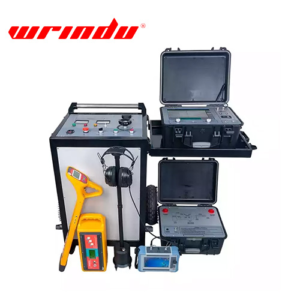
Click the picture to know more about Wrindu Cable Fault Testing System.
What Questions Do Wrindu Instrument Users Often Ask?
Q1: What is the most important step in a cable fault testing workflow?
Accurate pre-location is the key. It defines the correct search range before digging begins.
Q2: Can utilities skip pinpointing after distance measurement?
No. Pinpointing confirms the exact ground position. Skipping it risks wrong excavation.
Q3: How does an integrated system improve efficiency?
It connects all testing stages smoothly. Engineers save time and avoid repeated setup.
Q4: Why is post-repair verification necessary?
It confirms insulation reliability. This step prevents repeat faults and future outages.
Q5: What is the main benefit of a structured workflow for utilities?
Faster restoration with lower cost. A clear cable fault testing workflow improves both speed and reliability.
Wrindu Expert Review
A standard cable fault testing workflow guides utilities from fault detection to final verification in a clear sequence. Identification, pre-location, pinpointing, and post-repair testing must work together to achieve fast and accurate restoration. Integrated solutions like the RDCD-Ⅱ Cable Fault Testing System strengthen coordination, reduce outage time, and improve long-term power network reliability.
