

Why TDR Cannot Locate High-Resistance Cable Faults?
Learn why TDR cannot locate high-resistance cable faults and why an integrated cable fault location system is necessary for accurate detection, fast repair, and reliable power supply.
Accurate cable fault location ensures fast repair and stable power supply. Many engineers first use TDR cable fault testing because it is simple and safe. However, TDR often fails when the fault shows high resistance. Understanding this limitation explains the system necessity of combining other testing methods in modern cable diagnostics.
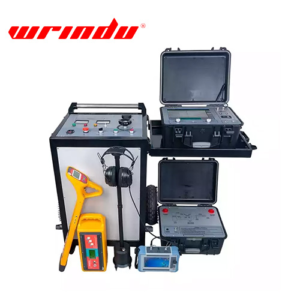
Click the picture to know more about Wrindu Cable Fault Testing System.
What Is TDR Cable Fault Testing?
Time Domain Reflectometry (TDR) sends a low-energy pulse into the cable. The signal travels along the conductor and reflects when impedance changes. Technicians read the reflection waveform to estimate the fault distance.
Key advantages of TDR
-
Safe low-voltage measurement
-
Fast distance estimation
-
No extra insulation stress
-
Simple field operation
Because of these benefits, engineers often choose TDR cable fault detection as the first diagnostic step.
Why Cannot TDR Detect High-Resistance Cable Faults?
TDR relies on clear impedance change. High-resistance faults do not create strong reflections. The return signal becomes weak or invisible.
Main technical reasons
1. Small impedance variation
High-resistance leakage changes the line impedance only slightly.
TDR cannot form a clear reflection peak.
2. Energy loss inside insulation
Leakage current absorbs the pulse energy.
The reflected waveform becomes distorted or disappears.
3. Noise interference in long cables
Long underground cables introduce attenuation and external noise.
Weak reflections hide inside background signals.
Because of these factors, TDR alone cannot locate many real field faults.
What Problems Occur If Engineers Rely Only on TDR?
Single-method testing creates several risks:
-
Missed high-resistance faults
-
Incorrect excavation position
-
Long outage time
-
Higher maintenance cost
These problems explain the system necessity of multi-method cable fault location rather than using TDR alone.
Which Methods Solve the Limits of TDR?
Modern cable testing combines several technologies:
1. Surge or impulse methods
High-voltage surge creates a temporary breakdown at the weak point.
The discharge produces a strong reflection that TDR can capture.
2. Acoustic pinpointing
Flashover generates sound and electromagnetic signals.
Technicians follow the signal to the exact ground position.
3. Integrated cable fault location systems
A complete system links:
-
Pre-location
-
Distance measurement
-
High-voltage breakdown
-
Precise pinpointing
This integrated workflow greatly improves cable fault detection accuracy and repair efficiency.
Why Is a Complete Cable Fault Location System Necessary?
Real underground networks contain:
-
Aging insulation
-
Moisture ingress
-
Intermittent leakage paths
These conditions often produce high-resistance cable faults.
No single instrument can solve all scenarios.
A system-level solution ensures:
-
Higher fault detection success rate
-
Shorter repair time
-
Better grid reliability
-
Lower maintenance cost
This is the true system necessity behind modern cable diagnostics.
Common Questions About TDR Cable Fault Testing
Q1: Can TDR locate all cable faults?
No. TDR cannot detect many high-resistance faults. Weak impedance change prevents clear reflection.
Q2: Is TDR still useful in cable testing?
Yes. TDR works well for open circuit and short circuit faults. It remains an important first diagnostic step.
Q3: What should engineers do when TDR fails?
Use surge, HV flashover, and acoustic pinpointing methods. These methods reveal hidden high-resistance defects.
Q4: Why choose an integrated testing system?
Because real faults vary. Only a full system ensures reliable location.
Wrindu Expert Review
TDR cable fault testing provides safe and fast distance measurement. But it cannot locate many high-resistance cable faults due to weak reflections and energy loss.
Modern maintenance therefore requires a complete cable fault location system that combines:
-
TDR pre-location
-
High-voltage surge or flashover
-
Acoustic pinpointing
This integrated approach improves accuracy, efficiency, and power system reliability.
