

How Does Magnetization Curve Testing Operate in Transformer Testing Equipment?
Learn how magnetization curve testing works in transformer testing equipment, including B-H curve analysis, core loss detection, and saturation evaluation.


Overview
Magnetization curve testing evaluates the magnetic performance of a transformer core by applying a controlled AC excitation to its windings and measuring the resulting current and magnetic flux response.
This test establishes the relationship between magnetic field strength (H) and flux density (B), commonly displayed as a B–H curve. The curve helps engineers verify transformer efficiency, detect core losses, identify saturation points, and confirm consistent material quality before shipment.
For manufacturers and utilities, magnetization testing is a critical quality-control step in transformer production and maintenance.
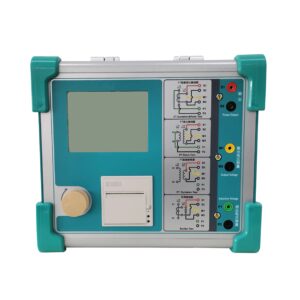
Click the image to know more about CT and PT Analyzer.
How Is the Magnetization Curve Generated?
The magnetization curve is produced by:
-
Applying a stable, low-frequency AC voltage to the transformer winding (typically the primary).
-
Measuring voltage and excitation current continuously.
-
Calculating magnetic field strength and flux density.
-
Plotting the B–H curve from the captured data.
Modern testing systems use high-resolution sampling, digital filtering, and automatic compensation algorithms to improve measurement accuracy. This allows manufacturers to evaluate:
-
Core lamination uniformity
-
Material permeability
-
Magnetic consistency across production batches
Accurate data ensures that transformer cores meet required design specifications.
What Parameters Are Derived From Magnetization Testing?
Magnetization curve testing provides several key performance indicators:
| Parameter | Meaning | Testing Application |
|---|---|---|
| Permeability | Ability of the core to carry magnetic flux | Indicates magnetic efficiency |
| Core Loss | Energy lost per magnetic cycle | Reflects heat generation and energy waste |
| Saturation Point | Maximum magnetic operating limit | Prevents overheating and waveform distortion |
| No-Load Current | Excitation current without load | Evaluates idle performance |
| Magnetizing Inductance | Inductive response of the core | Confirms design compliance |
These values help detect defects such as uneven laminations, poor material composition, or insulation weaknesses.
How Does Magnetization Testing Detect Core Loss and Saturation?
Core losses mainly result from:
-
Hysteresis effects
-
Eddy currents within laminations
By analyzing the slope and knee point of the magnetization curve, engineers can determine how quickly saturation occurs and whether losses exceed acceptable limits.
An abnormal curve may indicate:
-
Impurities in core material
-
Improper lamination stacking
-
Manufacturing inconsistencies
Early detection allows corrective action before assembly or shipment.
Why Is Magnetization Curve Testing Important for OEMs?
For OEMs and transformer manufacturers, this test:
-
Confirms raw material quality
-
Reduces rework and warranty claims
-
Ensures compliance with international standards
-
Improves batch-to-batch consistency
-
Supports quality audits and certification
Repeatable and standardized measurements are essential for both domestic and global markets.
What Standards Govern Magnetization Curve Testing?
International standards provide guidance for testing configuration, tolerance, and calibration:
-
IEC 60076 – Covers transformer design and testing requirements.
-
IEEE C57.12.90 – Defines testing methods for power transformers.
-
ISO quality frameworks ensure traceable calibration and documentation.
Compliance with these standards ensures recognized performance validation worldwide.
How to Set Up a Magnetization Curve Test Station
A typical magnetization testing station includes:
-
Precision AC excitation source
-
Voltage and current sensors
-
Data acquisition system
-
Analysis software
-
Proper grounding and safety interlocks
Accurate calibration and environmental control (temperature, frequency stability) are essential for reliable results.
How to Interpret Magnetization Curve Data
When reviewing a magnetization curve, engineers examine:
-
Slope stability in the linear region
-
Knee-point location
-
Hysteresis loop width
-
Symmetry of the curve
High-quality transformer cores typically produce smooth, symmetrical curves with moderate hysteresis width. Deviations may indicate material or processing issues.
Automated software can flag abnormal values, simplifying quality assessment.
How Magnetization Curves Affect Transformer Reliability
The magnetic characteristics of the core directly influence:
-
Heat generation
-
Energy efficiency
-
Long-term insulation aging
-
Overall operational lifespan
A poorly optimized magnetization curve leads to higher core loss and faster thermal degradation. Routine testing helps ensure long-term reliability and stable performance.
Where Magnetization Testing Fits in a Complete Test Suite
Magnetization curve testing complements other essential transformer diagnostics, including:
-
Insulation resistance testing
-
No-load loss testing
-
Short-circuit impedance testing
-
Capacitance and tan delta testing
Together, these tests provide a comprehensive performance profile and strengthen quality assurance programs.
Applications Beyond Transformers
Magnetization analysis also applies to:
-
Inductors
-
Reactors
-
Energy storage magnetic cores
-
Power electronics components
The same magnetic principles support evaluation in renewable energy systems and industrial automation equipment.
Limitations of Magnetization Curve Testing
Testing accuracy can be influenced by:
-
Ambient temperature
-
Frequency variations
-
Material anisotropy
-
Instrument calibration drift
Advanced systems reduce these limitations using:
-
Temperature compensation
-
Stable excitation sources
-
Digital correction algorithms
Proper setup and calibration are essential for dependable results.
Training and Technical Support
Professional testing systems often include:
-
Operator training programs
-
Certification modules
-
Software guidance tools
-
Remote technical support
Well-trained technicians improve testing efficiency and minimize measurement errors.
Conclusion
Magnetization curve testing plays a critical role in transformer manufacturing and diagnostics. By measuring the relationship between magnetic flux and field strength, engineers can assess core efficiency, detect defects, and confirm compliance with international standards.
Integrated within a broader testing program, magnetization curve analysis strengthens product reliability, reduces operational risk, and supports long-term asset performance in power systems and industrial applications.
