What is a tan delta test?
A tan delta test — also known as a dissipation factor test or loss angle test — is a non‑destructive diagnostic method used to evaluate the condition of insulation in electrical equipment such as transformers, cables, bushings, and capacitors.
This test measures dielectric losses within the insulation material, helping assess how well the insulation stores and releases electrical energy.
A rising tan delta value indicates increasing energy losses, which typically signal insulation deterioration caused by aging, moisture contamination, thermal stress, or other defects.
Based on test results, engineers can estimate the remaining service life of the insulation and make reliable maintenance, repair, or replacement decisions.
What is a good tan delta value?
A tan delta (tanδ) value below 0.5% (0.005) at 20°C is generally considered good and acceptable for most transformer windings and bushings.
Under no circumstances should the measured value exceed this standard limit.
More importantly, the rate of change over time should be monitored closely.
A yearly increase of no more than 0.1% (0.001) is acceptable.
- A rise only in tan delta (with little change in capacitance) suggests general insulation deterioration.
- A rise in both tan delta and capacitance typically indicates moisture ingress.
How do you interpret tan delta results?
Tan delta results are interpreted by comparing measured values against standard limits and tracking trends over multiple tests.
- For new transformers, the tan delta value should generally be ≤ 0.005.
- For aged or in‑service transformers, the increase from previous readings should be ≤ 0.001.
Values significantly higher than these thresholds indicate compromised insulation, such as contamination, moisture, aging, or partial discharge damage.
How do you calculate tan delta?
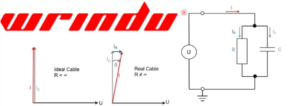
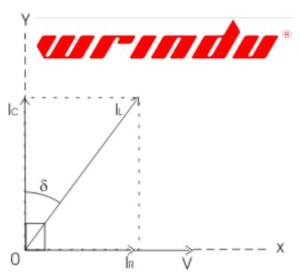
In an ideal insulator, the material acts as a perfect capacitor, with leakage current consisting only of a capacitive component (Ic) leading voltage by 90°.
In real‑world conditions, however, impurities, moisture, and degradation create a resistive leakage current (Ir).
The tan delta is defined as the ratio between the resistive and capacitive components of the leakage current:
tanδ = Ir / Ic
This ratio represents the dielectric loss angle and directly reflects the purity and health of the insulation.
What does a high tan delta value mean?
A high tan delta value means increased dielectric losses and lower insulation quality.
It indicates the insulation is contaminated, degraded, damp, or thermally aged, leading to higher energy dissipation, overheating risk, and shorter equipment life.
Negative tan delta values are theoretically impossible in valid testing and usually result from
measurement errors, incorrect connections, or instrument issues.
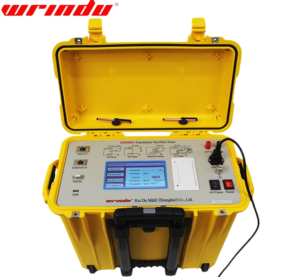
If you are interested in our Transformer Tan Delta Tester, feel free to contact us for more details!
Click the picture to know more about Wrindu Tan Delta Tester.