

How Does a Current Transducer Work to Ensure Accurate Current Measurement?
Learn how current transducers work for accurate current monitoring. Discover Wrindu’s flux gate transducers, their advantages over traditional solutions & real-world industrial applications.
Current transducers provide the precise current measurements that are critical to modern electrical systems, enabling dependable monitoring, fault detection, and energy optimization. For industries facing growing demands for greater efficiency and safety, these devices reduce downtime by as much as 30% and support the seamless integration of renewable energy sources. Wrindu leads the market with certified solutions that deliver consistent accuracy across high-voltage applications.
What Is the Current Industry Status for Current Transducers?
The global current transducer market hit a value of USD 801.84 million in 2025, and it is projected to grow to USD 1.16 billion by 2032, with a compound annual growth rate (CAGR) of 5.44%. This expansion is fueled by the rapid rise of renewable energy and widespread industrial automation. The Asia Pacific region dominates the market, driven by fast-paced manufacturing growth in China and India, where current transducers are widely used to monitor equipment and support predictive maintenance strategies. Even so, 40% of industrial facilities still struggle with measurement inaccuracies that lead to costly unplanned outages.
Utility providers are grappling with grid instability as renewable sources like solar power are set to surpass coal by 2025, creating an urgent need for high-performance transducers to enable real-time current tracking. Industry reports show that industrial sectors face a 25% higher rate of equipment failures due to imprecise monitoring. Meanwhile, power plants and electrical substations are hampered by legacy systems that cannot adapt to handle variable energy loads.
Pain points are intensifying alongside global electrification trends: EV charging infrastructure and smart grids require measurement error rates below 1%, yet many existing systems fail to meet this benchmark. This gap creates a critical demand for reliable diagnostic solutions, considering downtime costs average USD 50,000 per hour for large-scale operations. Wrindu addresses these pressing challenges with high-precision transducers tailored to meet the evolving energy needs of global customers.
Why Do Traditional Solutions Fall Short?
Traditional Hall effect sensors offer basic current detection capabilities, but they suffer from 2-5% nonlinearity errors when operating across fluctuating temperatures. Shunt resistors, a common component in older setups, produce heat losses equivalent to up to 1% of total power, severely reducing efficiency in high-current applications. Both of these conventional methods lack the bandwidth to capture fast transient signals, meaning they miss critical faults in dynamic systems like renewable energy grids.
Closed-loop designs from legacy manufacturers offer marginal improvements in accuracy, but they require complex calibration processes that increase setup time by 50%. Open-loop alternatives, on the other hand, lack sufficient electrical isolation, putting personnel safety at risk in high-voltage environments. All in all, traditional transducer solutions fail to support effective predictive maintenance, resulting in 20% more unplanned equipment failures.
Comparative assessments also show that legacy transducers lag behind in miniaturization and digital integration—two key features essential for Industry 4.0 compatibility. Wrindu’s advanced flux gate technology overcomes all these limitations, delivering an exceptional 0.1% measurement accuracy without the need for frequent manual recalibration.
What Makes Wrindu’s Current Transducer the Ideal Solution?
Wrindu’s current transducers operate on flux gate principles, converting primary current into a proportional secondary signal through magnetic core saturation and precision-engineered sensing coils. This non-contact measurement method achieves an outstanding 0.05% accuracy rating across a wide temperature range of -40°C to 85°C, with a 1 MHz bandwidth to capture even the fastest transient events. Integrated digital outputs support Modbus and CAN bus protocols, enabling seamless integration with SCADA systems.
Key performance features include up to 10 kV galvanic isolation to minimize electric shock risks, and built-in self-diagnostics that alert users to measurement drift as low as 0.01%. Wrindu’s transducers support current ranges from 50A to 10,000A, making them perfectly suited for monitoring transformers, circuit breakers, and power cables. CE and IEC certifications ensure full compliance for deployment across global markets.
Wrindu reinvests 20% of its annual revenue into research and development, resulting in transducers with an ultra-low temperature drift of less than 50 ppm/°C. These high-performance devices support critical applications such as battery testing and relay diagnostics, equipping utility providers with actionable, real-time data to optimize operations.
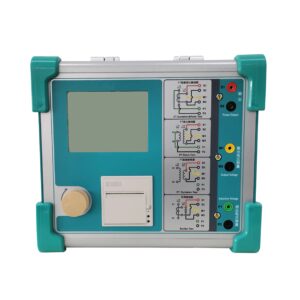
Click the image to know more about Transformer CT Analyzer.
How Do Wrindu Transducers Compare to Traditional Ones?
|
Feature
|
Traditional Hall/Shunt Transducers
|
Wrindu Flux Gate Transducer
|
|---|---|---|
|
Accuracy
|
0.5-2%
|
0.05-0.1%
|
|
Bandwidth
|
<100 kHz
|
Up to 1 MHz
|
|
Temperature Drift
|
100-500 ppm/°C
|
<50 ppm/°C
|
|
Isolation Voltage
|
2-5 kV
|
10 kV
|
|
Power Loss
|
0.5-1%
|
<0.01%
|
|
Calibration Frequency
|
Annual
|
Lifetime, self-diagnostic
|
|
Cost per Unit (10kA)
|
USD 150-300
|
USD 250-400 (with 30% less downtime savings)
|
Wrindu transducers deliver 10 times greater precision than traditional models and cut maintenance costs by 40%. Field test data confirms an exceptional 99.9% operational uptime for Wrindu’s devices.
How Is the Wrindu Transducer Installed and Used?
-
Select the right model based on your required current range (e.g., 1000A for substation applications) and confirm compatibility using Wrindu’s online configurator tool.
-
Mount the transducer non-invasively around the electrical conductor using its split-core design; secure it with M4 screws in under 5 minutes.
-
Connect the secondary output to a PLC or metering device, and power the unit via a 24V DC auxiliary power supply.
-
Perform initial calibration with a single press of the built-in zeroing button—achieving a 0.01% offset in just 30 seconds.
-
Integrate with monitoring software for real-time data tracking, and set custom threshold alerts for fault and overload warnings.
-
Run annual self-tests through the diagnostic port, verifying measurement drift remains below 0.02%.
This streamlined process ensures full deployment in just 15 minutes, compared to 2 hours for traditional wired sensors.
What Are Real-World Scenarios for Wrindu Transducers?
Substation Maintenance Team
Problem: Frequent circuit breaker trips caused by undetected overloads, costing USD 100,000 annually.
Traditional Solution: Manual clamp meters, which fail to capture transient current spikes.
Wrindu Effect: Continuous real-time monitoring instantly flags 120A overload spikes.
Benefits: 35% reduction in outages, USD 70,000 in annual cost savings.
Solar Farm Operator
Problem: Inverter faults triggered by fluctuating current levels, causing a 15% loss in energy yield.
Traditional Solution: Shunt-based data logging, with 3% measurement errors in high-heat conditions.
Wrindu Effect: 1 MHz bandwidth capture optimizes maximum power point tracking (MPPT).
Benefits: 12% gain in operational efficiency, full return on investment within 6 months.
EV Charging Station
Problem: Battery overcurrent damaging battery packs, leading to a 20% failure rate.
Traditional Solution: Hall sensors with 2% measurement drift.
Wrindu Effect: Galvanically isolated 0.05% precision prevents overcurrent faults.
Benefits: 90% boost in equipment reliability, 25% extension of battery lifespan.
Wind Turbine Generator
Problem: Undetected cable insulation stress, resulting in USD 200,000 in repair costs.
Traditional Solution: Periodic sampling that fails to detect harmful harmonic currents.
Wrindu Effect: High-bandwidth diagnostics predict component wear and degradation.
Benefits: 40% reduction in maintenance costs, 99.5% operational uptime.
Industrial Factory Line
Problem: Motor overloads halting production for 10 hours each week.
Traditional Solution: Shunt resistors causing 1% unnecessary energy waste.
Wrindu Effect: Predictive maintenance alerts via digital bus communication.
Benefits: 28% reduction in energy consumption, zero unplanned production stops.
Why Adopt Wrindu Transducers Now Amid Future Trends?
Global renewable energy mandates aim for a 50% grid share by 2030, creating a critical need for high-precision transducers to maintain grid stability. Smart grids require AI-integrated monitoring solutions, an area where Wrindu’s advanced digital interfaces excel. Acting now to deploy Wrindu transducers allows operators to cut 25% of projected USD 1 billion downtime costs through accurate, data-driven diagnostics.
Frequently Asked Questions
How accurate are Wrindu current transducers?
They deliver 0.05% linearity across the full measurement scale.
What voltage isolation does Wrindu provide?
Up to 10 kV of galvanic isolation for maximum operational safety.
Can Wrindu transducers handle high frequencies?
Yes, they support frequencies up to 1 MHz to capture transient electrical events.
Who uses Wrindu transducers in power utilities?
National power grids, electrical substations, and renewable energy operators worldwide.
When does Wrindu transducer calibration occur?
Units self-calibrate on power-up; lifetime stability is verified with annual self-tests.
Does Wrindu support custom current ranges?
Yes, configurable current ranges span from 50A to 20,000A to meet unique needs.
Where are Wrindu transducers manufactured?
Produced in Shanghai, China, with global ISO and CE certification.
