

Why Voltage Regulation Differs in Generator Types
Learn why generator voltage regulation differs between types. Explore armature reaction effect, voltage drop causes, and practical ways to improve generator voltage stability.
Voltage regulation is a key performance factor in any generator system. It determines how well a generator can maintain a stable output voltage when the load changes.
Different types of generators—especially self-excited and separately excited DC generators—show different voltage regulation behaviors due to their excitation methods.
In this guide, we explain why voltage regulation differs, what causes voltage drop, and how to improve generator voltage stability.
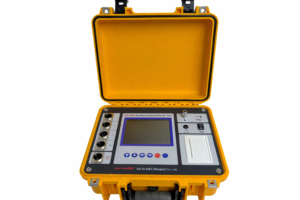
Click the image to know more about Three Phase Capacitance and Inductance Tester.
What Is Generator Voltage Regulation?
Voltage regulation refers to the change in output voltage between no-load and full-load conditions.
\text{Voltage Regulation (%)} = \frac{V_{no\text{-}load} – V_{full\text{-}load}}{V_{full\text{-}load}} \times 100
- Low percentage = better regulation
- High percentage = poor regulation
A generator with good voltage regulation keeps its output voltage nearly constant, even when load varies.
Why Voltage Regulation Differs in Generator Types
The main reason lies in how the field winding is powered.
1. Self-Excited Generators
In self-excited generators:
- The field current depends on the generator’s own output
- When load increases:
- Output voltage drops
- Field current decreases
- Magnetic flux weakens
This creates a negative feedback effect, causing further voltage drop.
👉 Result: Poor to moderate voltage regulation
2. Separately Excited Generators
In separately excited generators:
- Field current comes from an external DC source
- It remains stable regardless of load changes
👉 Result:
- Magnetic flux stays constant
- Output voltage is stable
👉 Excellent voltage regulation
3. Compound Generators
Compound generators combine:
- Series winding (boosts voltage under load)
- Shunt winding (stabilizes voltage)
👉 Result:
- Better voltage regulation than simple self-excited types
- Can be designed for nearly constant voltage
What Causes Voltage Drop in Generators?
Voltage drop is a common issue, especially under load conditions.
1. Armature Reaction Effect
The armature reaction effect occurs when the magnetic field produced by the armature current distorts the main field flux.
Effects include:
- Weakening of magnetic field
- Shift in neutral plane
- Reduced generated voltage
👉 This is one of the main reasons for voltage drop in generators.
2. Internal Resistance Losses
Voltage drop also occurs due to resistance in:
- Armature winding
- Brushes
- Commutator
As current increases:
- Voltage loss (I × R) increases
- Output voltage decreases
3. Load Changes
Heavy loads cause:
- Increased current
- Greater voltage drop
- Reduced terminal voltage
4. Weak Field Excitation
In self-excited generators:
- Reduced field current → reduced flux → lower voltage
How to Improve Generator Voltage Stability
Improving voltage stability is essential for reliable power supply, especially in industrial and testing applications.
1. Use Separately Excited Systems
Switching to a separately excited generator:
- Eliminates dependency on load
- Provides stable field current
- Improves voltage control
2. Install Automatic Voltage Regulators (AVR)
AVR systems:
- Adjust field current automatically
- Maintain constant voltage
- Respond quickly to load changes
3. Optimize Field Current Control
- Use rheostats or electronic controllers
- Fine-tune magnetic flux
- Maintain stable voltage output
4. Reduce Armature Reaction
Methods include:
- Interpoles (commutating poles)
- Compensating windings
These help neutralize magnetic distortion.
5. Perform Regular Maintenance
Routine checks can prevent instability:
- Inspect brushes and commutator
- Measure winding resistance
- Check insulation condition
- Verify excitation system
6. Conduct Load Testing
Load testing helps:
- Identify voltage drop under real conditions
- Evaluate generator performance
Professional testing equipment (such as Wrindu systems) can improve accuracy and reliability.
Practical Example
- A self-excited generator in a small plant may experience 10–20% voltage drop under full load
- A separately excited generator may limit voltage drop to less than 5%
This difference is critical in:
- Laboratories
- Precision manufacturing
- Power system testing
Why Voltage Stability Matters
Stable voltage is essential for:
- Protecting sensitive equipment
- Ensuring system efficiency
- Reducing energy losses
- Improving equipment lifespan
Poor voltage regulation can lead to:
- Equipment damage
- System failures
- Increased maintenance costs
Conclusion
Voltage regulation differs in generator types mainly because of how the field generator excitation is controlled.
- Self-excited generators are simple but less stable
- Separately excited generators provide precise and reliable voltage control
Understanding factors like armature reaction effect and internal voltage drops helps engineers improve system performance.
By applying proper control methods and regular testing, generator voltage stability can be significantly enhanced.
