

What Is a Reactor and What Is It Used For
Learn what a reactor is, how it works, and its applications in power systems. Explore types of reactors, series vs parallel reactors, and their role in voltage regulation.
A reactor, also known as an inductor, is an electrical component that stores energy in a magnetic field when current flows through it. All conductors carrying current naturally generate a magnetic field, but a simple straight conductor produces relatively weak inductance. To achieve practical inductance, conductors are wound into coils, often forming a solenoid, which is referred to as a hollow-core reactor.
Sometimes, a magnetic core (typically made of iron) is inserted into the solenoid to further increase inductance, resulting in an iron-core reactor. Reactors are essential for managing inductive reactance in electrical systems, while capacitors manage capacitive reactance.
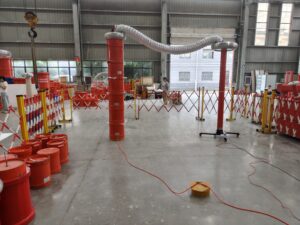
Click to know more about AC Series Resonance Variable Frequency Withstand Voltage Test Device.
How Are Reactors Classified?
Reactors can be categorized based on structure, cooling method, connection type, function, and purpose:
1. By Structure and Cooling Method
- Hollow-core reactors
- Iron-core reactors
- Dry-type reactors
- Oil-immersed reactors
2. By Connection Method
- Series reactors – connected in line with a circuit
- Parallel reactors – connected across a circuit
3. By Function
- Current-limiting reactors – restrict excessive current
- Compensation reactors – manage voltage and reactive power
4. By Application
- Current-limiting reactors
- Smoothing reactors
- Filtering reactors
- Power factor compensation reactors
- Series and balancing reactors
- Grounding reactors
- Arc suppression coils
- Adjustable or controllable reactors
- Saturated and auto-saturated reactors
- Resonant reactors (series or parallel)
What Are the Main Functions of Parallel Reactors?
Parallel reactors are widely used in power systems to improve reactive power conditions and ensure stable operation. Their functions include:
- Reducing transient overvoltage in lightly loaded or lightly discharged lines, compensating for line capacitance.
- Improving voltage distribution in long-distance transmission lines.
- Balancing reactive power at the site under light load conditions, preventing unreasonable reactive power flow and reducing line losses.
- Lowering steady-state bus voltage when large units are paralleled with the system, facilitating generator synchronization.
- Preventing self-excitation resonance in generators connected to long lines.
- Compensating phase-to-phase and phase-to-ground capacitance when small reactors are connected to the neutral through low-reactance grounding devices, helping extinguish latent currents quickly.
- Limiting and filtering current in the system to protect equipment and maintain stability.
Why Are Reactors Important in Electrical Systems?
Reactors are vital for maintaining system stability, reducing losses, and protecting electrical equipment. By controlling inductive reactance and managing reactive power, reactors prevent voltage spikes, resonances, and overloads, ensuring safe and reliable operation of power transmission and distribution networks.
FAQs About Reactors
Q1: What is the difference between a hollow-core and iron-core reactor?
Hollow-core reactors have air or non-magnetic material as the core, producing moderate inductance. Iron-core reactors contain a magnetic core that significantly increases inductance.
Q2: How do series and parallel reactors differ?
Series reactors are inserted directly into the line to limit current, while parallel reactors are connected across the circuit to manage voltage and reactive power.
Q3: Can reactors be used for power factor correction?
Yes. Specific reactors, often called compensation reactors, help adjust reactive power and improve the system’s power factor.
Q4: Why are resonant reactors used in power systems?
Resonant reactors (series or parallel) are designed to eliminate harmonic distortion, prevent voltage instability, and control resonance in transmission lines.
Q5: How do reactors help protect generators?
Reactors prevent self-excitation, reduce voltage spikes, and balance reactive power, ensuring safe parallel operation and stable generator performance.
Conclusion
Reactors are essential components in electrical power systems, playing multiple roles such as current limitation, voltage regulation, reactive power compensation, and harmonic suppression. By carefully selecting the type, structure, and connection method, engineers can optimize system performance, protect equipment, and ensure stable power transmission over long distances.
