

Why Is a Reactor Important in an AC Resonant Test System
Discover how reactors work in AC resonant test systems to improve voltage generation, testing efficiency, and insulation verification for cables and transformers.
An AC resonant test system is widely used for high-voltage withstand testing of cables, transformers, GIS equipment, and switchgear. One of the most important components inside the system is the reactor.
But why is the reactor so important, and how does it help achieve accurate test results?
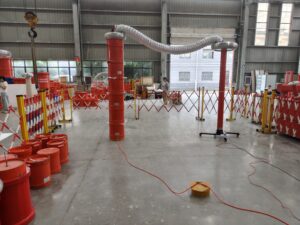
Click to know more about AC Series Resonance Variable Frequency Withstand Voltage Test Device.
What Does a Reactor Do in a Resonant Test System?
A reactor provides inductance to the resonant circuit. When combined with the capacitance of the test object, resonance occurs at a specific frequency.
At resonance:
- Test voltage can be increased efficiently
- Power consumption is reduced
- The power supply capacity requirement becomes smaller
- Testing becomes safer and more stable
Without a reactor, the system cannot generate the high voltage required for insulation testing.
How Does Resonance Improve High-Voltage Testing?
In a resonant circuit, inductive reactance equals capacitive reactance.
This creates several advantages:
- Higher output voltage
- Lower input power
- Reduced heat generation
- Improved testing efficiency
This is why resonant testing has become the preferred method for testing long power cables and high-voltage equipment.
Why Are Multiple Reactors Used?
Different test objects have different capacitance values.
Using multiple reactors allows engineers to:
- Adjust inductance values
- Match different cable lengths
- Test transformers and GIS equipment
- Expand testing capability
Modular reactor combinations make the AC resonance system more flexible.
What Equipment Can Be Tested Using Reactors?
Reactors are commonly used for testing:
- Power cables
- XLPE cables
- Power transformers
- GIS systems
- Switchgear
- Busbars
- Generators
- Motors
They help ensure insulation reliability before equipment is energized.
FAQs
Why does an AC resonant test system need a reactor?
The reactor provides inductance required to create resonance and generate high test voltages efficiently.
Can one reactor test all equipment?
No. Different test objects require different reactor combinations based on voltage and capacitance.
What happens if the reactor value is incorrect?
The system may fail to reach resonance, reducing testing accuracy and efficiency.
Are dry-type reactors better for field testing?
Yes. Dry-type reactors are lighter, easier to transport, and require less maintenance.
Conclusion
The reactor is the core component of any AC resonant test system. It enables efficient voltage generation, improves testing accuracy, and helps utilities verify insulation performance safely and reliably.
