

How to Detect and Locate High-Resistance Cable Faults?
Learn why high-resistance cable faults are difficult to detect and how TDR, ARM, ICE, and acoustic-magnetic methods help locate them.
High-resistance cable faults are difficult to locate because they may not produce a clear electrical reflection during low-voltage testing.
These faults often occur when cable insulation is damaged, carbonized, or partially broken down. The fault path may conduct electricity only when a sufficient voltage is applied.
Technicians need to understand the fault characteristics before selecting a suitable detection and pre-location method.
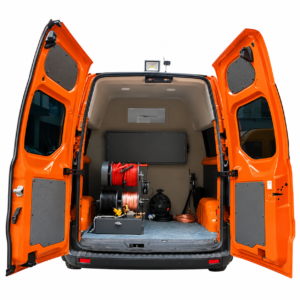
Click the image to know more about Wrindu RDCD-C Vehicle-Mounted Cable Fault Testing System.
What Is a High-Resistance Cable Fault?
A high-resistance cable fault occurs when an unintended electrical path has a relatively high resistance compared with a direct short circuit.
It may develop between two conductors or between a conductor and earth.
Common causes include:
- Partially damaged cable insulation.
- Carbonized insulation around a breakdown point.
- Moisture and contamination in damaged insulation.
- Aging insulation with reduced dielectric strength.
- Partial electrical contact between damaged conductors.
There is no single resistance threshold that defines every high-resistance cable fault. The classification depends on the cable system, test conditions, and fault characteristics.
Why Are High-Resistance Cable Faults Difficult to Detect?
A standard TDR instrument uses a low-voltage pulse to identify impedance changes along a cable.
Some high-resistance faults do not produce a strong enough reflection under this test condition. The reflected signal may be too weak to distinguish from normal waveform changes.
Another problem occurs when the insulation defect does not conduct at the applied test voltage.
In this case, the cable may show no clear fault-related reflection even though an insulation defect exists.
What Are the Common Signs of a High-Resistance Cable Fault?
High-resistance faults may produce different symptoms depending on their location and operating conditions.
| Possible sign | Explanation |
|---|---|
| Repeated protection trips | The fault may become conductive under certain voltage conditions |
| Unstable insulation resistance | The insulation condition may change with voltage or environment |
| Intermittent power interruption | The fault may appear and disappear |
| Abnormal leakage current | Current may flow through a damaged insulation path |
| Unclear TDR waveform | The fault may not create a strong low-voltage reflection |
These signs indicate possible cable problems, but they cannot independently confirm a high-resistance fault.
Can TDR Detect High-Resistance Cable Faults?
TDR can detect some high-resistance faults, but its performance depends on the electrical characteristics of the fault.
If the fault produces a measurable impedance change under low-voltage testing, TDR may identify its distance.
However, some insulation defects remain non-conductive during the measurement. In such cases, the instrument may not show a clear reflection.
Technicians should not conclude that a cable is healthy simply because the TDR waveform does not show an obvious fault.
What Is the Arc Reflection Method (ARM) for Cable Fault Location?
The Arc Reflection Method (ARM) is used to help locate certain high-resistance cable faults.
It combines high-voltage impulse testing with reflection measurement.
A suitable high-voltage impulse creates a temporary arc at the fault point. This arc changes the electrical impedance, allowing a reflected signal to travel back toward the measuring instrument.
The instrument analyzes the waveform to estimate the fault distance.
ARM is useful when a fault cannot be identified clearly with ordinary low-voltage TDR.
However, it does not work for every fault. The fault must respond to the applied impulse under the selected test conditions.
What Is the Impulse Current Method (ICE)?
The Impulse Current Method (ICE) is another technique used for pre-location of suitable high-resistance cable faults.
It applies a high-voltage impulse to the cable and records the transient current produced by the discharge.
The instrument analyzes the current waveform and its propagation time to estimate the fault distance.
ICE and ARM use different measurement signals:
| Comparison | ARM | ICE |
|---|---|---|
| Full name | Arc Reflection Method | Impulse Current Method |
| Main signal | Reflected voltage waveform | Transient current waveform |
| Test condition | High-voltage impulse | High-voltage impulse |
| Main purpose | Pre-location of suitable high-resistance faults | Pre-location of suitable discharge faults |
| Measurement basis | Reflection from a temporary arc | Current wave propagation |
| Main limitation | Requires suitable arc formation | Requires a detectable discharge response |
The choice between ARM and ICE depends on the fault characteristics and the available testing equipment.
What Is the Difference Between High-Voltage Surge Testing and Fault Pinpointing?
High-voltage surge testing and ground pinpointing are two different stages of cable fault location.
Surge testing applies a controlled impulse to a suitable cable fault. It may help activate the fault and generate a detectable discharge.
Ground pinpointing uses sensors to identify the physical position of that discharge along the cable route.
| Testing stage | Main equipment | Purpose |
|---|---|---|
| Fault pre-location | TDR, ARM, or ICE equipment | Estimate the distance to the fault |
| Fault activation | High-voltage surge generator | Create a detectable discharge at a suitable fault |
| Ground pinpointing | Acoustic-magnetic locator | Narrow down the fault position above ground |
| Cable route detection | Cable path detector | Trace the cable route before excavation |
A high-voltage impulse does not automatically identify the exact ground position. Pre-location and pinpointing provide different information.
How Do You Choose a Method for High-Resistance Cable Fault Location?
The testing method should match the fault’s electrical characteristics.
| Test method | Suitable application | Main limitation |
|---|---|---|
| Insulation resistance test | Initial insulation condition assessment | Does not directly locate the fault |
| Standard TDR | Faults producing identifiable impedance reflections | May miss some high-resistance faults |
| ARM | Suitable faults that can form a temporary arc | Requires appropriate impulse conditions |
| ICE | Suitable faults producing measurable transient current | Requires a detectable discharge response |
| Acoustic-magnetic pinpointing | Physical pinpointing of a suitable discharge fault | Depends on detectable acoustic and magnetic signals |
Technicians should check cable ratings, insulation type, and equipment limits before selecting a test method.
What Safety Precautions Are Required for High-Voltage Cable Fault Testing?
High-voltage surge testing requires strict safety controls.
Before testing, technicians should:
- Isolate the cable from the power supply.
- Verify the absence of operating voltage.
- Discharge and ground the cable according to the approved procedure.
- Check the rated voltage and condition of test equipment.
- Establish a controlled test area.
- Keep personnel away from high-voltage connections during testing.
- Discharge and ground the cable again after the test.
Only trained personnel should perform high-voltage testing. The applied voltage and impulse energy must follow the cable manufacturer’s requirements and the testing equipment instructions.
Frequently Asked Questions About High-Resistance Cable Faults
Why can’t a normal TDR tester locate a high-resistance fault?
Some high-resistance faults produce weak reflections under low-voltage testing. Others do not conduct until a higher voltage is applied.
Can ARM detect all high-resistance cable faults?
No. ARM requires suitable arc formation at the fault point. Its effectiveness depends on the insulation damage and test conditions.
What is the difference between ARM and ICE?
ARM analyzes a reflected voltage waveform created by a temporary arc. ICE analyzes transient current signals produced during high-voltage discharge.
Does a high-resistance fault always cause protection trips?
No. Some high-resistance faults produce limited current and may not trigger conventional overcurrent protection.
Can high-resistance cable faults be located without excavation?
Pre-location and ground pinpointing can narrow down the fault position before excavation. The damaged section normally needs to be exposed for repair.
About Wrindu Cable Fault Testing Equipment
Wrindu is a Chinese OEM manufacturer of electrical testing equipment and power testing solutions. Its cable testing product range supports field cable testing and fault pre-location.
The RDCD-C Vehicle-Mounted Cable Fault Testing System integrates different cable testing instruments into a vehicle-mounted setup. The actual equipment configuration should be checked against the required pre-location and pinpointing methods.
The system is supplied without a vehicle. Customers can select a suitable vehicle according to their operating requirements.
Visit the RDCD-C Vehicle-Mounted Cable Fault Testing System for more information.
