

How to Calculate Power Factor in a Three-Phase Electrical System?
Learn the power factor formula and how to calculate PF in single-phase and three-phase systems using voltage, current, active power, and apparent power.
Power factor is an important parameter in three-phase electrical systems. It shows how much of the supplied apparent power is converted into active power.
Engineers use power factor calculations to check electrical loads, evaluate system performance, and identify the need for reactive power compensation.
This article explains the power factor formula, how to calculate it in single-phase and three-phase systems, and how to understand the measurement results.
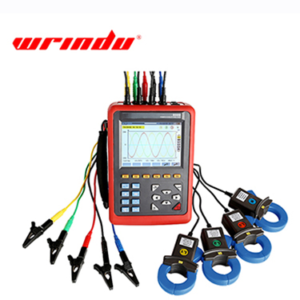
Click the image to know more about Wrindu Power Quality Analyzer.
What Is the Formula for Calculating Power Factor?
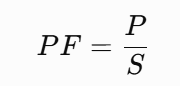
Power factor (PF) is the ratio of active power to apparent power.
The basic formula is:
[
PF=\frac{P}{S}
]
Where:
- PF = Power factor
- P = Active power (W or kW)
- S = Apparent power (VA or kVA)
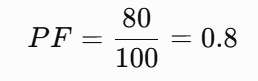
For example, if an electrical system uses 80 kW of active power and has 100 kVA of apparent power:
[
PF=\frac{80}{100}=0.8
]
The power factor is 0.8.
A value closer to 1 indicates that a larger proportion of apparent power is converted into active power.
How Do You Calculate Power Factor in a Single-Phase System?
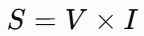
For a single-phase AC system, apparent power is calculated as:
[
S=V\times I
]
Therefore, the power factor formula is:
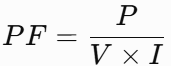
[
PF=\frac{P}{V\times I}
]
Where:
- P = Active power (W)
- V = RMS voltage (V)
- I = RMS current (A)
For example, assume a single-phase load has:
- Voltage: 230 V
- Current: 10 A
- Active power: 1,840 W
First, calculate apparent power:

[
S=230\times10=2300\ VA
]
Then calculate power factor:
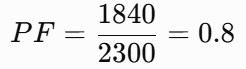
[
PF=\frac{1840}{2300}=0.8
]
The calculated power factor is 0.8.
How Do You Calculate Power Factor in a Three-Phase System?
For a balanced three-phase system, apparent power can be calculated using line voltage and line current:

[
S=\sqrt{3}\times V_L\times I_L
]
The power factor formula is:
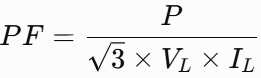
[
PF=\frac{P}{\sqrt{3}\times V_L\times I_L}
]
Where:
- P = Total three-phase active power (W)
- (V_L) = Line-to-line voltage (V)
- (I_L) = Line current (A)
For example, consider a balanced three-phase system with:
- Line voltage: 400 V
- Line current: 20 A
- Total active power: 11,085 W
Calculate apparent power:

[
S=1.732\times400\times20
]

[
S\approx13,856\ VA
]
Then calculate power factor:
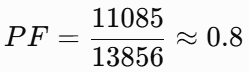
[
PF=\frac{11085}{13856}\approx0.8
]
The three-phase power factor is approximately 0.8.
This formula assumes a balanced three-phase system. For unbalanced loads, engineers should use the total measured active power and apparent power based on the actual phase conditions.
What Is the Difference Between Active, Reactive, and Apparent Power?
Understanding these three power values helps engineers interpret power factor.
| Power Type | Symbol | Unit | Meaning |
|---|---|---|---|
| Active Power | P | kW | Power used to perform useful work |
| Reactive Power | Q | kvar | Power exchanged between the source and reactive loads |
| Apparent Power | S | kVA | Combined effect of active and reactive power |
For a sinusoidal system, these values follow the power triangle relationship:
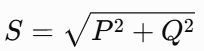
[
S^2=P^2+Q^2
]
A lower power factor generally means more apparent power is needed to deliver the same active power.
What Factors Affect Power Factor Measurements?
Several operating conditions can affect power factor readings.
1. Load Type
Induction motors, transformers, and other inductive loads require reactive power. Their power factor may decrease when they operate under light loads.
2. Load Changes
Industrial equipment does not always operate at a constant load. Frequent motor starting and changes in production demand can cause power factor variations.
3. Harmonic Distortion
Nonlinear loads, such as variable frequency drives and switching power supplies, can introduce harmonics. These distortions may reduce true power factor.
4. Measurement Connections
Incorrect voltage and current phase connections can produce inaccurate readings. Engineers should check the phase sequence and ensure that each current channel matches the corresponding voltage phase.
How Can Engineers Measure Power Factor in a Three-Phase System?
A power quality analyzer can measure voltage, current, active power, reactive power, apparent power, and power factor.
A typical measurement process includes:
- Connect the voltage leads to the corresponding phase terminals.
- Install current clamps on the correct phase conductors.
- Check the phase sequence and channel connections.
- Start the measurement.
- Review the PF, active power, reactive power, and apparent power readings.
- Record the results under different load conditions.
For a complete assessment, engineers should also check voltage and current waveforms, harmonics, and total harmonic distortion (THD).
Frequently Asked Questions
What Is a Good Power Factor for a Three-Phase System?
A power factor close to 1 is generally desirable. However, the required value depends on the equipment, operating conditions, and local utility requirements.
Can Power Factor Be Greater Than 1?
For the usual definition of true power factor in a passive electrical load, its magnitude does not exceed 1. A reading above 1 may indicate a measurement or data configuration problem.
Is the Three-Phase Power Factor Formula the Same for All Loads?
The basic relationship PF = P/S applies to single-phase and three-phase systems. However, the apparent power calculation depends on the system configuration and whether the load is balanced.
Why Do Engineers Measure Power Factor?
Power factor measurement helps engineers evaluate electrical load performance, identify reactive power demand, and determine whether compensation is necessary.
Conclusion
Power factor is calculated by dividing active power by apparent power. In a balanced three-phase system, engineers can calculate it using total active power, line voltage, and line current.
Correct measurement also requires proper phase connections and consideration of load conditions. A power quality analyzer can help engineers evaluate power factor together with other electrical parameters.
