

THD vs TDD: What Is the Difference in Power Quality Analysis?
Learn the difference between THD and TDD, including their formulas, reference values, applications, and roles in IEEE 519 harmonic analysis.
Total Harmonic Distortion (THD) and Total Demand Distortion (TDD) are two important indicators used in electrical power quality analysis. Both describe harmonic distortion, but they use different reference values.
THD compares harmonic components with the fundamental voltage or current. TDD compares harmonic current with the maximum demand load current.
Understanding the difference helps engineers evaluate harmonic conditions and check compliance with IEEE 519.
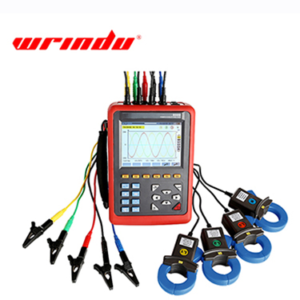
Click the image to know more about Wrindu Power Quality Analyzer.
What Is the Difference Between THD and TDD?
The main difference is the reference value used in each calculation.
THD uses the fundamental component at the time of measurement. TDD uses the maximum demand load current as its reference.
| Comparison | THD | TDD |
|---|---|---|
| Full name | Total Harmonic Distortion | Total Demand Distortion |
| Measurement object | Voltage or current | Current |
| Reference value | Fundamental voltage or current | Maximum demand load current |
| Unit | Percentage (%) | Percentage (%) |
| Main purpose | Evaluate waveform distortion | Evaluate harmonic current relative to demand |
| Common application | General power quality analysis | Harmonic current assessment under IEEE 519 |
THD is useful for evaluating waveform distortion under different load conditions. TDD provides a demand-based reference for assessing current harmonics at the point of common coupling (PCC).
How Do You Calculate THD?
THD measures the combined RMS value of harmonic components relative to the fundamental component.
The current THD formula is:

[
THD_I=\frac{\sqrt{I_2^2+I_3^2+\cdots+I_n^2}}{I_1}\times100%
]
Where:
- (I_1) = Fundamental current
- (I_2,I_3,\ldots,I_n) = Individual harmonic currents
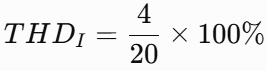
For example, assume a load has a fundamental current of 20 A and a combined RMS harmonic current of 4 A.
[
THD_I=\frac{4}{20}\times100%=20%
]
The current THD is 20%.
This result describes harmonic current relative to the fundamental current at the time of measurement.
How Do You Calculate TDD?
TDD uses the maximum demand load current instead of the fundamental current.
The formula is:

[
TDD=\frac{\sqrt{I_2^2+I_3^2+\cdots+I_n^2}}{I_L}\times100%
]
Where:
- (I_2,I_3,\ldots,I_n) = Individual harmonic currents
- (I_L) = Maximum demand load current
For example, assume:
| Parameter | Value |
|---|---|
| Combined RMS harmonic current | 4 A |
| Maximum demand load current | 40 A |
The calculation is:

[
TDD=\frac{4}{40}\times100%=10%
]
The TDD is 10%.
The result shows that the combined harmonic current is 10% of the maximum demand load current.
Why Can THD and TDD Have Different Values?
THD and TDD can produce different percentages because their reference currents are different.
Consider the following example:
| Parameter | Value |
|---|---|
| Fundamental current | 20 A |
| Combined harmonic current | 4 A |
| Maximum demand load current | 40 A |
The calculated results are:
[
THD_I=\frac{4}{20}\times100%=20%
]
[
TDD=\frac{4}{40}\times100%=10%
]
The current THD is 20%, while TDD is 10%.
Neither result is incorrect. They describe the same harmonic current using different reference values.
Why Does IEEE 519 Use TDD for Current Distortion?
IEEE 519 uses TDD to evaluate current harmonic distortion at the point of common coupling.
A demand-based reference helps engineers assess harmonic current in relation to the facility’s maximum demand load rather than only its instantaneous operating current.
IEEE 519 also considers the ratio of available short-circuit current to maximum demand load current, commonly expressed as (I_{SC}/I_L), when determining applicable current distortion limits.
Engineers should identify the correct PCC, system voltage, maximum demand current, and short-circuit current before evaluating compliance.
A current THD reading alone is not sufficient to establish IEEE 519 compliance.
When Should Engineers Use THD and TDD?
The choice depends on the purpose of the measurement.
| Application | Recommended Indicator | Reason |
|---|---|---|
| Checking waveform distortion | THD | Compares harmonics with the fundamental component |
| Comparing current distortion at different load levels | THD and TDD | Provides both instantaneous and demand-based references |
| Evaluating current harmonic emissions at the PCC | TDD | Uses maximum demand load current |
| Checking voltage waveform distortion | Voltage THD | Evaluates harmonic voltage components |
| Monitoring nonlinear loads | Current THD | Shows harmonic current relative to fundamental current |
Engineers should not use TDD as a replacement for voltage THD. Each indicator serves a different measurement purpose.
Can a Power Quality Analyzer Measure THD and TDD?
A power quality analyzer can measure individual harmonic components and calculate THD when the instrument supports these functions.
However, TDD calculation also requires the correct maximum demand load current as its reference.
Engineers should check whether the analyzer supports TDD calculation directly. If it does not, they need to obtain the required demand current and calculate TDD separately.
The Wrindu RDCR5000 Digital Power Quality Analyzer supports four voltage channels, four current channels, harmonic measurement up to the 50th order, and voltage and current THD measurement.
Its harmonic analysis and recording functions help engineers collect the data needed for power quality assessment.
Frequently Asked Questions
Is TDD Always Lower Than Current THD?
No. TDD is lower when the maximum demand load current is greater than the fundamental current used in the THD calculation. The actual relationship depends on the measurement conditions and reference current.
Can THD Be Used to Check IEEE 519 Compliance?
THD is useful for waveform analysis, but current harmonic compliance under IEEE 519 requires the applicable TDD-based evaluation. Engineers must also consider the PCC and system conditions.
Does TDD Measure Voltage Harmonics?
No. TDD is a current distortion indicator. Voltage harmonic distortion is evaluated using voltage THD.
Why Is Maximum Demand Load Current Important?
It provides the reference current for TDD and helps evaluate harmonic current relative to the facility’s demand rather than its instantaneous load.
Conclusion
THD and TDD both describe harmonic distortion, but they use different reference values. THD compares harmonics with the fundamental component, while TDD compares harmonic current with maximum demand load current.
Engineers should use the correct indicator according to the measurement objective and applicable power quality requirements.
