

Why Is THD High? Common Causes and Troubleshooting Methods
Find out why THD is high, what causes harmonic distortion, and how engineers troubleshoot VFDs, transformers, motors, and electrical systems.
High Total Harmonic Distortion (THD) indicates that harmonic components make up a larger proportion of the fundamental voltage or current.
In industrial electrical systems, nonlinear loads are a common source of harmonic distortion. Variable frequency drives (VFDs), rectifiers, UPS systems, and switching power supplies can all contribute to harmonic currents.
However, high THD does not always mean the same problem. Engineers need to identify whether the distortion comes from voltage or current measurements before investigating the source.
This article explains why THD becomes high, how to identify possible causes, and what engineers should check during troubleshooting.
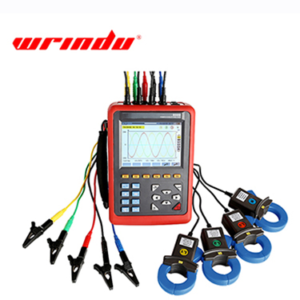
Click the image to know more about Wrindu Power Quality Analyzer.
Why Does THD Become High in Electrical Systems?
THD increases when harmonic components become larger relative to the fundamental component.
For current THD, this can happen when nonlinear loads produce significant harmonic currents or when the fundamental load current becomes lower.
For voltage THD, harmonic voltage distortion can increase when harmonic currents flow through network impedance.
Common causes include:
| Cause | Effect on THD |
|---|---|
| Variable frequency drives | Produce harmonic input currents |
| Industrial rectifiers | Introduce harmonic current components |
| UPS systems | Power converters can generate current distortion |
| Switching power supplies | May produce nonlinear input currents |
| Uneven nonlinear loads | Can create differences between phase measurements |
| Network resonance | Can amplify selected harmonic components |
| Low fundamental load current | Can increase the percentage of current THD |
Engineers should check the individual harmonic spectrum instead of relying on the total THD value alone.
Why Is Current THD High but Voltage THD Low?
Current THD and voltage THD describe different electrical conditions.
A facility can have high current THD but relatively low voltage THD when the supply network has low impedance and sufficient short-circuit capacity.
For example, a VFD may draw distorted current from the network. If the network impedance is relatively low, the resulting voltage distortion may remain limited.
| Measurement | Possible Explanation |
|---|---|
| High current THD, low voltage THD | Nonlinear loads produce distorted current, but voltage distortion remains limited |
| High current THD, high voltage THD | Significant harmonic currents may be interacting with network impedance |
| Low current THD, high voltage THD | Supply-side distortion or other network conditions may contribute |
| Different THD between phases | Different loads or harmonic sources may exist on each phase |
These combinations provide troubleshooting clues, not final diagnoses.
Why Does Current THD Increase at Low Load?
Current THD is calculated using the fundamental current as its reference.
When the fundamental current decreases, the same harmonic current can represent a larger percentage of the fundamental component.
For example:
| Parameter | Condition A | Condition B |
|---|---|---|
| Fundamental current | 20 A | 10 A |
| Combined harmonic current | 2 A | 2 A |
| Current THD | 10% | 20% |
Calculation:
Condition A:
[
THD_I=\frac{2}{20}\times100%=10%
]
Condition B:
[
THD_I=\frac{2}{10}\times100%=20%
]
The harmonic current remains at 2 A, but current THD increases from 10% to 20%.
This does not mean that the absolute harmonic current has doubled. It means that the harmonic current has become a larger proportion of the fundamental current.
Which Harmonic Orders Should Engineers Check First?
Different harmonic orders can provide clues about the connected electrical loads.
For a 50 Hz system:
| Harmonic Order | Frequency | Possible Source or Condition |
|---|---|---|
| 3rd | 150 Hz | Nonlinear single-phase loads |
| 5th | 250 Hz | Six-pulse rectifiers and VFDs |
| 7th | 350 Hz | Six-pulse rectifiers and converter loads |
| 11th | 550 Hz | Converter-related harmonic components |
| 13th | 650 Hz | Converter-related harmonic components |
The 5th and 7th harmonics are common in systems using six-pulse rectifiers.
However, the actual harmonic spectrum depends on equipment design, operating conditions, and network characteristics.
How Do Engineers Troubleshoot High THD?
A systematic measurement process helps engineers identify possible harmonic sources.
Step 1: Check voltage and current THD separately
Record voltage THD and current THD for all three phases. Do not treat the two measurements as interchangeable.
Step 2: Review individual harmonic orders
Check which harmonic components contribute most to the total distortion.
Step 3: Identify nonlinear loads
List the connected VFDs, rectifiers, UPS systems, welding machines, and switching power supplies.
Step 4: Compare different load conditions
Measure harmonic levels when suspected equipment is operating and compare them with measurements under other operating conditions.
Step 5: Check phase differences
Compare voltage, current, and harmonic measurements across all three phases.
Step 6: Record changes over time
Use continuous recording to identify whether THD increases during specific operating periods.
Step 7: Investigate the network conditions
If harmonic levels remain abnormal, evaluate system impedance, transformer loading, capacitor banks, and possible resonance.
This process helps narrow down the source of distortion before engineers select corrective equipment.
How Can Engineers Identify Harmonic Problems in Transformers and Motors?
Harmonic distortion can increase electrical losses and thermal stress in transformers and motors.
Engineers should combine power quality measurements with equipment operating data.
| Equipment | Possible Harmonic-Related Problem | Recommended Measurement |
|---|---|---|
| Transformer | Increased heating and losses | Load current and harmonic spectrum |
| Induction motor | Additional heating and losses | Voltage THD and current harmonics |
| Capacitor bank | Harmonic current and resonance risk | Capacitor current and harmonic spectrum |
| Neutral conductor | Increased triplen harmonic current | Neutral current and 3rd harmonic |
| Power cables | Additional conductor heating | Current loading and harmonic components |
High THD alone does not confirm that harmonics caused equipment overheating. Engineers should also check loading, cooling, connections, and equipment condition.
Can Capacitor Banks Cause High THD?
Capacitor banks can interact with the inductance of transformers and electrical networks.
Under certain conditions, this interaction can create resonance and amplify selected harmonic components.
Engineers should investigate capacitor bank conditions when harmonic levels increase after capacitor switching or reactive power compensation.
A harmonic spectrum measurement can help identify whether particular harmonic orders increase during these operating conditions.
Do not add or modify capacitors without evaluating the system’s impedance and resonance risk.
How Can Engineers Reduce High THD?
The correct corrective method depends on the harmonic source and system characteristics.
| Corrective Method | Main Function | Suitable Application |
|---|---|---|
| Passive harmonic filter | Reduces selected harmonic components | Systems with identified dominant harmonics |
| Active harmonic filter | Compensates harmonic currents | Systems with changing nonlinear loads |
| Line reactor | Helps reduce current distortion from certain loads | VFD and rectifier circuits |
| Low-harmonic drive | Reduces harmonic current generation | New motor drive installations |
| Load redistribution | Changes the distribution of nonlinear loads | Systems with uneven phase loading |
Engineers should measure the harmonic spectrum before selecting a corrective solution.
After installing a filter or changing the electrical system, repeat the measurements under comparable load conditions to evaluate the results.
How Can a Power Quality Analyzer Help Troubleshoot High THD?
A power quality analyzer can measure voltage and current harmonics, display individual harmonic orders, and calculate THD.
The Wrindu RDCR5000 Digital Power Quality Analyzer supports four voltage channels and four current channels.
Its harmonic analysis covers the 0th to 50th order and includes voltage THD and current THD measurement.
Other functions include:
- Real-time voltage and current waveform display
- Harmonic ratio bar charts
- Three-phase imbalance measurement
- Voltage flicker measurement
- Transient waveform capture
- Long-term trend recording
The analyzer can record 20 selected parameters simultaneously at five-second intervals, with a maximum recording period of 300 days under the specified configuration.
These functions help engineers compare phase measurements, identify changes in harmonic levels, and review electrical conditions over time.
Frequently Asked Questions
Can High THD Cause Transformer Overheating?
Yes. Harmonic currents can increase transformer losses and temperature rise. However, engineers should also check transformer loading, cooling, and other possible causes.
Why Does THD Increase When Electrical Loads Change?
THD depends on the relationship between harmonic components and the fundamental component. When equipment starts or stops, both values can change.
Can a VFD Cause High Current THD?
Yes. Conventional VFD rectifier circuits can draw non-sinusoidal current and produce harmonic components. The actual distortion depends on the drive design and operating conditions.
Does Installing a Harmonic Filter Always Reduce THD?
Not necessarily. The filter must match the harmonic spectrum and electrical network. Incorrect filter selection may produce limited results or create resonance problems.
How Can Engineers Confirm That THD Has Improved?
Measure voltage THD, current THD, and individual harmonic orders before and after corrective actions. Use comparable load conditions and measurement locations when comparing the results.
Conclusion
High THD can result from nonlinear loads, changing fundamental current, network impedance, or resonance conditions.
Engineers should distinguish between voltage THD and current THD, review individual harmonic orders, and compare measurements under different operating conditions.
A power quality analyzer helps collect the data needed to identify possible harmonic sources and evaluate corrective actions.
