

Benefits of Kelvin Resistance Testing for Industrial Use
Explore top benefits of Kelvin resistance testing: high accuracy, error elimination, reliability. Key advantages for industrial and OEM precision testing.
In industrial manufacturing, power utility maintenance, and electronics production, reliability is non-negotiable. For decades, the 2-wire resistance measurement method sufficed for basic checks. However, as modern equipment demands higher precision and stricter compliance, the benefits of Kelvin resistance testing have become indispensable. Also known as the 4-wire Kelvin method, this technology delivers game-changing advantages that traditional testing cannot match, making it the gold standard for low-resistance measurement in industrial environments.
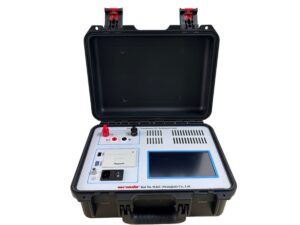
Click the image to know more about Wrindu DC Resistance Tester.
Core Benefits of Kelvin Resistance Testing for Industrial Scenarios
1. Complete Elimination of Lead & Contact Resistance Errors
The single greatest advantage of Kelvin resistance testing is its ability to neutralize the two biggest sources of measurement error: test lead resistance and contact resistance.
- 2-wire limitation: Includes lead and contact resistance in the final reading, leading to inflated, inaccurate results, especially for milliohm or microohm-level samples.
- Kelvin advantage: Separates current (force) and voltage (sense) paths. The sense leads, which carry almost no current, measure only the voltage drop across the Device Under Test (DUT), completely excluding external resistance errors. This “zero-error” measurement ensures results reflect the true resistance of the component, not the wiring or connections.
2. Ultra-High Precision for Critical Components
Kelvin testing delivers industrial-grade precision that is critical for quality control (QC) in high-stakes industries.
- It provides resolutions down to the microohm (1μΩ), enabling the detection of tiny resistance fluctuations that would otherwise go unnoticed.
- This level of accuracy is essential for identifying defective components before they reach assembly lines, preventing costly rework, product failures, and safety hazards.
3. Enhanced Equipment Reliability & Longevity
By ensuring accurate resistance measurements, Kelvin testing directly contributes to the reliability and lifespan of industrial equipment.
- In power utilities, detecting high resistance in transformer windings or cable joints early prevents overheating, fires, and unplanned outages.
- In EV manufacturing, precise internal resistance checks of battery cells ensure stable performance, prevent thermal runaway, and extend battery life.
- For electronics manufacturers, it validates the integrity of PCB traces, connectors, and solder joints, ensuring products meet strict performance benchmarks.
4. Full Compliance with Industry Standards
Many industrial sectors, including automotive, aerospace, and energy, mandate compliance with rigorous international standards (ISO, IEC, CE).
- Kelvin resistance testing provides the audit-ready, repeatable data required for regulatory compliance and product certification.
- It is a requirement for processes like 4-wire Kelvin method for power utilities (grid asset maintenance) and Kelvin testing in electronics manufacturing (component qualification), ensuring operations meet global safety and quality norms.
5. Reduced Downtime & Cost Savings
While 4-wire Kelvin testing requires a higher initial investment in equipment, it delivers significant long-term cost savings.
- It minimizes downtime by identifying issues early, before they escalate into major equipment failures.
- By eliminating measurement errors, it reduces scrap rates, rework costs, and warranty claims, directly improving operational efficiency and profitability.
Why Industrial & OEM Teams Choose Kelvin Over Traditional Methods
For Original Equipment Manufacturers (OEMs) and industrial service providers, the choice is clear:
- 2-wire testing is suitable for quick, low-precision checks on high-resistance components.
- 4-wire Kelvin testing is mandatory for any application where accuracy, reliability, and compliance matter. It is the only method that can meet the demands of modern industrial QC, power utility inspections, and high-volume manufacturing.
Wrindu Expert Perspective: Maximizing Kelvin’s Industrial Value
Wrindu (Rui Du Mechanical and Electrical (Shanghai) Co., Ltd.), a global leader in power testing equipment with ISO9001, IEC, and CE certifications, emphasizes that the full benefits of Kelvin resistance testing are only realized when paired with professional equipment and best practices.
“At Wrindu, we design our Kelvin testers and tools to amplify these core advantages,” says a senior Wrindu engineer. “Our solutions are tailored to address the unique needs of industrial scenarios, from power utility grid maintenance to EV battery production. We ensure our equipment not only delivers the highest accuracy but also simplifies compliance and reduces operational risks. For industrial users, investing in Wrindu’s Kelvin testing solutions means investing in reliability, efficiency, and long-term success.”
FAQs: Key Benefits of Kelvin Resistance Testing
Q1: Is Kelvin resistance testing worth the higher cost for industrial use?
Yes, the long-term cost savings from reduced errors, downtime, and rework far outweigh the higher upfront cost of Kelvin testing equipment. It is a strategic investment in quality and reliability.
Q2: How does Kelvin testing improve safety in industrial environments?
By detecting hidden resistance issues early, Kelvin testing prevents overheating, equipment failure, and potential safety hazards like fires or electric shocks, protecting personnel and assets.
Q3: Can small businesses or non-critical operations benefit from Kelvin testing?
Yes, even small-scale operations can benefit. While it may not be mandatory for every task, using Kelvin testing for critical components ensures quality, builds customer trust, and avoids costly mistakes as the business scales.
Q4: Does Wrindu offer solutions to help industrial users leverage these benefits?
Yes, Wrindu provides a comprehensive range of 4-wire Kelvin testing equipment, including micro-ohmmeters, Kelvin multimeters, and dedicated test leads, designed to meet the diverse needs of industrial, OEM, and power utility users.
Explore More Essential Resources:
