

CT Saturation vs CT Accuracy: What Engineers Need to Know
Learn the difference between CT saturation and CT accuracy, including accuracy class, protection CT performance, burden, and saturation risks.
Why Do Engineers Need to Understand CT Performance?
Current transformers (CTs) provide current signals for measurement and protection systems.
Engineers often focus on CT accuracy because accurate current measurement is important.
However, accuracy is not the only factor that affects CT performance.
A CT can have good measurement accuracy under normal conditions but still face problems during high fault currents.
This is why engineers need to understand the difference between CT accuracy and CT saturation.
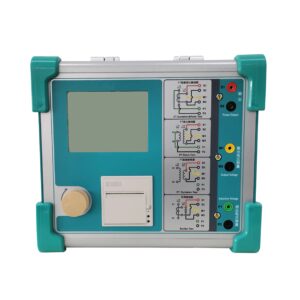
Click the image to know more about Wrindu CT and PT Analyzer.
What Is CT Accuracy?
CT accuracy describes how closely the secondary current matches the expected value.
A CT with good accuracy provides a current signal close to the actual primary current.
Accuracy is important for:
- Energy measurement
- Metering systems
- Monitoring equipment
For example, measurement CTs need accurate current signals to support billing and power monitoring.
What Is CT Saturation?
CT saturation happens when the magnetic core cannot continue producing a correct secondary current signal.
During a high fault current:
- Primary current increases quickly
- Magnetic flux increases
- CT core reaches its limit
After saturation starts:
- Secondary current waveform becomes distorted
- Output accuracy decreases
- Protection relays may receive incorrect information
What Is the Difference Between CT Accuracy and CT Saturation?
CT Accuracy Focuses on Normal Operation
CT accuracy mainly describes performance under rated conditions.
Engineers use accuracy values to evaluate:
- Measurement errors
- Current conversion quality
- Metering performance
Accuracy is especially important for measurement applications.
CT Saturation Focuses on High Current Conditions
CT saturation appears during abnormal conditions.
Examples include:
- Short circuits
- Large fault currents
- Heavy system disturbances
Protection engineers focus on saturation because relays need reliable current signals during faults.
Can a High Accuracy CT Still Saturate?
Yes. High accuracy does not always mean better saturation performance. A CT may provide excellent measurement results during normal operation but saturate during a large fault.
Therefore, engineers should evaluate:
- Knee point voltage
- Excitation characteristics
- Burden condition
- Protection requirements
Why Are Protection CTs Different From Measurement CTs?
What Are Measurement CTs Used For?
Measurement CTs mainly support:
- Energy meters
- Power meters
- Monitoring systems
They focus on maintaining accuracy during normal current conditions.
What Are Protection CTs Used For?
Protection CTs provide current signals to:
- Protection relays
- Circuit breakers
- Fault detection systems
They need to continue working during high fault currents.
Therefore, protection CTs usually require:
- Higher knee point voltage
- Better saturation performance
- Stable output during faults
How Does Accuracy Class Affect CT Selection?
What Is CT Accuracy Class?
Accuracy class defines the maximum allowed measurement error under specific conditions.
Different applications require different accuracy levels.
For example:
- Metering CTs focus on measurement accuracy.
- Protection CTs focus on fault performance.
Engineers should select the accuracy class based on the system requirement.
Why Is Accuracy Class Not Enough for Protection CTs?
Protection systems need more information than accuracy class.
Engineers should also check:
- Knee point voltage
- Excitation curve
- Secondary resistance
- Burden value
These parameters show whether the CT can provide reliable signals during faults.
How Does Burden Affect CT Saturation Risk?
What Is CT Burden?
CT burden represents the total load connected to the secondary circuit.
It includes:
- Relay input
- Meter input
- Cable resistance
- Terminal resistance
Why Does High Burden Increase Saturation Risk?
A higher burden requires higher secondary voltage from the CT.
If the CT cannot provide enough voltage:
- Core flux increases
- Saturation happens earlier
- Current output becomes inaccurate
Therefore, engineers should check the burden before selecting a CT.
How Can Engineers Evaluate CT Saturation Performance?
Check Knee Point Voltage
Knee point voltage shows the CT core’s ability to handle increasing voltage.
A higher knee point usually provides better protection performance.
Perform Excitation Testing
Excitation testing shows the relationship between:
- Secondary voltage
- Excitation current
Engineers can use the curve to identify abnormal core behavior.
Review Secondary Circuit Conditions
Engineers should check:
- Cable length
- Cable resistance
- Connected equipment
A well-designed secondary circuit helps reduce saturation risk.
How Does CT Testing Help Engineers Choose the Right CT?
CT testing provides important information before equipment operation.
Engineers can use test results to confirm:
- CT performance
- Protection suitability
- Saturation margin
- Installation quality
A CT analyzer can combine multiple tests, including:
- Ratio testing
- Excitation testing
- Knee point testing
- Resistance testing
- Burden testing
This helps engineers evaluate CT characteristics more efficiently.
CT Saturation and Accuracy FAQs
Is CT saturation the same as CT accuracy error?
No. CT accuracy describes measurement error under normal conditions, while saturation happens when the CT core cannot handle increasing current.
Why do protection CTs need better saturation performance?
Protection CTs must provide reliable current signals during fault conditions.
Can measurement CTs experience saturation?
Yes. Any CT may saturate if the current and burden conditions exceed its capability.
Which test checks CT saturation performance?
Excitation testing and knee point testing are common methods for evaluating CT saturation behavior.
Does a higher accuracy class prevent CT saturation?
No. Engineers must also consider knee point voltage, burden, and core performance.
