

How to Perform CT Saturation Testing with a CT Analyzer
Learn how to perform CT saturation testing with a CT analyzer, including excitation tests, knee point tests, result analysis, and testing steps.
- BYwrindu
- On
- InTechnical FAQs
Why Is CT Saturation Testing Important?
Current transformers (CTs) provide current signals for protection relays and measurement systems.
During normal operation, a CT can convert primary current into a smaller secondary current accurately.
However, during a short circuit, the primary current can increase quickly. When the CT core cannot handle the increasing magnetic flux, saturation may occur.
CT saturation can cause:
- Distorted secondary current signals
- Incorrect relay input
- Reduced protection reliability
- Wrong fault judgment
Therefore, engineers use CT saturation testing to check whether a CT can provide reliable performance during high-current conditions.
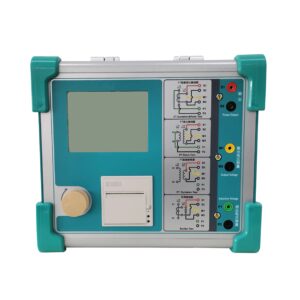
Click the image to know more about Wrindu CT and PT Analyzer.
What Does CT Saturation Testing Check?
CT saturation testing evaluates the magnetic performance of a current transformer.
The main purpose is to understand:
- How the CT core responds to increasing voltage
- When saturation starts
- Whether the CT meets protection requirements
- Whether the CT can support relay operation during faults
This information helps engineers confirm CT suitability before installation or during maintenance.
What Tests Can Evaluate CT Saturation Performance?
Engineers usually use several CT tests to evaluate saturation characteristics.
Excitation Test
An excitation test checks the relationship between secondary voltage and excitation current.
During the test:
- The analyzer applies increasing voltage to the CT secondary winding.
- The system measures excitation current at different voltage levels.
- The test equipment creates an excitation curve.
A normal CT keeps a stable relationship before saturation begins.
When saturation starts, excitation current increases rapidly.
Knee Point Voltage Test
Knee point voltage is one of the most important values in CT saturation analysis.
It shows the point where the CT core begins to lose its linear performance.
Before the knee point:
- The CT output follows the input current relationship.
- Excitation current remains relatively low.
After the knee point:
- Excitation current increases quickly.
- The CT cannot maintain accurate current conversion.
Engineers compare the measured knee point with the required value from CT specifications.
Secondary Resistance Test
Secondary resistance affects CT saturation performance.
The secondary circuit includes:
- CT winding resistance
- Cable resistance
- Connection resistance
A high resistance value increases the voltage requirement of the CT.
Therefore, resistance testing helps engineers identify:
- Aging winding problems
- Loose connections
- Cable issues
Burden Test
CT burden represents the total load connected to the secondary circuit.
The burden includes:
- Protection relays
- Measuring instruments
- Terminal blocks
- Secondary cables
When the burden increases, the CT needs a higher secondary voltage.
A high burden may cause earlier saturation.
Therefore, burden testing helps engineers confirm that the CT works within its rated condition.
How Do Engineers Perform CT Saturation Testing?
Check CT Information Before Testing
Before starting the test, engineers should review:
- CT ratio
- Accuracy class
- Protection class
- Rated burden
- Knee point requirement
Correct information helps engineers compare test results accurately.
Prepare the CT for Testing
Safety preparation is necessary before CT testing.
Engineers should:
- Isolate the CT from the energized system
- Confirm safe working conditions
- Check test connections
- Prepare suitable testing equipment
Proper preparation improves safety and testing accuracy.
Connect the CT Analyzer
A modern CT analyzer connects directly to the CT secondary terminals.
Engineers should confirm:
- Correct terminal connection
- Proper test wiring
- Grounding condition
Incorrect connections may affect the test result.
Run the Saturation Test
During the test, the CT analyzer applies test signals and measures CT characteristics.
The system automatically records:
- Voltage values
- Excitation current
- Knee point data
- Resistance results
The analyzer then creates a test report for evaluation.
Analyze the CT Test Results
Engineers should review several parameters together.
Important results include:
- Knee point voltage
- Excitation curve shape
- Secondary resistance
- Burden value
A single value does not always show the complete CT condition.
Engineers should compare results with:
- CT specifications
- Previous test records
- Protection system requirements
How Do Engineers Read a CT Excitation Curve?
The excitation curve shows the relationship between secondary voltage and excitation current.
A typical curve contains two main areas.
Before saturation:
- Voltage increases gradually.
- Excitation current changes slowly.
- CT performance remains stable.
After saturation:
- Excitation current rises quickly.
- The curve changes sharply.
- CT output becomes less accurate.
An abnormal curve may indicate:
- Core problems
- Incorrect CT selection
- Excessive burden
- Internal damage
How Does a CT Analyzer Improve Saturation Testing?
Traditional CT saturation testing may require several separate instruments.
A multifunction CT analyzer combines multiple tests into one system.
It can perform:
- CT ratio testing
- Polarity testing
- Excitation testing
- Knee point testing
- Resistance measurement
- Burden testing
A digital CT analyzer also provides:
- Automatic calculation
- Test curve display
- Data storage
- Report generation
This helps engineers complete CT evaluation faster and reduce manual work.
What Factors Affect CT Saturation Test Results?
Several factors can influence CT saturation performance.
CT Design Factors
Different CT designs have different saturation characteristics.
Important factors include:
- Core material
- CT ratio
- Protection class
- Rated knee point
Secondary Circuit Factors
The secondary circuit affects the voltage requirement of the CT.
Engineers should consider:
- Cable length
- Cable resistance
- Connection condition
- Connected equipment
A well-designed secondary circuit reduces saturation risk.
Testing Condition Factors
Test conditions can also influence results.
Engineers should record:
- Test frequency
- Temperature
- Test voltage
- Testing method
Consistent testing conditions help engineers compare results accurately.
When Should Engineers Perform CT Saturation Testing?
CT saturation testing is useful in several situations.
During Substation Commissioning
Engineers test CT performance before energization.
The test confirms that protection CTs can support relay operation.
During Regular Maintenance
Periodic testing helps engineers monitor CT condition.
It can identify:
- Performance changes
- Aging problems
- Increased burden
- Core condition issues
After Protection System Upgrades
When protection settings or relay systems change, engineers should verify whether existing CTs still meet requirements.
CT saturation testing helps confirm system compatibility.
During Fault Investigation
After a protection problem, engineers can use CT testing to check whether CT performance contributed to the issue.
CT Saturation Testing FAQs
What is CT saturation testing?
CT saturation testing checks whether a current transformer can maintain reliable output when the current level increases.
Which CT test checks saturation performance?
Excitation testing and knee point testing are common methods for evaluating CT saturation characteristics.
Why is knee point voltage important?
Knee point voltage shows when the CT core starts to lose linear performance.
Can a CT analyzer test saturation performance?
Yes. A multifunction CT analyzer can perform excitation and knee point tests to evaluate CT saturation.
What causes CT saturation?
Common causes include high fault current, low knee point voltage, excessive burden, and unsuitable CT selection.
How can engineers reduce CT saturation risk?
Engineers can reduce risk by selecting suitable CTs, controlling secondary burden, and performing regular CT testing.
