

Frequency Domain Dielectric Response Testing: Complete Guide for Transformer Insulation Diagnosis
Learn how Frequency Domain Dielectric Response (FDS) testing helps diagnose transformer insulation aging, moisture, and oil deterioration. Discover how RDGYB-JD1000 provides accurate insulation condition assessment.
Power transformers are among the most important assets in electrical power systems. Their reliability directly affects grid safety, power supply stability, and equipment lifetime.
During long-term operation, transformer insulation systems are exposed to thermal stress, electrical stress, moisture penetration, and oil aging. These factors gradually reduce insulation performance and may eventually lead to unexpected failures.
Traditional insulation tests such as insulation resistance testing and power factor (tan delta) measurement provide useful information, but they usually evaluate insulation characteristics at a limited frequency or a single testing condition.
Frequency Domain Dielectric Response (FDS), also known as Dielectric Frequency Response (DFR), provides a more comprehensive method by measuring dielectric characteristics over a wide frequency range. It can reveal hidden insulation problems such as moisture content, oil deterioration, and aging of cellulose materials.
The Wrindu RDGYB-JD1000 Frequency Domain Dielectric Response Insulation Diagnostic Analyzer combines FDS and Polarization/Depolarization Current (PDC) technologies to provide accurate and reliable insulation condition assessment for transformers, bushings, cables, and other high-voltage equipment.
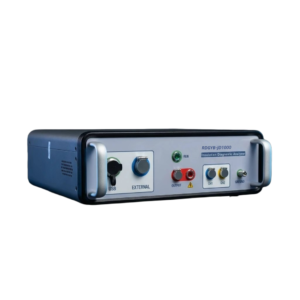
Click the image to know more about Wrindu Frequency Domain Dielectric Response Insulation Diagnostic Analyzer.
What Is Frequency Domain Dielectric Response (FDS) Testing?
Frequency Domain Dielectric Response testing is an advanced insulation diagnostic method that analyzes how insulating materials respond to different frequencies of applied voltage.
Every insulation material has unique dielectric characteristics. When an AC voltage is applied, the insulation produces a current response influenced by:
- Moisture content
- Insulation aging
- Oil conductivity
- Material structure
- Temperature conditions
By measuring capacitance and dielectric loss across a wide frequency range, engineers can evaluate the actual condition of transformer insulation.
Unlike traditional tests that provide only one measurement value, FDS creates a complete dielectric response curve that represents the insulation condition.
Why Is Transformer Insulation Diagnosis Important?
A transformer insulation system usually consists of:
- Cellulose paper insulation
- Transformer oil
- Solid insulating materials
Over time, insulation degradation occurs due to:
Moisture Contamination
Moisture is one of the biggest threats to transformer insulation.
High moisture levels can:
- Reduce insulation strength
- Accelerate cellulose aging
- Increase dielectric loss
- Shorten transformer service life
Oil Aging
Transformer oil provides both insulation and cooling functions.
Aged oil may experience:
- Increased conductivity
- Reduced insulation performance
- Higher dielectric losses
Thermal Aging
Continuous operation at high temperatures accelerates paper insulation degradation and reduces mechanical strength.
Therefore, accurate transformer insulation diagnosis is essential for:
- Preventive maintenance
- Failure prevention
- Asset life extension
- Improved grid reliability
How Does Frequency Domain Dielectric Response Testing Work?
FDS testing measures dielectric properties by applying AC voltage at different frequencies and analyzing the resulting current response.
The basic process includes:
Step 1: Apply Testing Voltage
The analyzer applies an AC voltage signal to the insulation system.
Step 2: Measure Dielectric Response
The instrument records:
- Current response
- Capacitance
- Dielectric loss factor (tanδ)
Step 3: Analyze Frequency Response Curve
The software evaluates insulation characteristics based on the measured data.
Step 4: Calculate Insulation Condition Parameters
Advanced analysis can provide:
- Cellulose moisture content
- Oil conductivity
- Insulation aging condition
- Moisture distribution characteristics
The RDGYB-JD1000 supports frequency range measurement from 0.1mHz to 10kHz and integrates FDS and PDC technologies for comprehensive diagnosis.
What Problems Can FDS Testing Detect?
Transformer Moisture Content
Moisture inside cellulose insulation is difficult to detect using conventional methods.
FDS technology can evaluate:
- Average moisture content
- Uneven moisture distribution
- Moisture migration inside insulation systems
The RDGYB-JD1000 uses advanced analysis models to evaluate cellulose moisture and uneven moisture distribution, providing deeper information for maintenance decisions.
Transformer Oil Aging
Oil condition directly affects transformer insulation performance.
FDS analysis can evaluate:
- Oil conductivity
- Dielectric loss
- Insulation degradation trends
This helps engineers determine whether transformer oil remains in good condition.
Insulation Aging
As insulation ages, dielectric characteristics change.
FDS testing can identify:
- Increased dielectric loss
- Abnormal polarization behavior
- Insulation deterioration trends
This allows utilities to plan maintenance before serious failures occur.
FDS Testing vs Traditional Insulation Tests
FDS vs Insulation Resistance Test
| Item | Insulation Resistance Test | FDS Test |
|---|---|---|
| Measurement | Resistance value | Frequency response |
| Information | Limited | Comprehensive |
| Moisture Diagnosis | Limited | Excellent |
| Aging Evaluation | Limited | Advanced |
Insulation resistance testing provides a basic insulation condition check, while FDS provides deeper information about insulation behavior.
FDS vs Tan Delta Testing
Tan delta testing is widely used for insulation evaluation.
However, traditional tan delta testing normally focuses on power frequency measurement.
FDS provides:
| Tan Delta Test | FDS Test |
|---|---|
| Single frequency | Multiple frequency analysis |
| Basic insulation evaluation | Detailed condition diagnosis |
| Limited moisture information | Moisture evaluation capability |
The combination of FDS and tan delta analysis provides a more complete understanding of transformer insulation.
What Is the Difference Between FDS and PDC Testing?
Both FDS and PDC are dielectric response technologies.
Frequency Domain Dielectric Response (FDS)
FDS measures dielectric characteristics in the frequency domain.
Main outputs:
- Capacitance
- tanδ curve
- Frequency response characteristics
Polarization Depolarization Current (PDC)
PDC measures insulation current response over time.
It provides information about:
- Polarization behavior
- Insulation condition
- Moisture influence
The RDGYB-JD1000 combines both technologies into one diagnostic platform, improving testing efficiency and analysis capability.
Why Choose RDGYB-JD1000 Frequency Domain Dielectric Response Analyzer?
The RDGYB-JD1000 is designed for modern transformer insulation diagnosis.
Integrated FDS and PDC Technology
One device provides multiple diagnostic methods for comprehensive insulation analysis.
Wide Measurement Range
Features:
- Frequency range: 0.1mHz–10kHz
- Output voltage options up to 10kV
- Output current up to ±50mA
Accurate Moisture Evaluation
The analyzer can evaluate:
- Cellulose moisture content
- Oil conductivity
- Uneven moisture distribution
Strong Anti-Interference Performance
High-voltage substations often have strong electromagnetic interference.
RDGYB-JD1000 uses clean AC output and filtering technology to improve measurement stability in challenging environments.
Portable Field Testing Design
The compact design makes it suitable for:
- Substations
- Transformer maintenance sites
- Field diagnostic applications
The device weighs only 6.2kg (excluding test leads), making transportation and field operation convenient.
Case Study: 220kV Transformer Bushing Insulation Diagnosis Using FDS Testing
A field test was conducted on the medium-voltage side bushing of a 220kV transformer at Hongtang Substation.
The test conditions included:
- Equipment: 220kV transformer bushing
- Insulation type: Oil-paper insulation
- Test frequency range: 1mHz–1000Hz
- Test voltage: 200V
The comparison test evaluated:
- Capacitance
- Dielectric loss
- Cellulose moisture content
- Oil condition
The results showed that both tested systems provided similar conclusions regarding insulation condition. The key evaluation parameters were consistent.
The test also showed that stable low-frequency measurement and strong interference resistance are important factors for reliable dielectric response diagnosis.
Applications of Frequency Domain Dielectric Response Testing
FDS technology is widely applied to:
Power Transformers
For:
- Moisture evaluation
- Aging assessment
- Insulation condition diagnosis
Transformer Bushings
For:
- Oil-paper insulation evaluation
- Moisture detection
- Dielectric loss analysis
Current Transformers and Instrument Transformers
For:
- Insulation condition monitoring
Rotating Machines and Cables
With suitable voltage amplifiers, FDS can also support solid insulation diagnosis.
FAQs
What is frequency domain dielectric response testing?
Frequency Domain Dielectric Response testing is an insulation diagnostic method that measures dielectric characteristics over multiple frequencies to evaluate insulation condition.
What can FDS testing detect?
FDS testing can detect:
- Moisture in cellulose insulation
- Oil conductivity changes
- Insulation aging
- Abnormal dielectric behavior
Why is FDS better than traditional insulation tests?
FDS provides a complete frequency response curve instead of a single measurement value, allowing deeper insulation analysis.
Can FDS testing measure transformer moisture?
Yes. FDS technology can estimate cellulose moisture content and analyze uneven moisture distribution.
What equipment is used for FDS testing?
A professional dielectric response analyzer, such as the Wrindu RDGYB-JD1000, is used for FDS and PDC insulation diagnosis.
Conclusion
Transformer failures are often caused by hidden insulation problems that cannot be detected through traditional testing methods alone.
Frequency Domain Dielectric Response testing provides a powerful solution for evaluating transformer insulation condition, moisture content, oil aging, and long-term reliability.
With integrated FDS and PDC technology, advanced analysis software, wide frequency measurement capability, and portable field design, the Wrindu RDGYB-JD1000 Frequency Domain Dielectric Response Insulation Diagnostic Analyzer helps utilities and maintenance teams make better decisions, reduce unexpected failures, and extend transformer service life.
