

How CT Testing Prevents Protection System Failures in Substations
Learn how CT testing helps prevent protection system failures by identifying ratio errors, polarity issues, saturation risks, and burden problems.
Why Do CTs Matter in Protection Systems?
Current transformers (CTs) are important parts of substation protection systems.
They reduce high primary current into a smaller signal that protection relays can process.
Protection systems depend on accurate CT signals to:
- Detect abnormal current conditions
- Identify faults
- Send trip commands to circuit breakers
If a CT provides an incorrect signal, the protection system may not respond correctly.
Therefore, regular CT testing helps engineers improve protection system reliability.
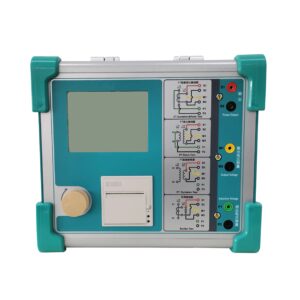
Click the image to know more about Wrindu CT and PT Analyzer.
How Can CT Problems Affect Protection Systems?
A CT problem can influence the entire protection process.
Common effects include:
- Incorrect fault current measurement
- Delayed relay operation
- Unwanted breaker trips
- Failure to disconnect faulty equipment
These problems can increase equipment damage and outage risks.
What CT Problems Can Cause Protection Failures?
CT Ratio Errors
A CT ratio error means the secondary current does not match the expected value.
When the ratio is incorrect:
- Relays receive inaccurate current information
- Protection settings may not match actual conditions
- Fault detection may become unreliable
Ratio testing helps engineers confirm that the CT provides the correct current conversion.
CT Polarity Problems
CT polarity determines the direction of the secondary current signal.
Incorrect polarity can affect:
- Differential protection
- Directional protection
- Power measurement
For example, a reversed polarity connection may make a relay judge current direction incorrectly.
Polarity testing during installation helps prevent this type of problem.
CT Saturation During Fault Conditions
Why Does CT Saturation Affect Protection?
During a power fault, current can increase significantly.
A CT core may enter saturation when it cannot produce enough secondary voltage.
When saturation occurs:
- Secondary current becomes distorted
- Relay input becomes inaccurate
- Protection performance may decrease
This is especially important for protection-class CTs.
How Can Engineers Check CT Saturation Risk?
Engineers can evaluate saturation performance through:
- Excitation testing
- Knee point testing
- Burden testing
These tests show whether the CT can provide reliable current signals during fault conditions.
How Does CT Burden Influence Relay Performance?
What Is CT Burden?
CT burden is the total load connected to the CT secondary circuit.
It includes:
- Protection relays
- Measuring devices
- Terminal blocks
- Secondary cables
Every connected component adds electrical load.
What Happens When Burden Is Too High?
Excessive burden can cause:
- Higher secondary voltage requirements
- Increased measurement errors
- Earlier core saturation
Therefore, engineers should verify that the actual burden stays within the CT rating.
Why Is CT Testing Important for Differential Protection?
Differential protection compares current signals from different sides of equipment.
It depends on accurate CT performance.
CT problems such as:
- Wrong ratio
- Incorrect polarity
- Different saturation characteristics
may create incorrect current differences.
This can cause:
- False trips
- Failure to trip during faults
Therefore, CT testing is a key step when commissioning differential protection systems.
How Does CT Testing Support Relay Coordination?
Protection relays use CT signals to make operating decisions.
Engineers need accurate CT data when setting:
- Pickup current
- Time delay
- Protection zones
CT testing provides reliable information for protection settings.
This helps engineers confirm that relay settings match actual field conditions.
What CT Tests Help Verify Protection Reliability?
Different CT tests check different performance areas.
Ratio Test
Checks whether the CT transformation ratio matches the design value.
Polarity Test
Confirms the correct current direction relationship.
Excitation Test
Evaluates CT core performance.
Knee Point Test
Checks the saturation limit of protection CTs.
Resistance Test
Checks the condition of the secondary winding circuit.
Burden Test
Verifies the connected secondary load.
Together, these tests provide a complete view of CT performance.
How Can Digital CT Analyzers Improve Protection Testing?
Traditional CT testing often requires multiple instruments.
A digital CT analyzer combines several protection-related tests in one system.
It can help engineers:
- Test CT performance faster
- Reduce manual calculations
- Store protection test records
- Generate detailed reports
For protection engineers, digital testing makes it easier to evaluate CT condition before system operation.
How Does Preventive CT Testing Reduce Protection Risks?
Regular CT testing allows engineers to identify problems before failures occur.
Maintenance teams can monitor:
- Ratio changes
- Resistance variation
- Excitation curve changes
- Burden increases
Early detection helps teams plan maintenance before CT problems affect the power system.
CT Protection Testing FAQs
Why do CT failures affect protection systems?
Protection relays depend on CT signals. Incorrect CT output can lead to wrong protection decisions.
Which CT tests are important for protection systems?
Ratio, polarity, excitation, knee point, resistance, and burden tests are commonly used to verify CT performance.
Can CT saturation cause relay failure?
Yes. CT saturation can distort the current signal and reduce relay accuracy.
Why is CT polarity important for differential protection?
Differential protection compares current direction and magnitude. Wrong polarity can create incorrect protection decisions.
How often should protection CTs be tested?
Testing frequency depends on equipment condition, maintenance plans, and utility requirements.
Can a CT analyzer test protection CTs?
Yes. Many multifunction CT analyzers support protection CT testing, including excitation and knee point analysis.
