

How Do Acoustic-Magnetic and Cable Path Detectors Locate Underground Cables?
Learn how the RDCD-C RC11 pinpoints suitable discharge faults and how the R30 traces cable routes, measures depth, and identifies underground cables.
Underground cable fault location requires technicians to identify the correct cable route and find the physical position of a suitable cable fault. An acoustic-magnetic locator and a cable path detector perform these two different tasks. The Wrindu RDCD-C system uses the RC11 for acoustic-magnetic fault pinpointing and the R30 for cable route detection. The RC11 detects signals from a suitable discharge fault. The R30 traces the underground cable route, measures burial depth, and helps identify the target cable.
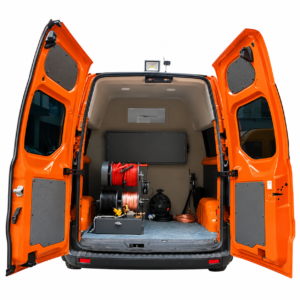
Click the image to know more about Wrindu RDCD-C Vehicle-Mounted Cable Fault Testing System.
What Is an Acoustic-Magnetic Cable Fault Locator?
An acoustic-magnetic cable fault locator detects acoustic and magnetic signals produced by a discharge at a suitable underground cable fault. During high-voltage testing, a discharge may occur at the damaged insulation point. This discharge can produce signals that the locator detects from above ground. Technicians use the detected signals to narrow down the physical fault position. This process is called cable fault pinpointing.
How Does Acoustic-Magnetic Cable Fault Pinpointing Work?
Acoustic-magnetic pinpointing uses two types of signals associated with a discharge.
- Acoustic signal: The sound generated by the discharge.
- Magnetic signal: The electromagnetic response associated with the discharge.
The RC11 detects both signals. Technicians move along the suspected cable route and compare the signal response at different positions. The method helps narrow down the position of a suitable discharge fault. It does not replace fault pre-location, which estimates the distance along the cable.
What Are the RC11 Acoustic-Magnetic Locator Specifications?
The published RC11 specifications include the following signal detection parameters.
| Parameter | Specification |
|---|---|
| Acoustic Signal Frequency Range | 100–1500 Hz |
| Sound Channel Dynamic Range | More than 104 dB |
| Magnetic Channel Dynamic Range | More than 110 dB |
These parameters describe the RC11’s acoustic and magnetic signal detection capabilities. The actual pinpointing result also depends on the discharge signal, cable burial conditions, background noise, and site environment.
Why Does Acoustic-Magnetic Pinpointing Need a Discharge Signal?
The RC11 detects signals associated with a discharge at the cable fault point. If the fault does not produce a suitable discharge, the acoustic signal may not be clear enough for pinpointing. In such cases, technicians may need to use an appropriate high-voltage testing method. The RDCD-C includes a high-voltage unit with a published output voltage of 0–32 kV and maximum impulse energy of 2048 J. The test settings must match the cable and fault requirements. Not every cable fault can be located through acoustic-magnetic detection. The method is intended for suitable discharge faults.
What Is a Cable Path Detector Used For?
A cable path detector identifies and traces underground cable routes. It helps technicians follow the target cable before fault testing and pinpointing. This is important in areas where several cables run through the same trench or cable corridor. The R30 cable path detector supports cable route tracing, burial depth measurement, and energized or de-energized cable identification. It helps technicians identify the correct cable, but it does not independently locate an electrical fault.
What Are the R30 Cable Path Detector Specifications?
The RDCD-III/R30 cable path detector supports the following functions.
| Parameter | Specification |
|---|---|
| Active Frequencies | 10 |
| Passive Frequencies | 2 |
| Signal Connection Methods | Direct connection, clamp coupling, and induction |
| Cable Identification | Energized and de-energized cable identification |
| Cable Pre-Calibration | Up to 10 cables |
| Main Detection Functions | Route tracing and burial depth measurement |
The R30 displays signal strength, direction, depth, and relative position. These readings help technicians follow the target cable during field work. The available connection method depends on cable access and site conditions.
What Are the Differences Between the RC11 and R30?
The RC11 and R30 are both used during underground cable fault location, but they do not perform the same task.
| Comparison | RC11 Acoustic-Magnetic Locator | R30 Cable Path Detector |
|---|---|---|
| Main Function | Fault pinpointing | Cable route detection |
| Detection Target | Acoustic and magnetic discharge signals | Cable tracing signals |
| Main Purpose | Narrow down a suitable fault position | Identify and follow the target cable |
| Key Information | Acoustic and magnetic signal response | Signal strength, direction, depth, and relative position |
| RDCD-C Role | Fault location | Cable identification and route tracing |
The RC11 helps technicians find where a suitable discharge fault occurs. The R30 helps them confirm which cable to follow and where it runs underground.
How Do the RC11 and R30 Work with Other RDCD-C Equipment?
The RDCD-C combines four main components for different stages of cable fault location.
| Testing Stage | Equipment | Main Function |
|---|---|---|
| Cable measurement and fault pre-location | RA40 | Measures cable length, calibrates wave velocity, and analyzes reflected signals |
| High-voltage testing | High-voltage unit | Provides high-voltage testing for suitable faults |
| Fault pinpointing | RC11 | Detects acoustic and magnetic discharge signals |
| Cable route detection | R30 | Traces cable routes, measures depth, and identifies cables |
A typical testing process starts with identifying the target cable and estimating the fault distance. If the fault requires high-voltage testing, technicians can use the high-voltage unit and then use the RC11 to search for the discharge position. And the R30 supports cable route identification throughout the field work. The actual sequence depends on the cable condition and testing requirements.
Why Is Cable Identification Important Before Excavation?
Several underground cables may run close to each other in urban distribution networks, substations, and industrial facilities. Technicians need to confirm the target cable before testing or excavation. The R30 supports energized and de-energized cable identification and can pre-calibrate up to 10 cables. Route tracing and depth measurement also provide useful information when planning excavation work. These functions help reduce the risk of following or working on the wrong cable.
Frequently Asked Questions About Acoustic-Magnetic Locators and Cable Path Detectors
Does an acoustic-magnetic locator trace the underground cable route?
No. The RC11 detects acoustic and magnetic signals to help pinpoint suitable discharge faults. The R30 performs cable route tracing.
Can the RC11 locate every type of cable fault?
No. It is used for faults that produce detectable discharge signals. Faults without a suitable discharge may require another testing method.
What is the acoustic frequency range of the RC11?
The published acoustic signal frequency range is 100–1500 Hz.
How many frequencies does the R30 support?
The R30 supports 10 active frequencies and 2 passive frequencies.
Can the R30 identify energized and de-energized cables?
Yes. The R30 supports both energized and de-energized cable identification.
Can the R30 measure underground cable depth?
Yes. Burial depth measurement is one of its supported functions.
About Wrindu RDCD-C Cable Fault Testing System
Wrindu is a Chinese OEM manufacturer of electrical testing equipment and power testing solutions. The company provides cable testing instruments and integrated systems for field applications. The RDCD-C Vehicle-Mounted Cable Fault Testing System combines the RA40 operation console, high-voltage unit, RC11 acoustic-magnetic locator, and R30 cable path detector. The testing equipment is installed inside a vehicle supplied by the customer. Contact Wrindu for technical specifications, system configuration, and vehicle installation guidance.
