

Is Surge Testing Safe for Electric Motors
Learn how surge testing detects early turn-to-turn insulation faults in electric motors. Discover Line-Line & Pulse-Pulse EAR methods, motor failure causes, and why surge testing is safe, non-destructive, and essential for predictive maintenance.
Electric motors are the unsung heroes of modern industry, driving everything from conveyor belts to massive water pumps. But when a motor fails unexpectedly, production grinds to a halt, costing companies thousands of dollars per hour. To prevent this, engineers use a diagnostic method called surge testing.
For years, a heated debate has circulated among maintenance professionals: Does surge testing actually protect motors, or does the high voltage cause irreversible damage? Let’s break down how surge testing works, why motors fail, and why modern testing is safer than you might think.
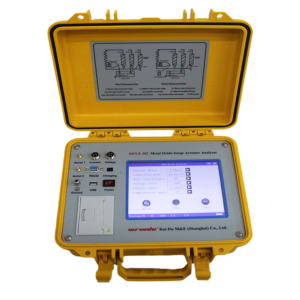
Click the image to know more about Metal Zinc Oxide Lightening Arrester.
How Does a Modern Surge Test Work?
To get accurate results from a surge test, a technician must first know the specific operating voltage of the motor. Different types of motors—whether they are brand new or have been in service for years—require different testing voltages based on industry standards.
An essential rule of physics in this process is Paschen’s Law. This principle states that a minimum voltage of approximately 350 volts is required to create an electrical arc across a gap in normal air conditions. If a test uses less than 350V, it cannot reliably detect insulation faults because electricity won’t jump across the weak spot.
Modern testing devices, such as those developed by Baker Instrument Company, use advanced wave analysis to find faults automatically:
-
Line-Line Error Area Ratio (L-L EAR): This method compares the voltage waveforms between different phases of the motor (Phases 1-2, 2-3, and 3-1). If the mathematical difference between the phases is out of tolerance, the machine stops the test and flags an error.
-
Pulse-Pulse Error Area Ratio (P-P EAR): An even more advanced technique that compares waveforms from one voltage pulse to the next as the power increases. If it detects a sudden shift in frequency—indicating a microscopic arc—it immediately cuts the power to protect the motor.
Why and How Do Electric Motors Fail?
A motor’s stator relies on two primary insulation systems: groundwall insulation (protecting the frame) and turn-to-turn insulation (protecting the individual wire coils).
When a motor starts up, it experiences intense electrical strain. Studies show that normal startups subject a motor to voltage surges that are 3 to 4.6 times its standard operating unit. While new insulation handles these spikes easily, time and environmental stress change things:
-
Gradual Wear: Over time, heat, moisture, chemicals, and mechanical vibrations weaken the insulation.
-
The Tipping Point: Once the insulation’s dielectric strength drops down to the level of normal operating voltage spikes, the deterioration accelerates exponentially.
-
The Short Circuit: Weak turn-to-turn insulation leads to a circulating current that can be twice as large as a blocked rotor current. If left undetected, this turn fault quickly spreads, causing a catastrophic short to the ground, melting the motor core, and forcing an expensive, unplanned shutdown.
In fact, research indicates that up to 80% of all electric motor failures start as weak turn-to-turn insulation. Standard diagnostic tools (like megohmmeter or HiPot tests) only check the groundwall insulation, completely missing these early-stage turn-to-turn faults. Only a surge test can catch them.
Is Surge Testing Destructive to Winding Insulation?
The short answer is no. A proper surge test is entirely non-destructive.
The secret lies in the physics of the test: it uses high voltage but extremely low current. Because the electrical pulse lasts for only 1 to 2 microseconds and repeats just a few times a second, the overall energy is incredibly tiny. The tool’s duty cycle is roughly 0.001%. To put it simply, it is like throwing a tennis ball against a brick wall—there isn’t enough thermal energy to burn or damage the insulation.
A Real-World Proven Case
In a 90-day stress study, an inexpensive motor was subjected to 40 million surge pulses. Even when testers intentionally blasted the motor with voltages up to 350% higher than recommended until a weak spot developed at 7,000V, the surge pulses did not worsen the damage. The motor continued to run normally.
It actually took a highly abusive, unrealistic test—rapidly starting and stopping the weakened motor 42 consecutive times—to finally force it into a smoking, catastrophic failure.
FAQs
Q1: Why should I choose surge testing over standard DC insulation tests?
Standard DC tests (like Insulation Resistance, Polarization Index, or HiPot) are excellent for checking if electricity is leaking to the ground frame. However, they cannot see inside the coils. Since roughly 80% of motor failures begin as shorts between individual wire turns, surge testing is the only reliable way to catch these flaws before they cause total motor failure.
Q2: Can a surge test accidentally destroy a motor that is currently running fine?
No. If a motor fails during a surge test, the test did not cause the damage; it merely revealed a critical fault that was already there. Because the energy of a surge test pulse is so low, it does not burn the copper or ruin the core, allowing maintenance teams to safely schedule a replacement during a planned outage rather than suffering a sudden, expensive breakdown.
Q3: Why is surge testing important for detecting hidden faults in electric motors?
Surge testing is important because it can detect early turn-to-turn insulation faults that standard tests like HiPot or megohmmeter cannot identify. Since around 80% of motor failures start from inter-turn insulation weakness, surge testing provides early warning before a catastrophic breakdown occurs.
Q4: How does Pulse-Pulse EAR improve motor surge testing accuracy?
Pulse-Pulse Error Area Ratio (P-P EAR) improves accuracy by comparing waveform responses between consecutive voltage pulses. If the waveform changes abnormally, it indicates microscopic arcing or insulation weakness, allowing the tester to stop the test immediately and prevent further damage.
Q5: Is surge testing safe for electric motor insulation systems?
Yes, surge testing is safe because it uses high voltage but extremely low current with microsecond-level pulses. The energy applied is very small, meaning it cannot generate enough heat to damage the insulation system under normal testing conditions.
Q6: Why do most electric motor failures start with turn-to-turn insulation damage?
Turn-to-turn insulation is the weakest part of a motor’s winding system. Over time, heat, vibration, moisture, and electrical stress degrade this insulation, leading to short circuits between coil turns, which can rapidly escalate into full motor failure.
Q7: How does surge testing compare with traditional DC insulation tests?
Traditional DC tests mainly evaluate groundwall insulation and detect leakage to the motor frame, while surge testing focuses on detecting internal winding faults between turns. Therefore, surge testing is more effective for identifying early-stage failures that DC tests often miss.
