

TDR Cable Fault Locator vs Cable Fault Testing System: What Is the Difference?
Learn the differences between TDR cable fault locators and cable fault testing systems. Understand their functions, applications, and how to choose the right cable fault location equipment.
Underground cable faults can cause unexpected power interruptions and expensive maintenance work. To restore power quickly, engineers need reliable equipment to identify fault locations accurately.
Among available solutions, TDR cable fault locators and cable fault testing systems are two commonly used technologies. Although both can measure cable faults, they are designed for different testing requirements.
A TDR cable fault locator is mainly used for distance measurement based on signal reflection, while a complete cable fault testing system combines multiple technologies to handle more complex cable failures.
Understanding the differences between these solutions helps engineers select the right equipment for underground cable maintenance.
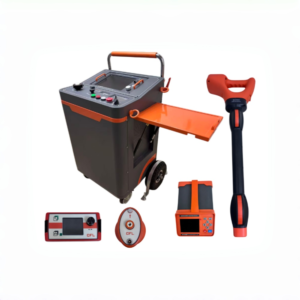
Click the image to know more about Wrindu Cable Fault Testing Systems.
What Is a TDR Cable Fault Locator?
A TDR (Time Domain Reflectometry) cable fault locator is a testing instrument that identifies cable faults by sending a low-voltage pulse into the cable and analyzing the reflected signal.
When the pulse reaches a point where cable impedance changes, part of the signal is reflected back to the tester. By measuring the signal travel time, the instrument calculates the distance to the fault.
TDR cable fault locators are commonly used for:
- Cable length measurement
- Open circuit fault detection
- Short circuit fault detection
- Low resistance fault location
- Cable condition checking
They are widely applied in:
- Power distribution systems
- Communication cables
- Control cables
- Industrial cable networks
How Does a TDR Cable Fault Locator Work?
The basic working process of TDR includes several steps:
Step 1: Send a Test Pulse
The instrument sends an electrical pulse through the cable conductor.
Step 2: Detect Signal Reflection
When the pulse encounters an abnormal point, such as a break or impedance change, a reflected waveform is generated.
Step 3: Calculate Fault Distance
The tester calculates the distance based on:
- Signal travel time
- Cable propagation speed
- Reflection characteristics
The result shows the approximate location of the cable problem.
What Are the Advantages of TDR Cable Fault Locators?
TDR technology provides several benefits:
Simple Operation
TDR testing usually requires simple connection and waveform analysis, making it suitable for routine cable checks.
Fast Distance Measurement
Engineers can quickly obtain the approximate fault distance without complicated testing procedures.
Suitable for Basic Cable Faults
TDR works effectively for:
- Open circuit faults
- Cable breaks
- Low resistance faults
Portable Design
Many TDR instruments are lightweight and suitable for field maintenance.
What Are the Limitations of TDR Cable Fault Locators?
Although TDR is useful for many applications, it has some limitations.
Difficulty Detecting High Resistance Faults
High resistance faults may not create strong reflection signals, making them difficult to identify with standard TDR methods.
Limited Fault Positioning Capability
TDR mainly provides distance information. Engineers may still need additional methods to locate the exact physical fault point.
Not Suitable for All Complex Cable Failures
For aged underground cables or high-voltage cable systems, additional high-voltage testing methods may be required.
What Is a Complete Cable Fault Testing System?
A cable fault testing system is a comprehensive solution that combines multiple testing technologies to diagnose different types of cable faults.
Unlike a basic TDR locator, a complete system usually includes:
- Fault distance measurement
- High-voltage impulse testing
- Cable path detection
- Cable identification
- Precise fault point locating
It is designed for more complex underground cable maintenance tasks.
How Does a Cable Fault Testing System Work?
A complete cable fault testing process usually includes three stages.
Stage 1: Fault Distance Pre-Location
The system uses methods such as:
- TDR
- Impulse current
- Multiple pulse testing
to determine the approximate distance to the fault.
Stage 2: Cable Path Identification
Before excavation, engineers need to confirm the actual cable route.
Cable path detection helps identify:
- Cable direction
- Cable depth
- Target cable among multiple underground cables
This improves safety and reduces incorrect excavation.
Stage 3: Precise Fault Location
After obtaining the fault distance, engineers use acoustic and electromagnetic methods to find the exact fault point.
This final step allows maintenance teams to repair the damaged section accurately.
What Are the Differences Between a TDR Locator and a Cable Fault Testing System?
The main differences are shown below:
| Feature | TDR Cable Fault Locator | Cable Fault Testing System |
|---|---|---|
| Main function | Distance measurement | Complete fault diagnosis |
| Testing technology | Reflection waveform analysis | Multiple testing methods |
| Open circuit faults | Yes | Yes |
| Low resistance faults | Yes | Yes |
| High resistance faults | Limited | Better capability |
| Cable path detection | Usually unavailable | Available |
| Precise fault locating | Requires additional tools | Integrated function |
| Complex cable faults | Limited | Suitable |
| Field application | Basic testing | Professional maintenance |
When Should Engineers Choose a TDR Cable Fault Locator?
A TDR cable fault locator is suitable when:
- The cable system is relatively simple
- The fault type is easy to identify
- Engineers mainly need distance information
- Budget and portability are important considerations
Typical applications include:
- Short cable networks
- Communication cables
- Low-voltage systems
- Basic troubleshooting tasks
When Is a Complete Cable Fault Testing System Needed?
A complete cable fault testing system is recommended for:
- Underground power cable networks
- Medium and high-voltage cable maintenance
- Utility distribution systems
- Industrial power facilities
- Complex cable fault diagnosis
It is especially useful when engineers need to handle:
- Unknown fault types
- High resistance faults
- Long-distance underground cables
- Difficult field environments
For example, Wrindu RDCD-III Cable Fault Testing System combines cable distance measurement, path detection, and precise fault location functions. It supports low-voltage pulse, high-voltage impulse, and multiple pulse testing methods, providing a complete workflow from fault detection to final positioning.
What Should Engineers Consider Before Buying Cable Fault Location Equipment?
Before selecting equipment, engineers should evaluate several factors.
Cable Voltage Level
Different cable systems require different testing capabilities.
Consider:
- Low-voltage cables
- Medium-voltage cables
- Industrial power cables
Fault Types
The equipment should match the expected fault conditions.
Important fault types include:
- Open circuit
- Short circuit
- Low resistance
- High resistance
- Insulation breakdown
Testing Distance
Long underground cable networks require equipment with sufficient measurement range.
The selected system should support the actual cable length in the application environment.
Accuracy Requirements
Higher accuracy reduces excavation work and improves repair efficiency.
Important parameters include:
- Distance measurement accuracy
- Fault locating accuracy
- Signal resolution
Field Operation Requirements
For outdoor maintenance, engineers should consider:
- Equipment portability
- Battery operation
- Display visibility
- Data storage
- Safety protection functions
How Can Integrated Cable Fault Testing Improve Maintenance Efficiency?
Integrated cable fault testing systems reduce the need to use multiple independent instruments.
A complete solution allows engineers to:
- Identify cable routes
- Measure fault distances
- Locate damaged points
- Reduce troubleshooting time
This approach is especially valuable for utility companies and organizations managing large underground cable networks.
FAQs About TDR Cable Fault Locators and Cable Fault Testing Systems
Q1: What is the difference between TDR and a cable fault testing system?
A: TDR mainly measures fault distance by analyzing signal reflections, while a cable fault testing system combines multiple technologies for distance measurement, cable identification, and precise fault location.
Q2: Can TDR detect high resistance cable faults?
A: Standard TDR has limitations when detecting high resistance faults. Additional high-voltage impulse testing methods may be required.
Q3: Is a cable fault testing system better than a TDR locator?
A: A cable fault testing system provides more functions and is suitable for complex cable maintenance, while TDR is suitable for simpler distance measurement tasks.
Q4: Which method is best for underground cable fault location?
A: The best method depends on cable conditions and fault types. Complex underground cable networks usually require a combination of distance measurement, path detection, and precise locating technologies.
Q5: Why is cable path detection important?
A: Cable path detection confirms the underground cable route and helps prevent incorrect excavation or testing of the wrong cable.
Q6: What equipment do utilities use for cable fault location?
A: Utilities commonly use TDR testers, impulse generators, cable path detectors, and integrated cable fault testing systems for underground cable maintenance.
